E-Paper



In address to Ethiopia’s Parliament, PM Modi emphasises role of Global South
Modi also emphasised the scope for India and Ethiopia to play a larger role in securing regional peace and connectivity

 Prefer HTon Google


NEW DELHI: The Global South’s rise is not aimed against anyone and envisions a world with access to technology, respect for sovereignty, shared prosperity and a global governance structure that reflects contemporary reality, Prime Minister Narendra Modi said on Wednesday while addressing a joint session of Ethiopia’s Parliament.
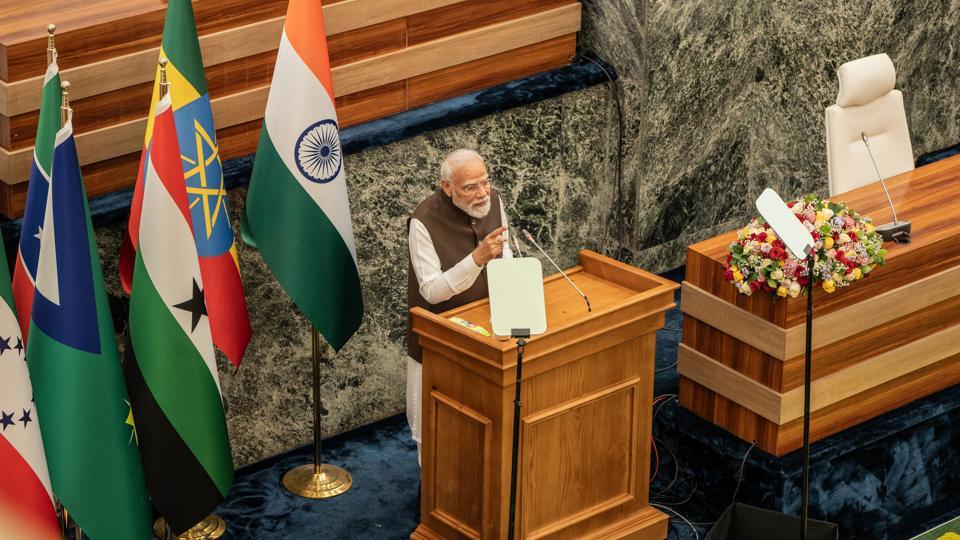
The speech was the final engagement in Modi’s two-day visit to the African country, the second leg of a three-nation tour, and came against the backdrop of India’s efforts to position itself as the voice of the Global South amid intense geopolitical churn on the international stage.
Modi also emphasised the scope for India and Ethiopia to play a larger role in securing regional peace and connectivity, and to cooperate more closely in areas ranging from trade and investment to mining and food security.
Modi noted that India and Ethiopia have a shared vision for the Global South as it writes its own destiny, and are working together for a world that is more just, more equal and more peaceful. “Our vision is of a world where the Global South rises not against anyone, but for everyone,” he said.
Both sides want a world with fair development, access to technology, respect for sovereignty, shared prosperity and defence of peace. “A world where decision-making reflects today’s reality, not the world of 1945, because the world cannot move forward if its systems remain locked in the past,” he said.
India has emphasised a “Global Development Compact” to prioritise technology sharing, affordable finance, capacity building and trade for sustainable growth, and backed an “Africa Skills Multiplier Initiative” at the G20 Summit in November to build local capacities aimed at inclusive development.
While Ethiopia sits at a crossroads in Africa, India is at the heart of the Indian Ocean, and this makes the two countries “natural partners in regional peace, security and connectivity”, Modi said. Cooperation in this sphere has been strengthened with the signing this year of a Defence Cooperation Agreement for collaboration in cybersecurity, defence industries and joint research.
Indian companies are among the largest investors in Ethiopia, with inflows of more than $5 billion in sectors such as textiles, manufacturing, agriculture and health creating more than 75,000 local jobs, Modi said, adding that the elevation of ties to a strategic partnership will unleash the potential of the two economies through cooperation in technology, innovation, mining and clean energy.
Both sides will also cooperate in food security, health security, and enhance cooperation in defence and security matters, he said, while reiterating the historic links between India and Ethiopia. “Indian soldiers fought alongside Ethiopians for the liberation of Ethiopia in 1941,” he said. “Thousands of Indian teachers came to Ethiopia. They taught children in Addis Ababa, Dire Dawa, Bahir Dar and Mekele. They reached Ethiopian schools and entered Ethiopian hearts.”
A growing number of Ethiopian students have studied in India, before returning home to build a modern country, such as the Parliament Speaker Tagesse Chafo, Modi noted. “The future is calling and India and Ethiopia are ready to answer,” he said. “We will walk together as equals. We will build together as partners.”
Before addressing the Parliament, Modi laid a wreath at the Adwa Victory Monument in Addis Ababa, which is dedicated to Ethiopian soldiers killed in the Battle of Adwa in 1896. Ethiopia’s Prime Minister Abiy Ahmed Ali accompanied Modi to the airport and saw him off as he travelled to Oman for the final leg of his tour.