E-Paper



In Droupadi Murmu’s primary school, 300 saplings planted to celebrate her oath-taking
In her in-law’s village of Pahadpur where Murmu runs the SLS tribal residential school in the memory of her deceased husband and two sons, three LCD screens were put up for the students to watch the oath-taking live


As Droupadi Murmu took oath as the 15th President of India on Monday morning with the word ‘Johar’ (Santhali for welcome) and spoke on environmental protection, students and teachers of the school where she studied for 7 years planted 300 saplings to mark the historic day.
Wearing a Jhal saree, a traditional Santhali saree won by women during special occasions, Murmu said she realised the importance of forests and water bodies in her life. “I was born in that tribal tradition which has lived in harmony with nature for thousands of years. I have realised the importance of forests and water bodies in my life. We take necessary resources from nature and serve nature with equal reverence,” she said while talking about her journey from a ward councillor to the office of President of India.
In Uparbeda upper primary school, where she studied from Class 1 till Class 7, the students and teachers planted 300 trees including Ashoka, Deodar and Aamla with each student assigned to look after at least one tree.
“We thought there could be no better way to mark Droupadi Murmu’s oath-taking than plant trees which will serve as a reminder of the historic day. The students took oath to look after the trees,” said headmaster Manoranjan Murmu. The first tree was planted by Bisweswar Mahanta, who was headmaster during Murmu’s student days.
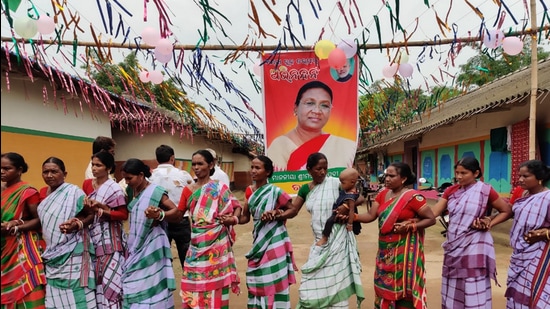
The school, however, resumed classes after distribution of sweets among the students. Elsewhere in the village, local villagers watched her oath-taking on television screens in their homes after celebrating the day with Santhali dances and music.
In her in-law’s village of Pahadpur where Murmu runs the SLS tribal residential school in the memory of her deceased husband and two sons, three LCD screens were put up for the students to watch the oath-taking live. There too, students were given sweets while villagers celebrated the occasion with music.
In her home town of Rairangpur, the town was awash with her posters as people broke into impromptu song and dance to celebrate the oath-taking of the most famous woman of the region. Laddoos were distributed among people. In her maternal uncle’s village of Dumuria, tribals sipped Handia, a local brew to celebrate the day.