
In Eid outreach, Amit Shah lets 120 Kashmiri prisoners in 3 states make a phone call home
Home Minister Amit Shah’s concession did not cover Kashmiris who were accused or convicted on terror charges
Over 120 prisoners from Jammu and Kashmir lodged in nine north Indian jails were permitted to call up home on Eid at the instance of Union Home Minister Amit Shah, people familiar with the development told Hindustan Times.
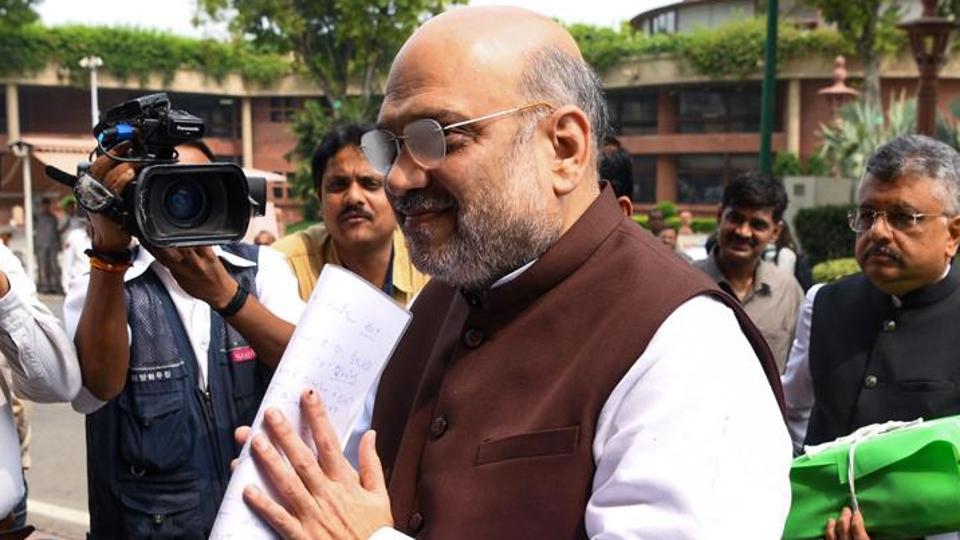
The home minister had recently issued instructions to compile a list of Kashmiris who are behind bars in various prisons so that they could be extended this concession, a government official said.
In all, 122 prisoners in three states, Uttar Pradesh, Haryana and Delhi were allowed to speak to their family members. Officials said 106 of the prisoners were in six UP jails while another 15 were lodged in Haryana jails.
This concession was not extended to people being tried in terror cases.
The gesture, the official said, was an attempt to bring some happiness in the lives of the prisoners and their families back home in Kashmir. Unlike other prisoners, prisoners from Kashmir do not have many visitors due to logistical reasons.
It also means that for people who are not accused in terror-related cases, the government is willing to take a sympathetic view and go an extra mile.
“But for those involved in terror, you saw what happened in the morning,” the official said, a reference to the encounter in south Kashmir’s Kulgam earlier in the day.
Two men, accused of being operatives of the ISJK (The Islamic State in Jammu and Kashmir, were shot dead in an encounter. One of them was identified by security forces as Adil Ahmad Wani alias Abu Ibrahim and the second, Shaheen Bashir Thoker.
ABOUT THE AUTHORShishir GuptaShishir Gupta is Executive Editor at Hindustan Times and one of India's top journalists covering national security, strategic affairs, foreign policy and geopolitics. Over the past three decades, he has extensively reported on India's military, diplomatic and security landscape, covering every major conflict and national security challenge, from the 1999 Kargil War and the 2020 East Ladakh standoff to Operation Sindoor in 2025. He has also covered major terror attacks, including the IC-814 hijacking, the 26/11 Mumbai attacks and the 2025 Pahalgam terror strike, along with numerous Pakistan-backed terrorist incidents in the Kashmir Valley and across India. He has reported on national and state elections for more than three decades. A recognised authority on strategic affairs, Gupta has covered India's nuclear programme since the Pokhran-II (Shakti series) tests in May 1998 and has written extensively on global nuclear issues, Indian diplomacy and the country's expanding global outreach. He has also reported widely on international conflicts and terrorism, with a special focus on the Indian subcontinent. Gupta has interviewed Prime Minister Narendra Modi more than four times, including Modi's first interview with the print media after becoming Prime Minister in May 2014. His other interviews include three with the Dalai Lama, as well as conversations with Benjamin Netanyahu, Amit Shah, Yogi Adityanath, S. Jaishankar, Nirmala Sitharaman and Piyush Goyal. He is the author of Indian Mujahideen: The Enemy Within (Hachette, 2011) and Himalayan Face-off: Chinese Assertion and Indian Riposte (Hachette, 2014). He was awarded the Chevening-Wolfson Joint Scholarship at Wolfson College, University of Cambridge, UK, in 1998 and participated in the International Visitor Leadership Program (IVLP) of the US State Department in 2006. He received the Ben Gurion Prize from Israel in 2011 and the K. Subrahmanyam Prize for Strategic Studies in 2015 from the Manohar Parrikar Institute for Defence Studies and Analyses (MP-IDSA). Since 2024, he has hosted Point Blank, Hindustan Times' weekly YouTube show on global geopolitics.Read More

E-Paper


