
 E-Paper



In villages abutting B’desh, upheaval across the border sparks uncertainty
Student protests in Bangladesh disrupt peaceful life of Purbandar Jodi village


Perched on the banks of the Mahananda river is Purbandar Jodi, a village of nearly 1,200 people in West Bengal. Across the rippling waters is Tetulia town in Bangladesh. For decades, the river has acted as a natural border, demarcating the two nations but also facilitating the movement of people across the two villages, helping families maintain ties of kinship and commerce.
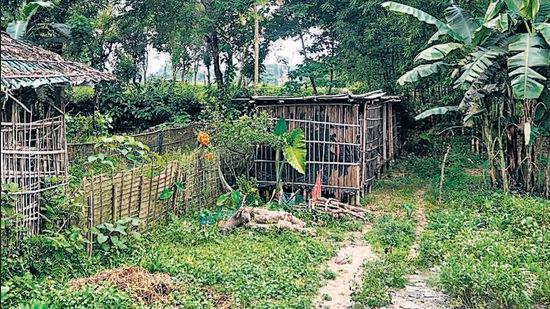
But the tranquil relationship was violently disrupted two weeks ago as Bangladesh was convulsed with student protests calling for the ouster of former premier Sheikh Hasina. From his house on the edge of the water, Mohammad Akhtar watched with fear as mobs gathered on the other side of the river. The village reverberated with the echoes of a loudspeaker installed on top of Tetulia police station.
“People were told to stay in their homes and not to participate in protests or indulge in violence. The messages were played once or twice a day in the early days and then its frequency increased. It was the time when we were hearing about hundreds of people dying in police shootings,” Akhtar said.
For two weeks, the loud warnings became a part of the life of Purbandar Jodi, whose residents became unwitting witnesses to the student revolution.
Then, it suddenly fell silent.
On August 5, Hasina fled the country as protesters stormed her residence amid widespread violence. “We heard that police officers also fled the station. Before all this, we would see many government vehicles coming to the police station at odd hours. All that stopped after August 5,” Akhtar said.
Now, the villagers have a new worry – a proposed fence that is supposed to cut through the village as part of the central government’s plans to bolster security along the 4,097km long border, 900km of which is still unfenced, mostly in West Bengal.
Officials say a border fence will curb smuggling, increase monitoring in the sensitive region, and boost security of local people.
On paper, this is a sound plan. But in villages such as Purbandar Jodi, a fence can disrupt their only way of life and cut them off from friends and kin.
Another resident, Mohammed Sukka, who works as a driver in Siliguri, said, “In places where there is no fenced border, villagers from both Bangladesh and India meet in the fields through which the international border passes. At these places, we fight over ownership of our cattle because their cattle come to our side. It is a type of meeting place for us. My father’s younger sister had met her husband at the border more than a decade ago. People may not admit it but there are relatives across both sides of the border. But now, because of the tight security or the situation there, Bangladesh people are hardly coming to the fields.”
It’s not just Purbandar Jodi. The length of the frontier in Bengal is dotted with small villages straddling the international border where the upheaval in Bangladesh has birthed myriad concerns. In some villages, people are worried about the fence; in some, the concern is about attacks on minorities; and in still others, people are preparing for an increase in militant attacks. HT visited some of these villages to take stock.
FEAR IN THE AIRAbout 20km from Purbandar Jodi is Phansidewa Bandar Gachh Hatkhola. Here, the house of Uttam Jha, a local priest, is barely four feet away from the spot where the proposed border fence is to be erected. It is also the first house near the Zero Line, which demarcates the international border. Next to Jha’s house is a Shiva temple, where his family has worshipped the local deity for 60 years.
Life here has always been peaceful. But over the last two weeks, almost every villager has asked Jha to approach the police for security. Against the backdrop of attacks in Bangladesh, locals fear Jha’s house and the temple could be targeted by militant groups.
“We keep hearing of how active militants have become in Bangladesh…our temple might be the first to be attacked and needs to be secured,” said Pannu Devnath, a former zilla parishad member of Phansidewa.
On August 9, around 1,000 Bangladeshi nationals attempted to cross into India illegally at the border but were stopped by the Border Security Force. Undeterred, they shouted slogans of Jai Shri Ram, claimed they were Hindus, and said they feared persecution in Bangladesh. BSF officers said they have flagged the importance of ensuring that temples are protected in their meetings – 83 till now – with the Border Guards Bangladesh.
Fearing attacks, the BSF has increased surveillance here.
Jha agreed that Bangladesh politics dominates everyday life in Phansidewa now.
“People from Phansidewa are very curious about what is happening in Bangladesh. If you go to the local market, you will find most people discussing Bangladesh politics. Whenever they see me, they tell me – ‘Panditji, your house is on the zero line. You should be careful’,” he said.
But was not worried about being targeted, citing the syncretic culture of the region. “I tell everyone that I have nothing to worry about. My aunt told me that some militants had attacked our house 50 years ago, but they were chased back by locals. I trust our government, my people, and my faith,” Jha said.
THUD OF JACKBOOTSLess than 3km from the priest’s house is Baneshwar Joth village, another unfenced village near the border. But Kharban Burman is not as optimistic as Jha. His worries, though, centre on political instability across the border and not about attacks on minorities.
On August 10, he was in the fields near the proposed border fence as a construction worker when he heard a loud whistle from the Bangladesh side and the thud of jackboots. Five BGB personnel walked over to the workers and asked them to stop, saying the area was disputed. “They said that the regime had changed in Bangladesh and that all such works at the border would resume only after the new government approved of such changes. We immediately alerted the BSF personnel after which a flag meeting was held,” Burman said.
At the flag meeting, BSF company commanders said that the construction was in India and that they would not stop. But ordinary people like Burman say that in a region where crossing the border is sometimes an everyday necessity, BGB personnel have started harassing them. “BGB people are usually polite to us but there was a sudden change in their behaviour…seeing their behaviour worries border residents like us,” he said.
In a statement, BSF said that BGB was not only cooperating with BSF on operational matters, and issues of mutual interest, but also taking steps for the safety of Indian nationals there.
A BSF spokesperson said that between August 10 and 13, the Indian force and BGB held at least 83 flag meetings at the border.
“While appreciating BGB’s role in preventing the Bangladeshi nationals coming to border, BSF authorities impressed upon to protect safety of Indian citizens and people belonging to minority communities in Bangladesh. BGB has not only been cooperating with BSF on International border on operational matters but also taking all steps for safety of Indian citizens and people belonging to minority communities,” said the spokesperson.
But many officials in the force believe it is too early to predict anything, pointing to the turbulence between India and Bangladesh when the Bangladesh Nationalist Party was in power. “Between 2001 and 2006, when the BNP was in power, the relationship between BSF and BGB had hit rock bottom. At one time in 2001, 19 border guards from both sides were killed in skirmishes at a disputed site in one single incident,” said a senior officer who has been in BSF for 30 years.
“Their intelligence chief was sacked. Their chief justice was also removed. Maybe the new government will make changes in the army and BGB too…many of us in this force for over 25-30 years will wish that such a situation never arises along the India-Bangladesh border.”
At Purbandar Jodi, Bangladesh villagers have stopped coming to the river to collect stones or visit a park on their side of the riverbank. Most residents believe the sight of more BSF personnel, who have now set up observation posts in the bushes on the sites of the proposed fence have stopped Bangladesh residents from entering the water.
“BSF teams bring vehicles equipped with CCTV cameras at night. The tight security because of the turmoil in Bangladesh has changed everything. We finally feel that the village across the river is a foreign country,” said Mohammed Azad, a resident.
 ABOUT THE AUTHORPrawesh Lama
Prawesh Lama, an Associate Editor at Hindustan Times with nearly two decades of frontline reporting experience across India’s conflict zones, border regions, and disaster-hit areas. He writes on internal security, insurgency, the Northeast, and Left-wing extremism and has reported from India’s hinterland and some of the most sensitive and strategically critical regions.Read More


