E-Paper



India, US can build bulwark against ‘might makes right’ mentality: Garcetti
Ambassador Eric Garcetti said wait times for first-time tourist visa interviews have dropped by 50% and US will find innovative solutions to reduce visa delays

 Prefer HTon Google


NEW DELHI: India and the US can stand together against coercion and use their military assets to ensure freedom in the Indo-Pacific, US ambassador Eric Garcetti said on Wednesday against the backdrop of concerns over China’s actions across the region.
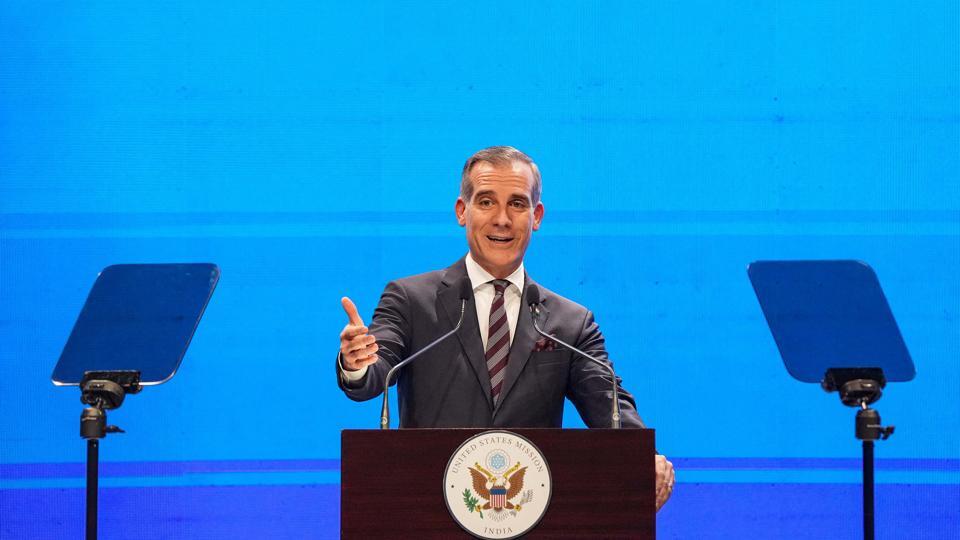
The defence industries of the two countries are increasingly connected and planned collaboration in future will deepen co-production and create resilient supply chains for India, the US and other partners, he said while speaking on the theme “A new chapter in US-India relations” at the Indian Institute of Technology (IIT)-Delhi.
Garcetti’s remarks also came against the backdrop of Prime Minister Narendra Modi’s visit to the US, which he described as an “incredible celebration of the bond between the world’s two great democracies”. During the visit, the two sides inked agreements to facilitate the manufacturing of GE F414 jet engines in India and the supply of 31 weaponised MQ-9 drones to the Indian military. Other initiatives for cooperation in areas ranging from semiconductors to telecommunications were also unveiled during the visit.
Garcetti made no reference to China in his speech, though there was no doubt who he was referring to when he spoke about India and the US opposing coercion. The US has increasingly pivoted towards India, ramping up defence and technology cooperation, as it perceives the country as a counterweight to China.
“We can stand together against those who would upend the common good for their own benefit. We can stand together for choice, resisting coercion. We can stand together as a force for stability to avert regional and global crises,” Garcetti said.
“We can deploy our ships together in the Pacific and Indian Oceans, and even beyond, to ensure maritime security. We can employ our air forces across the Indo-Pacific region to ensure freedom of the skies and the seas, and to jointly respond to humanitarian crises from the Sahara to the Pacific Islands.”
India and the US can “build a bulwark against this ‘might makes right’ mentality” and bolster the security, stability and prosperity of the world, he added.
Noting that he had seen the “power of transformative friendship” during PM Modi’s visit to the US last week, Garcetti used a Hindi phrase – “Sapne sakar karna” (making dreams a reality) – to set the tone for the next phase of bilateral ties. The Indian dream and the American dream are two sides of the same coin and the two countries should now focus on peace, prosperity, planet and people, he said.
In the context of burgeoning defence and security ties, Garcetti said the defence industries on both sides are increasingly connected, with components being made in India for US Apache attack helicopters and C-130 transport aircraft.
Indian and US leaders pledged at discussions last week to accelerate momentum through building and working together. “When the US and India work together to co-produce military equipment, we create a state-of-the-art system at a sustainable cost and with resilient supply chains for India, the US, and our partners,” he said.
“Through the co-production work that is already happening in airframes and engineering, and the planned work in aeroengines, artillery, and ground vehicles… we are poised to further deepen co-production and tackle new opportunities – some that we can’t even imagine today.”
Garcetti also referred to the issue of the two countries accommodating differences as their friendship becomes closer, and without directly referring to the Ukraine crisis, said protection is a key component of peace.
“As we’ve unfortunately seen over the past three years, we live in a world in which countries ignore sovereign borders, advancing their claims through violence and destruction,” he said.
The envoy highlighted the work being done by India and the US under frameworks such as the initiative for Critical and Emerging Technologies (iCET), the Strategic Trade Dialogue, the Indo-Pacific Economic Framework for Prosperity (IPEF), the Artemis Accords and Quad. The iCET has been turbo-charged to encompass space, artificial intelligence, health and semiconductors.
On delays in US visas, Garcetti said his country wants to eliminate barriers and expand visa operations. “We’re currently processing more visas, faster, than the US mission in India ever has before. We set a goal for ourselves to process at least a million visas in 2023, and we’re already more than halfway towards reaching that goal,” he said.
Wait times for first-time tourist visa interviews have fallen by more than 50% and the US will find innovative solutions, such as reducing the need for in-person interviews.
Garcetti also said that “investing in people also means standing up for the rights of everyone, especially the marginalised and most vulnerable”. India is a country of “tremendous diversity, with different faiths” and the US will “continue to engage on human rights issues, as we have always done, and as we do in all countries around the world”.