
 E-Paper



India staring at longest heatwave in 3 decades, monsoon relief unlikely soon
The Capital, which sweltered on its hottest June day in history on Monday (48 degrees Celsius) recorded as maximum temperature of 45.4 degrees Celcius at Palam in spite of a spell of light rain in the morning.

 Prefer HTon Google


Nearly two-thirds of India sizzled on Tuesday under a spell of a heatwave that is on course to becoming the longest ever as scalding temperatures killed four train passengers, drained water supplies, and drove thousands of tourists to hill stations already bursting at the seams.
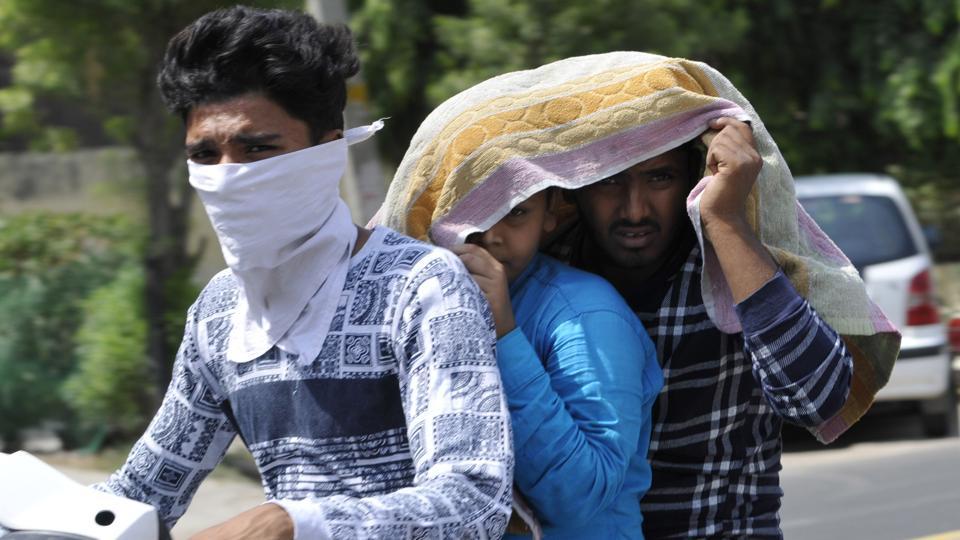
Across large swathes of northern, central and peninsular India, the mercury breached the 45 degree mark, including in Jhansi in Uttar Pradesh, Churu and Bikaner in Rajasthan, Hisar and Bhiwani in Haryana, Patiala in Punjab, and Gwalior and Bhopal in Madhya Pradesh.
The Capital, which sweltered on its hottest June day in history on Monday (48 degrees Celsius) recorded as maximum temperature of 45.4 degrees Celcius at Palam in spite of a spell of light rain in the morning.
Experts warned that monsoon relief was still some time away with the severe cyclonic storm, Vayu, barrelling towards the Gujarat coast and drawing rain clouds from over the sea.
With a heatwave spell stretching 32 days, 2019 has already seen the second-longest spell of scorching temperature ever recorded. If the mercury doesn’t dramatically drop in the next two days, 2019 will become the year with the longest heatwave spell in recorded history — with three weeks to go in June.
In 1988, there were 33 such days, and in 2016, there were 32 such days. A heatwave is defined as when the maximum temperature is at least 40 degree C (plains) and 30 degree C (hills), according to the India Meteorological Department (IMD).
Also Read | In scorching sun, UP villages without a drop to drink
The searing heat is already leaving people withered. Four elderly passengers on board the Kerala Express died apparently of suffocation and heat at Jhansi, where the mercury has hovered around the 45 degree mark since the beginning of the month. The four people, three of whom died on Monday evening, were part of a 67-member group returning to Coimbatore in Tamil Nadu after visiting Agra and were travelling in non-AC sleeper coaches.
“A team of doctors examined them on board the train at Jhansi; three of them had passed away by then and one passenger was rushed to hospital [who died on Tuesday],” said railway spokesperson Manoj Kumar Singh. He said the cause of death appeared to be heat but the exact cause would be known after a post-mortem examination.
The blazing heatwave is in line with predictions made by a number of scientific studies based on IMD data that show that the intensity of heatwaves is rising. DS Pai, a scientist at IMD, Pune, said their study of long-term heatwave data of 35 metrological sub-divisions showed a threefold increase in heatwaves every year since 1991. “Our observation indicates that the increase was steeper in the last two decades,” he said.
An Indian Institute of Tropical Meteorology (IITM), Pune study added that another impact of long spells of heat was an increase in the number of hot days and nights. An analysis of daily maximum and minimum temperatures of 121 IMD stations distributed across India between 1970 and 2015 showed the frequency of hot days and nights showed a big jump whereas that of cold days and nights dropped sharply. “With climate change, the frequency and intensity of heat waves in India will increase,” S Krishnan, a senior scientist at IITM, said.
In its heatwave bulletins, IMD has pointed out that this year’s hot spell has been amplified by the absence of pre-monsoon showers, the presence of hot and dry winds from western dry zones. However, the heatwave spell is likely to cool down this weekend, the IMD heat forecast on Tuesday said.
In major cities across northern India, the demand for power and water surged even as many sources of water – such as rivers and reservoirs – ran dry. The peak power demand in Delhi broke all records of this season on Monday and touched a high of 6,686 MW, reported the discoms. In the hinterlands, where there are often no secondary sources of water such as tanks and pipes, the situation is worse.
In Sonbhadra district on the eastern tip of Uttar Pradesh, for example, the scorching sun has forced many villagers to dig pits in the riverbed and wait for groundwater to ooze out. As the temperatures rise, the pits will go dry and villagers will have to trek kilometres for a pot of water. Hand pumps often don’t work in these regions because in many pockets, the water level has dipped below 300 feet.
The sweltering heat has driven tens of thousands of people into hill stations that are ill-equipped to handle a rush of such magnitude. Uttarakhand’s Nainital has seen an average of 15,000 to 20,000 tourists arrive daily in a city with a capacity of just 8,000 rooms. Mussoorie, which has 2,000 rooms, has seen 190,030 tourists flood the town since May.
As many as 15,000 vehicles have entered Manali and Shimla on weekends this month, translating to roughly 60,000 people — about a third of the population of these towns. The tourist influx is repeatedly choking all approach roads to the small Himalayan hill stations and causing massive traffic snarls in the mountains. Moreover, the hills have received no respite from the blistering sun — Monday’s maximum temperature for Mussoorie was six degrees above normal at 30.5 degrees Celsius while Dharamsala recording a maximum of 33.8 degrees Celsius.


