E-Paper



India, US chart course for new trade order with ‘historic’ framework
India also agreed to eliminate or reduce tariffs on all American industrial goods and a wide range of agricultural products.

 Prefer HTon Google


New Delhi: India and the US moved closer to an interim trade deal on Saturday, releasing a joint statement that confirms US tariffs on Indian goods have dropped to 18% from 50% and details a framework committing both countries to zero duties on select products, market opening measures and overall deeper economic ties — a breakthrough almost a year in the making.
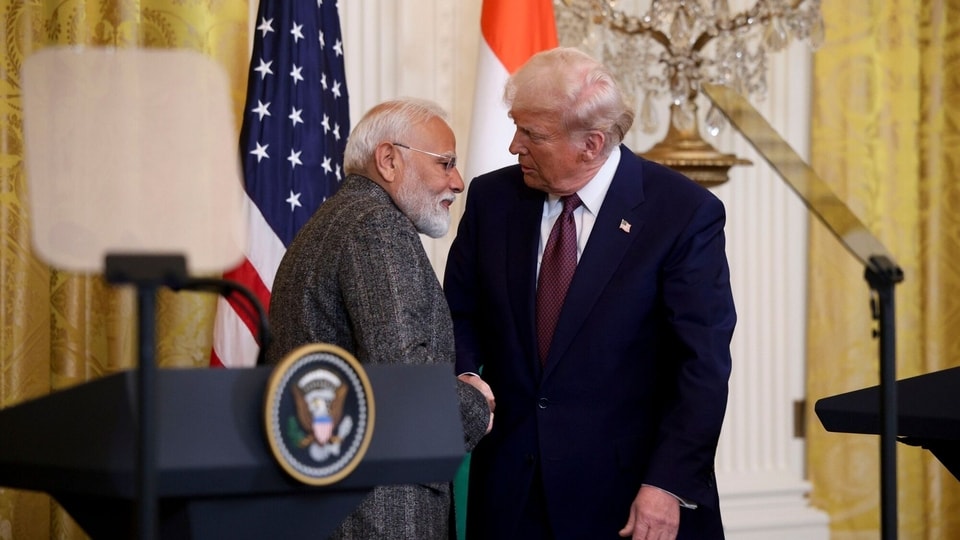
At the heart of the announcements were two documents — the joint statement, which lays out the path for the broader economic cooperation, and an executive order (EO) by president Donald Trump that removed the 25% US levy on Indian goods over New Delhi’s energy ties with Russia. A second EO, officials said, formally reducing the 25% so-called reciprocal tariff to 18% was expected.

Together, the moves mean a range of labour-intensive sectors — textiles and apparel, leather and footwear, plastics and rubber — that were reeling from 50% cumulative tariffs see a welcome 32 percentage point drop, restoring their competitiveness against rivals in Bangladesh, China and Vietnam in the American market.
Also read: Agriculture, dairy sectors ‘fully’ protected under India-US trade deal, Piyush Goyal tells Parliament
According to 2024 merchandise trade data, these items comprise about one-third—over $30 billion—of India’s total $87.3 billion in exports to the US that year. The tariff reduction gives Indian exporters an edge over competitors, with China facing 33% tariffs in the US market, Vietnam 20%, Bangladesh 20% and Indonesia 19%.
And it paves the way for zero duties on Indian exports of gems and diamonds, generic pharmaceuticals, and aircraft parts as soon as March this year, when both sides sign the interim trade agreement prior to a broad bilateral trade agreement (BTA). It is estimated that about $44 billion in Indian merchandise exports will get zero-duty access in the US market.
Also read: In India-US trade deal, a map does the talking on territories occupied by Pakistan, China
India’s commerce minister Piyush Goyal called it a “historic” framework and a “very fair, equitable and balanced agreement.” “Massive potential will be opened up for Indian exports in the world’s largest economy, the $30 trillion market, providing opportunities for our MSMEs, our farmers, our fishermen, our youth, our women, and the very talented and skilled people of India,” he said while addressing a press conference on Saturday.
“India will also get relief under Section 232 on aircraft parts, a preferential tariff rate quota on auto parts, and negotiated outcomes on generic pharmaceuticals, leading to tangible export gains in these sectors,” Goyal said. The US will remove tariffs on aircraft parts imposed under its aluminium, steel, and copper proclamations, while India gets a preferential quota for automotive parts.
The framework will open huge opportunities for Indian gem and jewellery, machinery parts, toys, leather and footwear, home décor, smartphones and several items from the agriculture sector, he said.
In return, India committed to purchasing $500 billion in US goods over five years — including energy products, aircraft and aircraft parts, precious metals, technology products such as graphics processing units (GPUs) used in AI applications and data centres, and coking coal. The joint statement said India “intends to purchase” these goods, with the US taking the commitment “with its best endeavour to meet the obligation.”
Prime Minister Modi called the development “great news” for both countries. “This framework reflects the growing depth, trust and dynamism of our partnership. It strengthens ‘Make in India’ by opening new opportunities for India’s hardworking farmers, entrepreneurs, MSMEs, startup innovators, fishermen and more. It will generate large-scale employment for women and youngsters,” he said in a post on X.
Commerce ministry officials said most of these items are already imported by India. India currently imports such products worth $300 billion annually, with imports growing 8-10% each year. Demand for these products could jump to $2 trillion over the next five years, making it “a win-win situation,” they said.
However, the framework “fully” protected Indian farmers through “carefully crafted exceptions,” Goyal said, shielding sensitive agricultural and dairy products from tariff reductions. “We are happy that we have been able to safeguard sensitive sectors, and balance our farmers’ sensitivities, particularly in agricultural goods and dairy,” he said.
Products excluded include meat, poultry, all dairy products, genetically modified food products, soymeal, maize, cereals including millets such as jowar, bajra, ragi, kodo and amaranth, fruits like banana, strawberries, cherries and citrus fruits, green peas, kabuli chana, mung, oil seeds, certain animal feeds, groundnuts, honey, malt and its extract, non-alcoholic beverages, flour and meals, starch, essential oils, ethanol for fuel, and tobacco.
Now, “we have put in motion” our goal of achieving $500 billion bilateral trade annually, Goyal said, referring to Prime Minister Narendra Modi and President Trump’s February 13, 2025 proclamation to more than double total bilateral trade to $500 billion by 2030.
India also agreed to eliminate or reduce tariffs on all American industrial goods—including motorcycles such as Harley-Davidson—and a wide range of agricultural products including dried distillers’ grains and red sorghum for animal feed, tree nuts, fresh and processed fruit, soybean oil, wine and spirits.
New Delhi also pledged to address longstanding barriers on US medical devices, eliminate restrictive import licensing procedures that delay market access for or impose quantitative restrictions on US information and communication technology (ICT) goods, and determine within six months of the agreement’s entry into force—”with a view towards a positive outcome”—whether to accept US or international standards and testing requirements for American exports in identified sectors.
“Recognising the importance of working together to resolve long-standing concerns, India also agrees to address long-standing non-tariff barriers to the trade in US food and agricultural products,” the statement said. For the purposes of enhancing ease of compliance with applicable technical regulations, the US and India intend to discuss their respective standards and conformity assessment procedures for mutually agreed sectors.
India also committed to stop directly or indirectly importing Russian oil and shift its energy purchases to the US and Venezuela.
Union minister of state for commerce Jitin Prasada said “competitiveness of Indian exporters” is key, as duties are ultimately paid by consumers in importing countries. “The deal puts India in a comparative advantage vis-à-vis other countries exporting labour-intensive products,” he said.
The joint statement also includes safeguards against unilateral decisions on trade matters. “In the event of any changes to the agreed upon tariffs of either country, the United States and India agree that the other country may modify its commitments,” ensuring both sides can respond to protect their interests.
The framework will provide direction to both partners so they can “expeditiously negotiate and further expand market access opportunities” through the proposed BTA, the statement said.