
 E-Paper



What does the trade deal with US mean for India? Key points for Delhi in the details so far
Some details will still require more clarification, and some items have been left for future negotiations. But here are the key takeaways.

 Prefer HTon Google


Less than a week after the announcement of a trade deal in principle, India and the United States have issued a joint statement which gives more details about what exactly has been agreed upon.
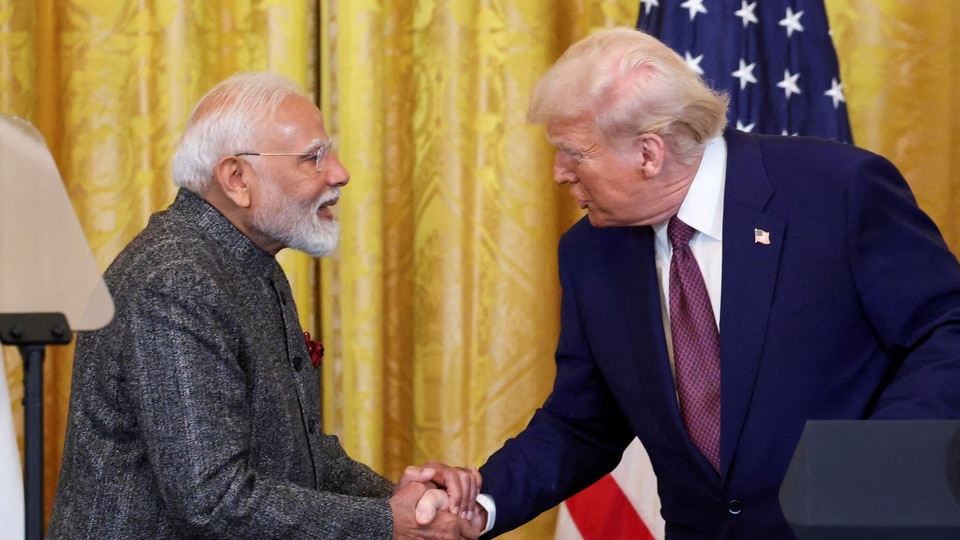
Some details will still require more clarification, and some items have been left for future negotiations. Follow live updates related to trade deal here.
ALSO READ | 18% tariff, $500 billion investment and tech boost | 10 takeaways from the India-US trade deal
But here are the key takeaways from Saturday's announcements.
What has India given for the deal to happen?
1. Russian oil purchases are still a big no
Of the existing 50% US tariffs on India, 25% were on account of the latter’s Russian oil purchase. It was both unfair and inconsistent. The former because the Biden administration was fine with India buying Russian crude to prevent an oil market disruption, and the latter because bigger buyers of Russian oil such as China were not slapped with this tariff.
India always had the option of declaring an end of Russian oil purchases and getting tariffs back to 25% from 50%.
Another order issued with the joint statement shows that the 25% additional tariffs are only being revoked because “India has committed to stop directly or indirectly importing Russian Federation oil, has represented that it will purchase United States energy products from the United States, and has recently committed to a framework with the United States to expand defense cooperation over the next 10 years”.
The statement further says that the US “shall monitor whether India resumes directly or indirectly importing Russian Federation oil” and any such finding can lead to “additional action” including reimposition of the 25% tariff.
To be sure, India has maintained that its oil purchases are driven by “market considerations” rather than being wedded to an unmoving resolve to buy from Russia and that these have anyway fallen sharply recently.
JP Morgan’s commodities team estimates that India’s Russian oil purchases fell from 34% of total purchases in November to 20% in January.
But Trump has prevailed on this front.
2. No blanket opening up of agriculture but it is not insignificant either
India is not going to remove its tariff barriers in a blanket manner as far as farm and dairy products are concerned. These have always been considered a key livelihood concern rather than just a trade-related matter by the Indian side in almost all trade negotiations.
The joint statement mentions a “wide range” of agricultural products such as “dried distillers’ grains (DDGs), red sorghum for animal feed, tree nuts, fresh and processed fruit, soybean oil, wine and spirits”.
These are not categories which will potentially have a large impact on Indian farming, although some targeted headwinds might exist.
Commitments such as in soybean, could also interfere with India's counter-cyclical policies to deal with domestic food inflation.
To be sure, agriculture is not completely off the hook either. “India also agrees to address long-standing non-tariff barriers to the trade in U.S. food and agricultural products”, the joint statement says.
ALSO READ | Agriculture, dairy sectors ‘fully’ protected under India-US trade deal, Piyush Goyal tells Parliament
3. US is targeting significantly higher overall exports to India than even a year ago
“India intends to purchase $500 billion of U.S. energy products, aircraft and aircraft parts, precious metals, technology products, and coking coal over the next 5 years”, the joint statement says.
This is significantly more promising from the US’s perspective compared to the joint statement issued by Donald Trump and Narendra Modi after the latter’s US visit on February 13, 2025, which had set a “bold new goal for bilateral trade — ‘Mission 500’ — aiming to more than double total bilateral trade to $500 billion by 2030”.
To put the $500 billion number in perspective, it equals India’s total merchandise imports from the US between 2008-09 and 2024-25.
The first three points clearly indicate that the US has extracted significant concessions and commitments from India for the trade deal to happen. This raises the natural question.
What has India got in return?
1. The biggest win is in terms of sentiment
Rude as it sounds, India stood to lose a lot beyond the 50% tariffs imposed by the Trump administration.
The potential pain points included higher tariffs on some exempted exports such as but not limited to iPhones, harmful impact on trade in services, and a hit to foreign portfolio investmen — both in equity and currency markets — and most importantly, hemorrhaging economic sentiment in the wake of the deal being delayed and overall Indo-US relations going south.
The deal, notwithstanding the concessions India has had to make, will help on this front. This aside, here is what India stands to gain from a readout of the joint statement.
2. An insurance in case Trump reneges on the deal; a possibility of lower tariffs
“In the event of any changes to the agreed upon tariffs of either country, the United States and India agree that the other country may modify its commitments”, the joint statement says.
This would buy India some insurance from Trump reneging on the deal like he has or threatened to with many countries.
Similarly, there is a promise that tariffs can go lower than 18% in the course of negotiations. This gives agency to India to try and improve the terms of the deal and not be wedded to it even if Trump kills it.
3. Lower tariffs than some competitors in labour-intensive sectors
The 18% tariffs are bad compared to a world which has no tariffs. But what is more important is the fact that India is not the only country which is facing US tariffs now. It is here that 18% tariffs give India some comparative advantage over other competing countries in key export markets in the US.
While calculating a weighted tariff rate requires more information than the joint statement gives, a JP Morgan note by Sajjid Chinoy issued on February 5 suggests that India will have marginally lower tariffs than key competitors such as China, Vietnam and Bangladesh in sectors such as textiles, footwear etc.
While a couple of percentage point of advantage in tariffs will not guarantee that India finally breaks ground in labour-intensive exports, it can definitely be described as a necessary even if not a sufficient condition for such success.
India is at least in the game even if it has to work hard for winning it. Higher tariffs would have killed India’s chances.
4. India also stands to gain in potentially harvesting a larger part of US-led GVC opportunities
The US decision to remove previous tariffs on India’s aircraft component and automobile component exports, as well as the promise of “negotiated outcomes with respect to generic pharmaceuticals and ingredients", holds promise for Indian industries beyond the labour-intensive ones.
These gains will allow India to push the envelop on increasing its footprint in US-led global value chains (GVCs) with potential spillover effects for technological learnings.
ALSO READ | What does White House's ‘India-US joint statement’ on ‘interim’ trade pact say? Read full text
These specific points aside, what is the larger takeaway from the trade deal for India?
Three things can be listed.
One, Indo-US relations have now crossed the proverbial Rubicon of what analysts used to call “strategic altruism” on part of the US. Trump’s US will insist on favours in return for giving them.
Two, India’s response to the trade deal should move beyond the politically correct dogma of reiterating things such as farmers’ interests and do a hard-headed analysis of the larger costs in terms of energy security and defense spending which is where the US might have extracted the largest concessions.
And three, the deal, in its present form or what it takes later, will only be as good as India can make it through an overhaul of its domestic economy to align capital’s priorities in line with pursuing larger national interest and not short-term (often speculative) gains.


