
 E-Paper



Don't view India-China through ‘third country lens’: PM Modi after Xi Jinping meet in Tinjian
“The two leaders deemed it necessary to expand common ground on bilateral, regional, and global issues,” MEA statement read as Modi invites Xi to India

 Prefer HTon Google


Prime Minister Narendra Modi said on Sunday, after his meeting with President Xi Jinping, that India-China relations "should not be seen through a third country lens” — an apparent reference to the US and Donald Trump's hawkish trade-tariff policies.
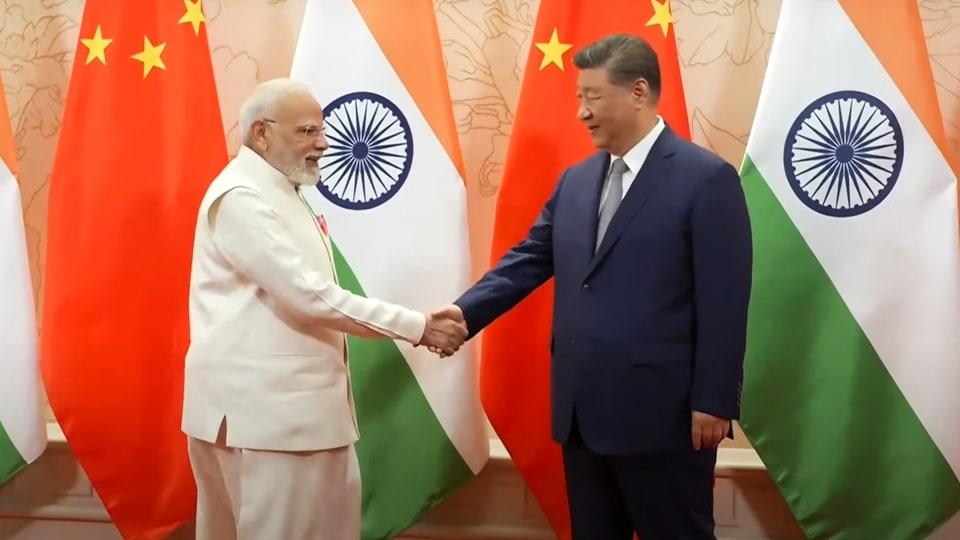
“The two leaders deemed it necessary to expand common ground on bilateral, regional, and global issues and challenges, like terrorism and fair trade in multilateral platforms,” a statement by India's ministry of external affairs (MEA) said, stressing the Asian neighbours' “strategic autonomy”.
They met on the sidelines of a summit of the Shanghai Cooperation Organisation (SCO) in Tianjin on August 31.
PM Modi's eastward visit to Japan and China came after President Trump's continued singling-out of India for buying Russian oil and other acts he does not agree with.
Particularly the China visit, after a seven-year gap, and the meeting there with Xi come amid a thaw in relations that were particularly frosty since a clash in Galwan over ongoing border disputes.
“Differences should not turn into disputes,” Modi and Xi asserted, as per the Indian foreign ministry statement, repeating an earlier assertion.
Modi and Xi acknowledged “the role of their two economies to stabilize world trade” and spoke also of a “fair, reasonable, and mutually acceptable resolution of the boundary question”, as per the MEA.
The foreign secretary, Vikram Misri, also held a briefing later from Tianjin: Video below
“Both leaders welcomed the positive momentum and steady progress in bilateral relations since their last meeting in Kazan (Russia) in October 2024. They reaffirmed that the two countries were development partners and not rivals, and that their differences should not turn into disputes,” the MEA statement read.
“A stable relationship and cooperation between India and China and their 2.8 billion peoples on the basis of mutual respect, mutual interest and mutual sensitivity are necessary for the growth and development of the two countries, as well as for a multipolar world and a multi-polar Asia befitting the trends of the 21st century,” it added.
On the border issue, the statement said PM Modi “underlined the importance of peace and tranquility” in border areas for better bilateral relations. It mentioned “the successful disengagement last year” and the peace since.
People-to-people ties through direct flights and visas was also marked as positive moves, particularly the resumption of the Kailash Manasarovar Yatra.
“The Prime Minister noted that India and China both pursue strategic autonomy, and their relations should not be seen through a third country lens,” the MEA statement read.
Modi also invited President Xi to the BRICS Summit that India will be hosting in 2026, at which Xi thanked him and offered China's support to India's BRICS presidency.
The PM also had a meeting with Cai Qi, member of the Standing Committee of the Politburo of the Communist Party of China. He sought Cai's support to realise the vision of the two leaders, the MEA said.
The SCO's full membership now includes Russia, Belarus, China, India, Iran, Kazakhstan, Kyrgyzstan, Pakistan, Tajikistan and Uzbekistan. It was originally seen as a foil to US influence in Central Asia, and later picked up four of the members: India and Pakistan in 2017, Iran in 2023, and Belarus in 2024.


