
 E-Paper



IAF grounds MiG-21 fleet for safety checks after Rajasthan crash
Three women were killed after a MiG-21 Bison fighter jet crashed into a house in Hanumangarh on May 8.

 Prefer HTon Google


The Indian Air Force has grounded its MiG-21 fighter fleet for safety checks following a crash in Rajasthan on May 8, officials familiar with the matter said on Saturday. Three women were killed after the MiG-21 Bison fighter jet crashed into a house in Hanumangarh, with the accident again putting the spotlight on the troubling safety record of India’s longest-serving fighter plane.
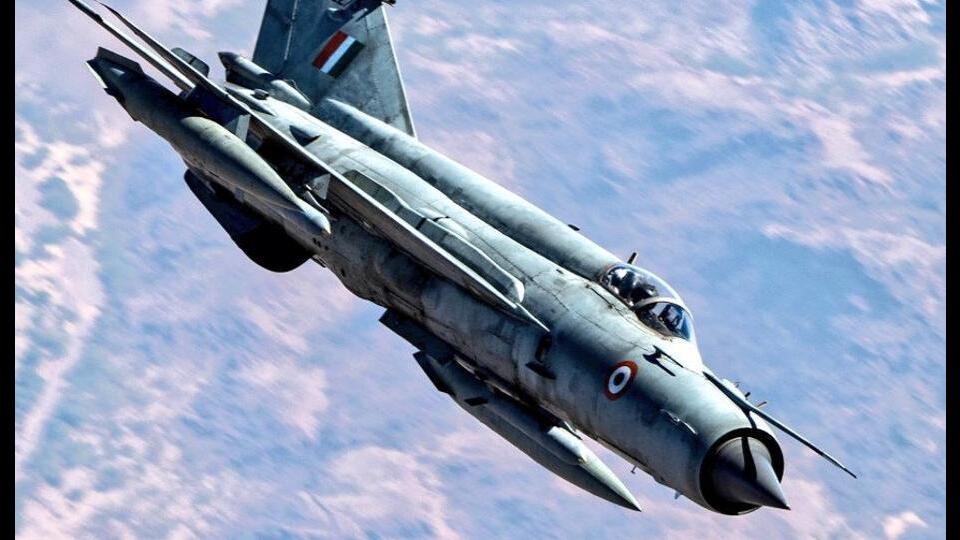
Also Read: 3 civilians killed as IAF MiG-21 crashes in Rajasthan
“The MiG-21 Bisons are currently not flying as the fleet is undergoing comprehensive safety checks after the May 8 crash. The fighters will resume flying in a phased manner after these checks and the completion of the inquiry into the latest crash,” said one of the officials cited above, who asked not to be named.
On May 8, the pilot faced an onboard emergency shortly after taking off from the Suratgarh air force station and attempted to recover the aircraft but failed to do so. It was on an operational training sortie. The aircraft wreckage fell on a house at Bahlol Nagar in Hanumangarh. The pilot ejected safely and was recovered about 25 km north-east of the Suratgarh base.
It is not uncommon for an aircraft fleet to be grounded for inspection after an unexplained crash or incident. But the MiGs have been a cause of concern for some time now. More than 400 MiG-21s have been involved in accidents that have claimed the lives of 200 pilots during the last six decades.
A spate of crashes, many of them fatal, prompted the Indian Air Force last year to announce that it will phase out the MiG-21 Bisons by 2025, having ostensibly been unable to do so in order to maintain adequate number of combat aircraft in service. It is welcome that the force has grounded these jets, notoriously nicknamed “flying coffins” at one point, and that it is working on quickly arranging for enough replacements to maintain combat readiness.
The IAF is set to retire its three remaining squadrons of the MiG-21 Bisons by 2025, the officials said. Each squadron has 16 to 18 fighter planes. The MiG-21 Bis (an upgraded MiG-21 variant flown for the first time in 1976) was further upgraded to MiG-21 Bison in India in 2000.
“I am happy that the government has decided to phase out the MiG-21s by 2025 and I hope this deadline doesn’t change,” Air Marshal Anil Chopra (retd), director general, Centre for Air Power Studies, said after the May 8 crash.
The planes have been grounded at a time when most of the military’s advanced light helicopters (ALHs) are also grounded for comprehensive checks after a string of recent incidents including the crash-landing of an army helicopter in Jammu & Kashmir’s Kishtwar on May 4 in which a soldier was killed, and two pilots were injured. The army, IAF, navy, and coast guard operate more than 330 ALHs.
Also Read: Army grounds Dhruv ALH fleet again following Kishtwar crash
HT reported on May 10 that a design review of a “safety-critical system” on the ALH may be in order, according to a top government regulatory body responsible for the certification of the airworthiness of military aircraft. The Bengaluru-based Centre for Military Airworthiness and Certification (CEMILAC) wrote to the three services and the coast guard about this on April 23. It has ordered the design review of the booster control rods to improve the ALH’s airworthiness.
The IAF got its first single-engine MiG-21 in 1963 and it progressively inducted 874 jets (different variants of the Soviet-origin supersonic fighter) to bolster its combat potential.
Of the 874 MiG-21s inducted, more than 60% were licence-produced in India. More MiG-21s have crashed than any other fighter because they formed the bulk of the fighter aircraft in the IAF’s inventory for a long time, the officials said. IAF has had to keep its MiG-21 fleet flying longer than it would have liked because of the delay in the induction of new fighters.
The IAF retired MiG-21 Bisons at the Srinagar-based No. 51 squadron, which is also known as “Sword Arms,” last September.
Wing Commander (now Group Captain) Abhinandan Varthaman, who was awarded Vir Chakra for shooting down a Pakistani F-16 during a dogfight over the Line of Control on February 27, 2019, was with the No. 51 squadron then.
The dogfight took place a day after the IAF bombed a terror facility in Pakistan’s Balakot.
IAF’s Mirage-2000s struck targets in Balakot on February 26, 2019, in response to the Pulwama suicide attack in Kashmir in which 40 Central Reserve Police Force (CRPF) personnel were killed 12 days earlier.


