E-Paper



Where Chandrayaan-3 lies in the historical context of lunar exploration
The Space Race between the US and the Soviet Union during the Cold War inspired intense investment in space exploration from the late 1950s to the mid-1970s.

 Prefer HTon Google


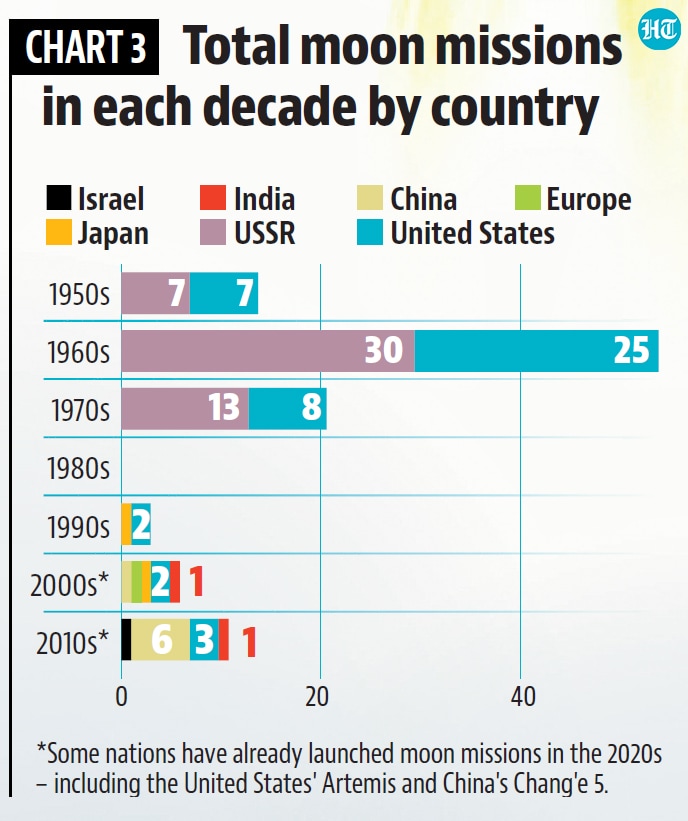
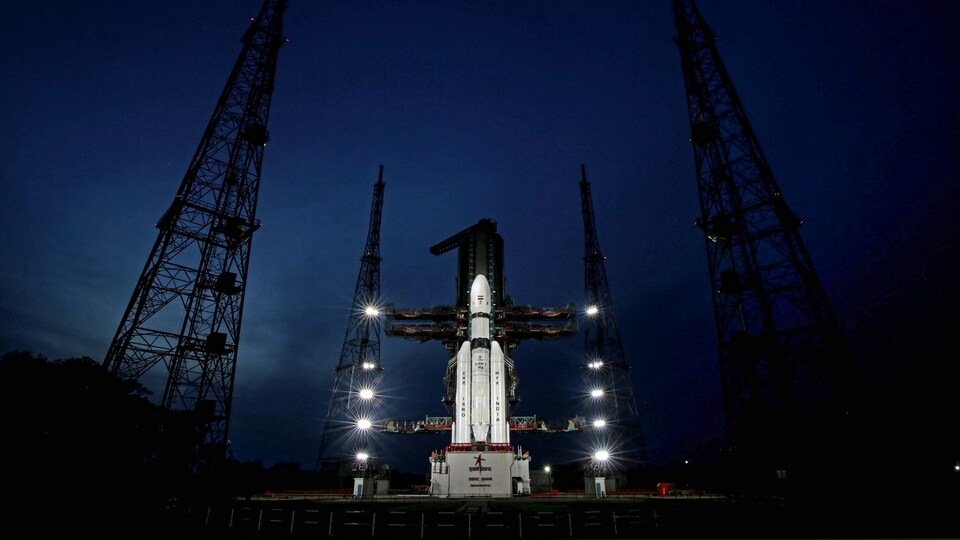
When the 640-tonne Launch Vehicle Mark-3 (LVM-3) rocket takes off from the Satish Dhawan Space Centre in Sriharikota on Friday, it carries not only the Chandrayaan-3, but also the weight of history as it seeks to place India in an elite club of nations that have successfully landed on the moon. Here are some charts that explain how this mission is placed in historical context.
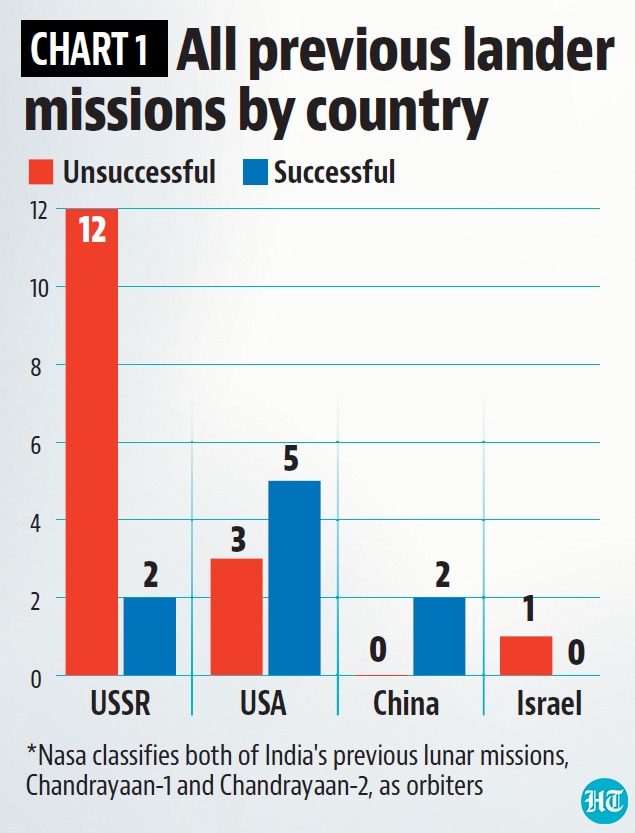
India aims to be the 4th nation to ever achieve a soft landing on moon
A soft landing takes place when a spacecraft lands intact on the lunar surface and does not, intentionally or unintentionally, crash. Till date, four countries – the former Soviet Union, the United States, China and Israel – have previously attempted such landings on the moon. All but Israel have succeeded. This means if Chandrayaan-3 is a success, India will be the fourth nation to ever accomplish this feat. Follow Chandrayaan-3 Launch LIVE Updates Here.
The Chandrayaan-2 mission, which ended in a “hard landing” on the lunar surface on September 6, 2019, was also an orbiter mission (which succeeded). Thus, it is not included in Nasa’s aggregation of past lander attempts.
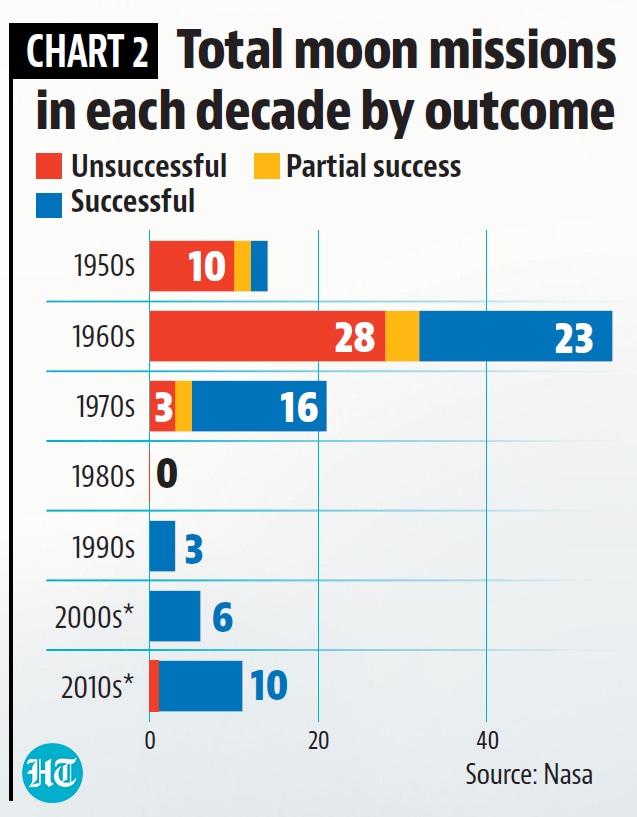
Interest – and success – in lunar missions is rising
The Space Race between the United States and the Soviet Union during the Cold War inspired intense investment in space exploration from the late 1950s to the mid-1970s. After a lengthy hiatus – no country executed a single lunar mission in the 1980s – exploration of the Moon resumed in the 1990s. In the time since the Space Race, the portion of successful missions has only generally increased, data shows.
More countries are joining in
With the conclusion of the Space Race, more countries jumped in to join the United States and Russia beginning in the 1990s. Japan executed the first successful lunar [CHECK] mission by a country other than the US or Russia in 1990. Europe, China also accomplished trips to the moon, with the first successful European lunar mission launching in 2003 and the first successful Chinese one launching in 2007. India was not far behind, as the first Indian mission – Chandrayaan-1 – was executed in 2008.
Israel has also since tried to join, with Beresheet in 2019 becoming the first privately funded mission sent into outer space. The spacecraft did not, however, land successfully on the lunar surface.