Sign in

Indigo disruption leads to airfares surging up to 10X

Airfares in India surged up to ten times normal rates after IndiGo canceled over 1,000 flights, leaving passengers scrambling for costly alternatives.

Published on: Dec 6, 2025, 04:50:02 IST
Share
Share via
  • facebook
  • twitter
  • linkedin
  • whatsapp
Copy link
  • copy link

New Delhi/AMRITSAR/Mohali/Srinagar:
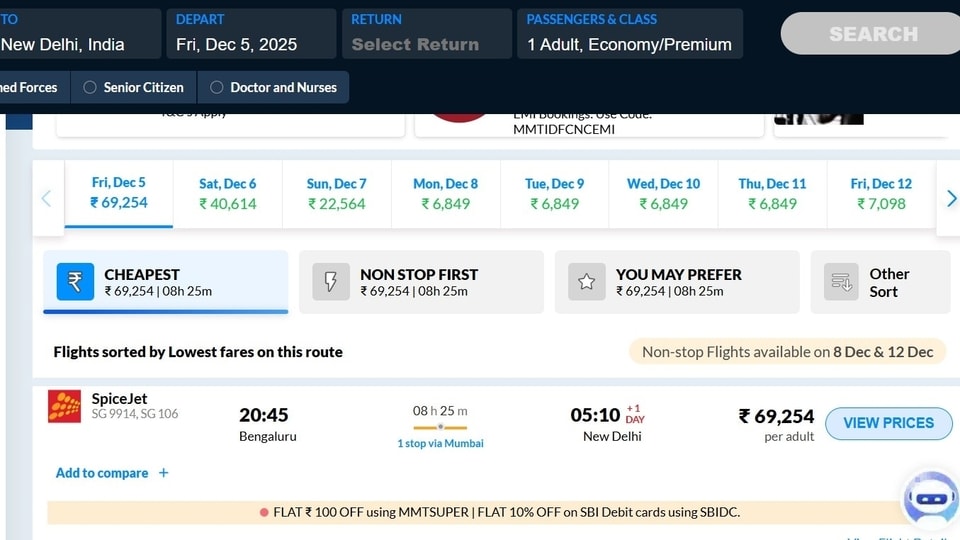
Screenshot of Makemytrip wesbite showing airfares for Bengaluru-Delhi route.

Airfares across Indian carriers surged to as much as ten times their usual rates on Friday following IndiGo’s mass cancellation of over 1,000 flights, with round-trip tickets on major routes crossing 80,000- 90,000 as passengers scrambled for limited seats on rival services.

A Delhi-Mumbai return ticket reached 93,000, while return fares to Bengaluru touched 92,000, Kolkata 94,000 and Chennai 80,000—compared to typical same-day economy round-trip fares of 20,000- 25,000 on these routes. Even last-minute bookings under normal circumstances rarely exceed 30,000.

By Friday evening, most flights were sold out, leaving passengers with little choice but to pay highly inflated fares or postpone travel.

“A return ticket that should have cost around 15,000 cost me 50,000 with another airline. I had no option but to buy the expensive tickets. It’s terribly unfair on fliers,” said a 36-year-old Delhi-based lawyer who booked a ticket to Bengaluru.

Travel agents said passengers facing emergencies were paying five to ten times normal fares, while others chose to extend their stays or seek alternative transport.

“While people in an emergency have chosen to still book other airlines, we have most customers telling us that they want to extend their stay and wait. Booking trains for shorter journeys of four to seven hours is also emerging as an option,” said Rahul Saraswat, general manager at Delhi-based travel company Shivam Services.

Varun Thukral, who runs Luxury Vacations, said: “The Delhi-Mumbai, Delhi-Bengaluru routes are heavily impacted and the prices have increased exponentially. For instance, for a Delhi-Mumbai flight, airlines other than IndiGo are selling return tickets for 40,000-50,000”.

A Gulzar, 62, who works in the social sector, came to Delhi for a US Embassy interview that was scheduled as a one-day affair. “My ticket got cancelled. I have managed to get one Air India ticket for Hyderabad on December 6, but they are charging exorbitant prices. Normally, a ticket from Delhi to Hyderabad would cost around 5,000-7,000, but I had to pay 32,000 for it,” he said.

Tickets connecting cities other than the capital recorded similar trends.

A Chandigarh to Bengaluru ticket on December 6 showed 65,000 for a single seat on Air India—a journey involving a layover in Mumbai with approximately 10 hours flying time. Passengers headed to Mumbai from Chandigarh were quoted fares around 43,000 for one-way bookings.

Chandigarh-based travel agent Manjit Singh said the spike was expected given IndiGo’s network size. “With IndiGo being the largest carrier of domestic flights, other airlines are now shooting up the prices, at least for another two-three days. So far, reasonable prices are showing from Monday onwards, but looking at the situation, the prices will shoot up further in a few hours,” he said.

IndiGo cancelled all 11 flights from Jammu on Friday and 13 from Srinagar, with passengers complaining of inadequate support from the airline.

IndiGo cancelled 258 flights in Mumbai—133 departures and 125 arrivals—out of 396 scheduled flights. Mumbai airport sources said 398 flights had been cancelled since December 3.

Luggage piled up in various cargo sections with minimal staff available for collection. Many passengers were seen arguing with IndiGo staff.

A couple whose Chandigarh flight was cancelled learned of the disruption while en route to the airport and had to return home. “We tried booking on other airlines, but prices were jacked up,” they said.

“Whatever has happened shouldn’t have happened. DGCA has taken note of it. IndiGo is India’s biggest airline in terms of operations. During the winter season, everyone is planning to travel either within the country or overseas. It’s a peak period to travel to different destinations. The airline shouldn’t have inconvenienced people. Those travelling from overseas may have to redraw their travel plans during Christmas, owing to such high airfares,” said Iqbal Mulla, former president of Travel Agents Association of India.

Civil aviation minister Ram Mohan Naidu has directed DGCA to closely monitor airfares during the flight disruptions and ensure the crisis does not lead to fare increases, according to a ministry statement issued Thursday.

(Inputs from Dheer Chawla, Ateeq Shaikh, Yogesh Naik )

  • Jasjeev Gandhiok
    ABOUT THE AUTHOR
    Jasjeev Gandhiok

    Jasjeev Gandhiok is an Assistant Editor with Hindustan Times, where he covers environment, climate change, the clean energy transition and wildlife at the National Bureau. Gandhiok has over a decade of experience in journalism and is based in Delhi. He has reported extensively on Delhi and the National Capital Region (NCR). This includes the region's air pollution woes, a polluted Yamuna and on urban wildlife still thriving in the region. He joined HT in October 2021. Prior to that, he had five-year stint at The Times of India in Delhi, where he also covered Delhi, with a focus on environment and wildlife. Gandhiok has covered some recent events around the Capital too, ranging from the farmers' protests, the northeast Delhi riots and the CAA-NRC protests, reporting from the ground on all of these. He also travels across the country to report on how environment and climate change impact everyday life, while also writing on endangered species. His reports in 2019 on toxic leachate from Delhi's landfills led to the National Green Tribunal (NGT) taking suo motu cognisance and ultimately asking the state government to start bio-mining to flatten and remove all three landfills in the capital. He also closely tracks the implementation of government policies on climate, renewable energy and environmental protection. His focus remains on impactful, public-interest journalism which explains how environmental decisions affect people's everyday lives.Read More

  • Snehil Sinha
    ABOUT THE AUTHOR
    Snehil Sinha

    Snehil Sinha is an Assistant Editor with the Delhi Metro bureau of Hindustan Times, where she reports on politics, governance, public policy, urban infrastructure and transport, subjects that shape the everyday lives of millions in the national capital. Over a journalism career spanning 14 years, she has built a reputation for meticulous, data-driven reporting that combines on-ground perspectives with policy analysis. She began her career with The Indian Express before joining Hindustan Times, where she has reported extensively on civic administration and urban governance in Gurugram, Noida and now Delhi. Her reporting is distinguished by its clarity, depth and balance. Whether covering large-scale infrastructure projects, environmental challenges, transport reforms or government policy, she tries to translate complex administrative decisions into accessible, engaging stories without losing nuance. Her work reflects a strong command of public records, official data and field reporting, often connecting policy announcements with their impact on citizens. Her stories go beyond headlines to explain how governance decisions influence the city's growth, mobility and quality of life, making her work an important contribution to informed public discourse.Read More

  • Hemani Bhandari
    ABOUT THE AUTHOR
    Hemani Bhandari

    Hemani Bhandari is a Special Correspondent with Hindustan Times in New Delhi, where she reports on crime, policing, governance and social issues. With over a decade of experience in journalism, she specialises in combining on-ground reporting with evidence-based storytelling to examine the human impact of public policy, law enforcement and urban governance. Over the years, she has reported extensively on major developments in the capital, including crime investigations, civic challenges, protests, and issues affecting vulnerable communities. As a Special Correspondent, she focuses on producing exclusive investigations, enterprise stories and long-form features that go beyond daily news cycles. She has a keen interest in using public records, official data and field reporting to uncover systemic issues and present complex subjects in an accessible manner. A graduate of the Asian College of Journalism, Hemani believes in rigorous, ethical and evidence-based reporting. She is passionate about investigative journalism and continuously seeks to expand her skills in data journalism, open-source investigations and digital reporting techniques.Read More

  • Surjit Singh
    ABOUT THE AUTHOR
    Surjit Singh

    Surjit Singh is a correspondent. He covers politics and agriculture, besides religious affairs and Indo-Pak border in Amritsar and Tarn Taran.Read More

  • Ravi Krishnan Khajuria
    ABOUT THE AUTHOR
    Ravi Krishnan Khajuria

    A principal correspondent, Ravi Krishnan Khajuria is the bureau chief at Jammu. He covers politics, defence, crime, health and civic issues for Jammu city.Read More

Get the latest India News, breaking headlines and real-time updates from across the country. Stay informed about politics, government policies, crime, weather major national developments and Karnataka Bandh LIVE.