
 E-Paper



Intensify anti-Maoist operations, says Shah to CMs in left-wing extremism meet
Home minister Shah asked all the chief ministers and their representatives to give priority to this in the next one year so that a permanent solution can be found to the problem, adding that it requires building pressure on the Maoists, increasing the speed of development activities and better coordination between central and state agencies.


Home minister Amit Shah on Sunday chaired a meeting with the chief ministers and representatives of 10 states affected by left-wing extremism to discuss a road map for development and to bring an end to the Maoist insurgency.
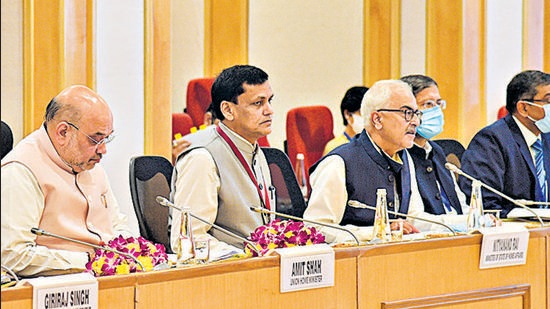
He asked all the chief ministers and their representatives to give priority to this in the next one year so that a permanent solution can be found to the problem, adding that it requires building pressure on the Maoists, increasing the speed of development activities and better coordination between central and state agencies.
The Maoist insurgency, which has claimed more than 16,000 civilian lives in the past 40 years, has now reached near its end, the home minister said. This needs to be accelerated and made decisive, he said.
Issues ranging from intensifying operations against Maoists, choking their funding through concerted action by agencies like the Enforcement Directorate (ED), the National Investigation Agency (NIA) and state police forces, targeting the front organisations, and carrying out widespread development activities, among others, were discussed during the meeting, which went on for several hours at Vigyan Bhawan in New Delhi.
Those who attended the meeting included chief ministers of Odisha (Naveen Patnaik), Bihar (Nitish Kumar), Telangana (K Chandrashekar Rao), Jharkhand (Hemant Soren), Maharashtra (Uddhav Thackeray) and Madhya Pradesh (Shivraj Singh Chouhan). Union ministers Ashwini Vaishnaw, Gen (retired) V K Singh, Giriraj Singh, Arjun Munda and Nityanand Rai, union home secretary Ajay Bhalla, and Intelligence Bureau chief Arvinda Kumar also attended the meeting. Director generals of NIA and central paramilitary forces, and union road, rural, and tribal affairs secretaries were in attendance as well.
The chief misters of of Chhattisgarh ( Bhupesh Baghel), West Bengal (Mamata Banerjee), Kerala (Pinarayi Vijayan) and Andhra Pradesh (Y S Jagan Mohan Reddy) did not attend the meeting but were represented by their chief secretaries and senior police officials.
The meeting comes in wake of the home ministry reducing the number of districts affected by left-wing extremism.
The number of such districts has declined sharply to 70 in 10 states for the first time in over three decades, with Bihar, Odisha and Jharkhand showing the biggest improvement, HT reported last month. Only 25 districts in eight states are now categorised as most affected, while Uttar Pradesh is now free of Maoism, according to the Union home ministry’s revised list that was updated in July.
The incidents of Maoist violence has declined by 70% to 665 in 2020 from a high of 2,258 in 2009. Deaths due to such incidents of has also fallen by 82% 183 in 2020 from a high of 1,005 in 2010.
Shah said during the meeting that “in decades of fighting, we have reached a point where the death toll is less than 200 for the first time and this is a huge achievement for all of us.”
“We all know that unless we get rid of the problem of left-wing extremism completely, the full development of the country and the states affected by it is not possible. Without eliminating it, neither we will be able to spread democracy to the bottom nor will we be able to develop the underdeveloped areas,” Shah said. “So, instead of being satisfied with what we have achieved so far, we need to increase the speed to get what is left.”
He urged the states to hold a review meeting with police chiefs and central agencies at least every three months to deal to “take this fight forward”.
“In last two years, a huge and successful effort has been made to increase security camps in areas where security was not stringent, especially in Chhattisgarh, as well as in Maharashtra and Odisha. If regular review is done at the level of chief ministers, chief secretaries and director generals of police, then the problems of coordination at the lower level will automatically get resolved,” Shah said.
On the source of income of Maoists, Shah said it is “very important to neutralize” it “by making a system together”.
He said Centre has taken several developmental initiatives, which include approving the construction of 17,600km of roads, out of which 9,343km have already been built. As many as 2,343 new telecom towers have been installed and 2,542 more will come up within next 18 months.
The authorities have opened 1,789 new post offices, 1,236 bank branches, 1,077 ATMs and 14,230 banking correspondents. Another 3,114 post offices will be opened in next one year. All these will help the affected districts to join the mainstream.
For imparting education in these areas, Shah said special focus is given to opening of Eklavya Model Residential Schools. A total 234 of these schools have been sanctioned for Maoist-affected districts, of which 119 are already functional, Shah said.


