E-Paper



Is Covid-19 holding back the economy or demand?
There are two things which stand in the way of a holistic economic recovery: pandemic related restrictions preventing mobility, and therefore restoration of economic activities; and lack of aggregate demand due to incomes lost during the pandemic.


GDP data for the quarter ending June 2021 will be released on August 31. But most high frequency indicators suggest that the Indian economy managed a V-shaped recovery after the disruption of the second wave. The question at hand is not whether the economy has come back to the level where it was before the second wave of Covid-19. It is when the economy will regain pre-pandemic levels.
There are two things which stand in the way of a holistic economic recovery: pandemic related restrictions preventing mobility, and therefore restoration of economic activities; and lack of aggregate demand due to incomes lost during the pandemic. To be sure, it need not be an either-or choice between these two sources of economic headwinds, as the two can coexist. Here are four points which can put this question in context.
1. Has economic recovery slowed down of late?
The answer depends on which indicator one is looking at. The Nomura India Business Resumption Index (NIBRI), which surged from 62.9 in the week ended May 30 to 86.3 in the week ended June 27, seems to have lost momentum mid-July onwards.
NIBRI reached 96.4 in the week ended July 18 but has fallen marginally for two consecutive weeks and it was at 95 in the week ended August 1.
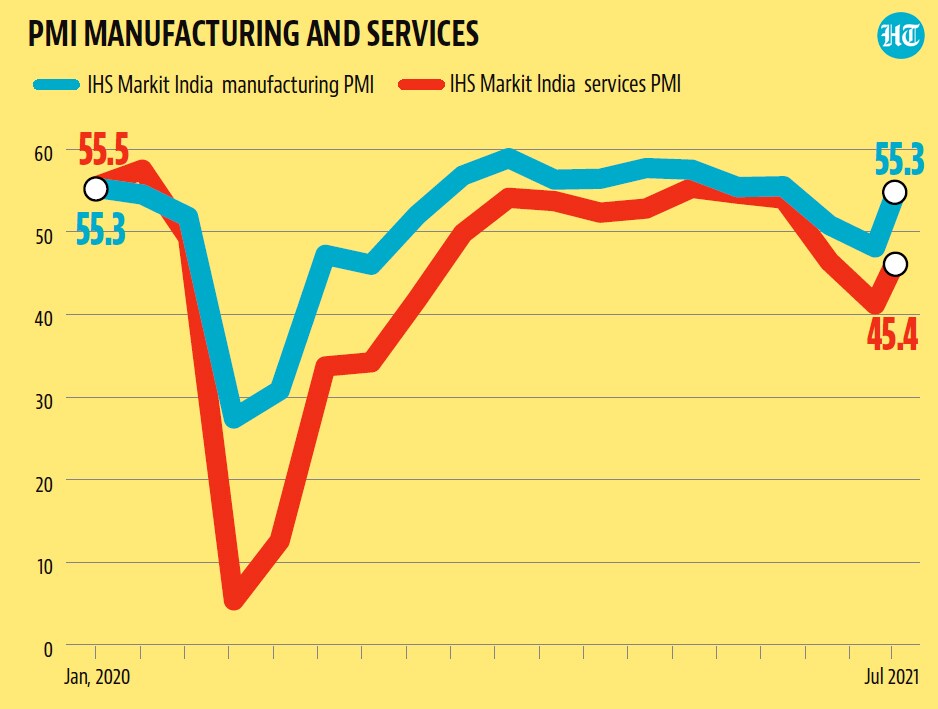
Purchasing Managers’ Index (PMI) for manufacturing clocked an impressive 55.3 last month. July 2021 was the first time when PMI manufacturing recorded an increase in employment since the pandemic began. But PMI for services was at 45.4, making July the third straight month of contraction in services activity. A PMI value less than 50 entails a contraction in economic activity compared to the previous month.
Services have a bigger share in Gross Value Added (GVA) than manufacturing. The share of services in GVA was 55.6% and that of manufacturing was 17.1% in 2019-20, the year before the pandemic struck. This means that a revival in services activity is crucial to boosting GDP growth.
The Monetary Policy Committee (MPC) of RBI has projected a growth rate of 18.5% and 7.9% in the quarters ending June 30 and September 30. There was a contraction of 24.4% and 7.4% in the June and September quarters in the last fiscal year.
2. Is a rise in Covid-19 cases slowing down recovery?
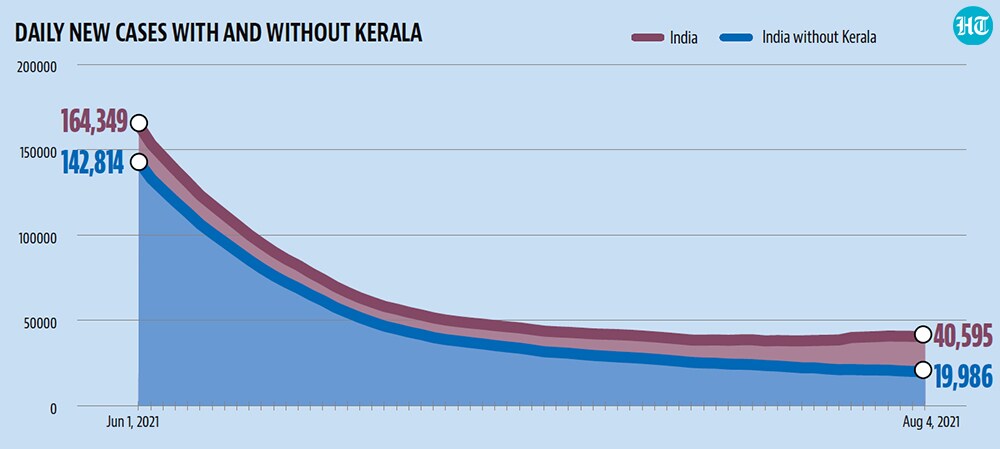
Not necessarily. It is true that seven-day average of Covid-19 cases has reversed its falling trajectory in India in the last two weeks. But this does not mean that the entire country is witnessing a resurgence in Covid-19 cases.
This is best seen by looking at India’s Covid-19 trajectory after excluding Kerala’s caseload.
Once this is done, the pandemic situation in the rest of the country looks healthier. The seven-day average of daily new cases in India was 40,595 on August 4. This comes down to 19,986 if Kerala is excluded. More importantly, the number of cases excluding Kerala is still falling, not rising.
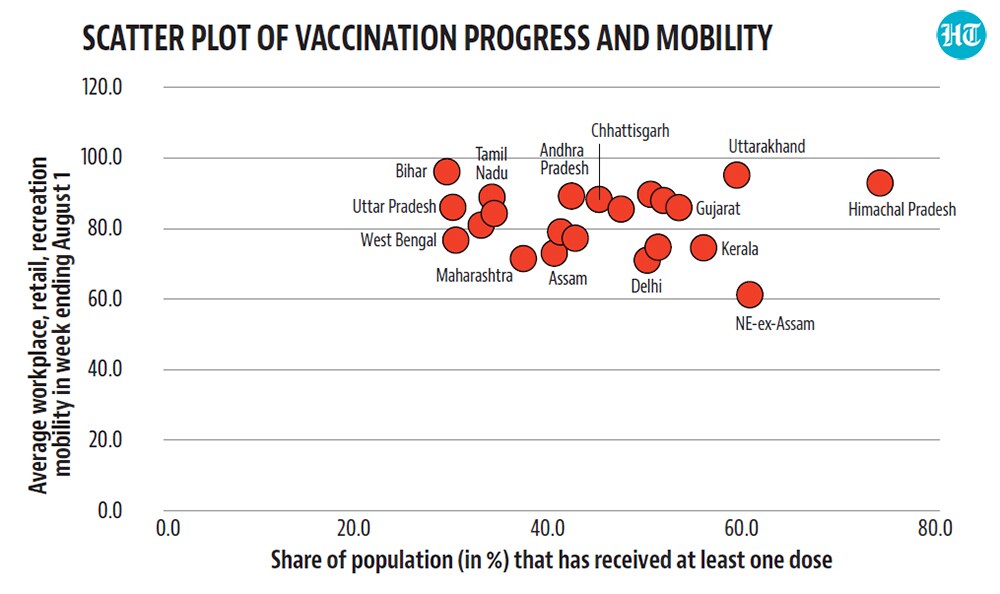
3. Is a slow pace of vaccination preventing restoration of mobility?
This is highly unlikely. By large most restrictions on mobility which were imposed during the second wave of infections have been removed. So there are no policy impediments to recovery.
It could also be argued that there is a voluntary inhibition in getting out, and people are waiting for vaccination to reach a critical level. This also seems unlikely. A comparison of mobility levels and vaccination progress by states shows very little correlation.
Some states are wild outliers – Bihar has the lowest share of population to have been vaccinated, but its mobility levels are the highest. The situation is the opposite in Kerala.
4. This makes the question of demand an important one
What if people do not have the means to spend like they used to before the pandemic? Evidence of the economic recovery being profit rather than wage-led, a squeeze on labour earnings, and movement of workers from high productivity to low productivity sectors, makes this eminently possible.
If true, this can create a vicious circle in the economy, where low demand destroys jobs and incomes, which then further depresses demand.
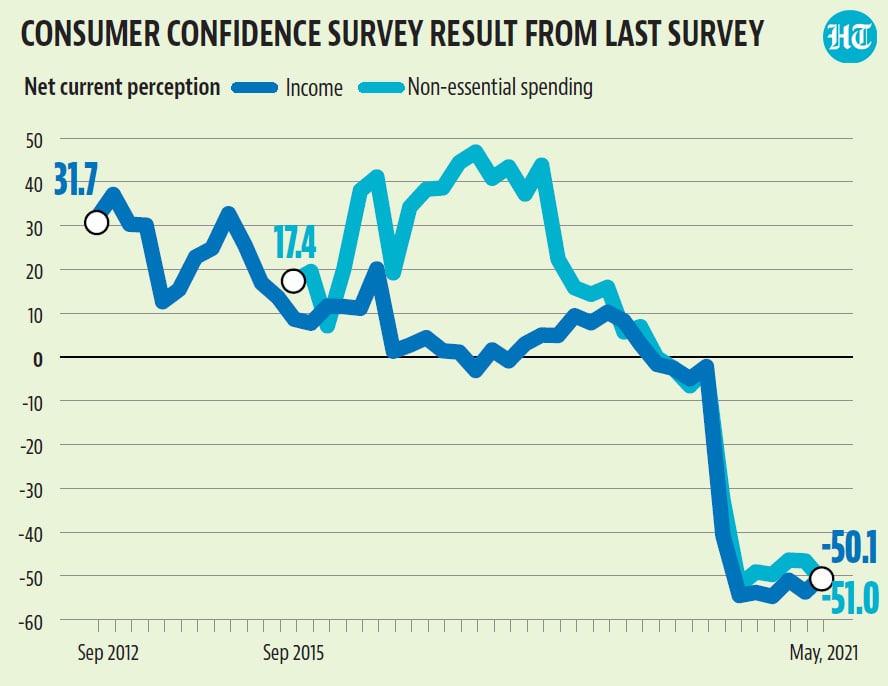
Whether or not this is happening right now will only be known when the GDP numbers for the September quarter are released in November . However, findings of the latest round of RBI’s Consumer Confidence Survey (CCS), which will be released on August 6 will offer an insight into the state of consumer demand.
Two data points will be of special interest in the CCS results: current perception on income levels and non-essential spending. The latter is important given the argument that rise in prices of essential commodities such as edible oil and petrol-diesel have put a squeeze on household budgets.
RBI’s monetary policy committee (MPC), would have had a look at the results of CCS and other forward-looking surveys before everyone else, and it remains to be seen whether it keeps the June projection of 9.5% GDP growth unchanged or not in its Friday announcement.