
 E-Paper



In Uttar Pradesh's Bundelkhand, Jal Jeevan Mission lends lifeline to parched citizens
Jal Jeevan Mission aims to bring drinking water to all rural households in India by 2024. In the Bundelkhand region, the programme has been successful.

 Prefer HTon Google


For most of Gulab Rani’s 76 years, life has revolved around one primal, basic hunt — the search for potable water. From the village of Jakhaura in Banda district, Rani’s story is not uncommon to the women of Bundelkhand, a cluster of seven districts in southern Uttar Pradesh, long plagued by poverty, marginalisation, and the scarcity of water.
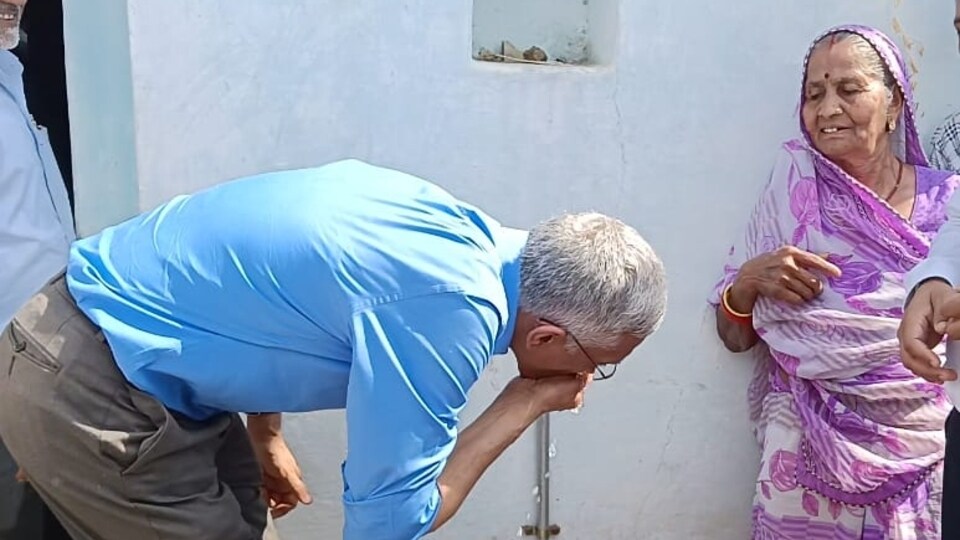
Every day, she would push past the pain in her arthritic knees, ignore her failing health, navigate past onrushing trains, and walk 2km one way to a decrepit well near the Mataundh railway station. Until March 2023, when under the central government’s Jal Jeevan Mission, a drinking water tap was installed in her home.
Outside her three-room house made of thatch that she shares with eight family members, Rani sits under the harsh sun in the scorching heat. And yet, this year, she sits with a sense of comfort. For in front of her are buckets of water, collected with little strain. “Every year the situation would worsen in the summer. There were times when we had to make several trips a day to the well just to fetch water for our domestic use. This time though, we are at ease even if the temperature is high. The regular water supply has put an end to my drudgery,” Rani said.
Read: Jal Jeevan Mission achieves 60% of its target, says govt
From the ramparts of the Red Fort on Independence Day in 2019, four months after the Bharatiya Janata Party (BJP) stormed to power with a full majority for a second consecutive time, Prime Minister Narendra Modi announced the launch of the Jal Jeevan Mission that set the ambitious target of bringing drinking water to all households in rural India in five years. The website of the department of drinking water and sanitation under the Jal Shakti ministry says that the mission envisages “safe and adequate drinking water through individual household tap connections by 2024 to all households in rural India”.
“The programme will also implement source sustainability measures as mandatory elements, such as recharge and reuse through grey water management, water conservation, rain water harvesting… JJM looks to create a jan andolan for water, thereby making it everyone’s priority,” the official website says.
There is perhaps no region in India than the 13 districts of Bundelkhand — seven in Uttar Pradesh and six in Madhya Pradesh — that have required such intervention more. A 2014 report of the National Institute of Disaster Management records that the “Indian Famine” that swept through the country in 1896 and 1897 started in Bundelkhand in early 1895, spreading to the United and Central Provinces, Bihar, Hissar, and parts of the Bombay and Madras Presidencies. More recently, Bundelkhand went through seven consecutive years of drought between 2003 and 2010, with a rainfall deficit of as high as 56% in 2007-08. The NIDM report says that deficit rainfall apart, the situation in Bundelkhand is exacerbated by water sources being “varied and often seasonal, ranging from ponds, tanks, lakes and streams to open wells, bore wells and irrigation canals radiating out from large-scale dams”.
Read: Drive to provide clean tap water to Uttar Pradesh’s rural areas expedited
It is no surprise then that Bundelkhand was one of the focus areas of the Jal Jeevan Mission. As HT reported in 2021, the Bundelkhand leg of the programme comprises 467 piped drinking water schemes under 32 projects. Of these, 43 are surface water-based schemes and 424 are ground water based.
Rakesh Kumar, chief engineer of the Jal Jeevan Mission for the region said, “The districts of Bundelkhand, known for water scarcity, have been the top priority of both the central and state governments, and both have worked together on this mission. The central government has been monitoring the progress on a weekly basis. To facilitate water supply, an agreement has been agreed with the state government for regular supply of waters from various reservoirs whereas the state revenue department has been focusing on the removal of encroachments on government land that delay the process. The terrain is tough and there are challenges, but Bundelkhand now leads in providing tap water across Uttar Pradesh,” Kumar said.
Government data on the publicly available real-time dashboard for the Jal Jeevan Mission shows that while the state average for Uttar Pradesh for households with tap water connections still languishes at 43.99%, the seven districts of Bundelkhand are all significantly higher than this average, ranging from coverage of 65.08% (Hamirpur) to 87.87% (Mahoba). In fact, of the top 10 districts in the state, five of the seven districts in the Bundelkhand figure; Mahoba being ranked number one.
The data also shows that these are not due to the historical prevalence of tap water connections either, but have been installed in a four-year period. The dashboard shows that in Chitrakoot, 163,169 households without water were identified in August 2019, of which 127,657 have since had tap water connections installed. As of May 24, the numbers for the other districts are 214,228 connections installed of 266,558 identified households in Banda, 205,738 of 249,782 in Jhansi, 145,563 of 211,577 in Jalaun, 111,980 of 178,367 in Hamirpur, 115,714 of 131,917 in Mahoba, and 144,077 of 179,726 in Lalitpur.
In Jhansi’s Dhawani village, 35-year-old Sushila Devi says that the easy access to tap water in her home is “freedom from bondage”; from a day that revolved only around the quest for water. “From the crack of dawn to the setting sun, all women did was to queue up near wells, water tanks, hand pumps and rivers nearby to collect water. Whatever time was remaining was spent in domestic chores. We simply had no time to contribute to anything else, or even to socialize,” Devi said.
Abhay Verma, professor of civil engineering at the Bundelkhand Institute of Engineering and Technology, Jhansi, said that the first beneficiaries of regular water supply to households in the region have been women. “They have been carrying the burden of water management in rural households for decades. This now diversifies their responsibilities in the home. This will also help narrow social divisions. Before this, the affluent that had access to handpumps, or submersible or boring pumps were not in favour of the scheme. On the other hand, it has seen great support from landless villagers, labourers and those that live below the poverty line. But now, there has been a transformation even among the rich because the quality of tap water is superior to that of pumped from deep boring wells,” Verma said.
Read: Jal Jeevan Mission: 52% rural households covered, tap water mission in key phase
Verma, however, said that there was still work for the government to do in the efficient use of water that is a scarce commodity. “Several farmers still insist on growing water-intensive crops such as rice and wheat, despite low groundwater. Often, tube wells are left open after the field is irrigated. Industries and hotels must also be included in water conservation programmes, and there is a need to identify and revive water bodies. An awareness programme needs to be run in the region on a large scale to make people water-conscious,” Verma said.
For now though, on a hot summer day, Sushila Devi sits in the earthen courtyard of her home, talking airily to her three children, revelling in the water that gushes from the tap in front of her. She now has time to spend with them; has time to attend to their education and their health; even time to augment her family’s income. “I now spend my day rearing the cattle or assisting in our dairy business. I have even involved myself in growing vegetables on our farmland to help increase our family income. I finally have time,” Devi said.


