For 33 years, an 18th-century astronomical observatory in the heart of Delhi functioned as a lighthouse for causes big and small – former soldiers demanding parity in pensions, a woman on hunger strike spotlighting army excesses, sexual violence victims hoping for justice, queer people dreaming of dignity, and a generation imagining a future free of corruption.
In the aftermath of the sprawling NEET agitation this summer that forced the education minister’s resignation and the ongoing stir against chief election commissioner Gyanesh Kumar, police have denotified Jantar Mantar as a designated protest site, ending its standing as the country’s most iconic site for dissent, all within a stone’s throw of the corridors of power in Lutyens Delhi.
The order – signed by police commissioner Anurag Kumar and dated October 11 – also designated three new protest venues: Ramlila Maidan, Burari Ground in north Delhi and CBD Ground in east Delhi. The first is spread across 12 acres and hosts thousands all year round. The other two are on the fringes of Delhi – 18km and 12.4km away from Jantar Mantar, respectively.
Deep Dive
Which protest venues replaced Jantar Mantar in Delhi?
Why did Delhi Police remove Jantar Mantar as a designated protest site?
What rules applied to protests at Jantar Mantar under the 2022 Delhi Police order?
The order, titled “Guidelines for Holding Protests or Demonstrations in Delhi”, said the Union ministry of home affairs constituted a committee to “examine alternative proper venues for citizen’s right for organising protest/demonstrations in place of the existing ‘designated site’”.
{{/usCountry}}The order, titled “Guidelines for Holding Protests or Demonstrations in Delhi”, said the Union ministry of home affairs constituted a committee to “examine alternative proper venues for citizen’s right for organising protest/demonstrations in place of the existing ‘designated site’”.
{{/usCountry}}“Based on the committee’s recommendations, Jantar Mantar as a protest venue has been de-notified,” the order said, adding that three new venues were designated for organising protests and demonstrations.
The standing order also clarified that detailed guidelines governing demonstrations at the newly designated venues will be issued separately.
Also read: Jantar Mantar denotified as protest site: A look back at landmark protests
New venues raise questions over accessibility and availability
While Ramlila Maidan is the closest to central Delhi, it is a paid venue that is already in demand for seasonal events. CBD Ground is surrounded by residential and commercial developments, while Burari Ground lies on the outskirts of the Capital.
The controversial decision came days after the Supreme Court urged authorities to identify a spacious and open alternative protest site equipped with basic amenities instead of Jantar Mantar. On October 9, the top court said Delhi should consider a larger spot with toilets, drinking water, medical assistance and space for emergency access. The bench said the city should identify a venue that would allow peaceful demonstrations while protecting public safety and access to essential services.
In October 2017, the National Green Tribunal (NGT) directed the Delhi government, New Delhi Municipal Council and Delhi police commissioner to stop dharnas, protests, public speeches and the use of loudspeakers on Jantar Mantar Road. It also ordered the removal of temporary structures and waste, and directed that protesters be shifted to Ramlila Maidan.
On July 23, 2018, the Supreme Court set aside the blanket prohibition.
The Delhi high court will on Tuesday hear a case filed on Monday morning on protests being barred at Jantar Mantar. The denotification was order was issued hours after this notification.
Also read: 'Mini-India', a space for all: Jantar Mantar's special place on Delhi's protest map
Jantar Mantar became Delhi’s protest hub
Jantar Mantar gets its name from an astronomical observatory built in 1724 by Maharaja Sawai Jai Singh II under Mughal emperor Muhammad Shah.
The stretch behind Jantar Mantar – forever in the shadow of the towering instruments designed to observe time and the movement of celestial bodies – housed countless agitations over the decades that reflected the shifting tides of power and public sympathies. These included the India Against Corruption protests, a sit-in by wrestlers demanding action against former Wrestling Federation of India (WFI) chief Brij Bhushan Sharan Singh, and most recently, the protests in the wake of the NEET UG paper leak that culminated in the resignation of then education minister Dharmendra Pradhan.
The Opposition criticised the decision.
“Thank God they haven’t been told to go to some ‘underground’ spot for the protests, where the BJP and their underground allies hold their secret meetings. The BJP is extremely terrified. To avoid public outrage, it wants to keep the people away from the places where the rulers sit,” Samajwadi Party chief Akhilesh Yadav said.
The Cockroach Janta Party – a satirical movement that forced the education minister’s resignation three months ago – also attacked the decision.
“If Modi thinks taking away Jantar Mantar will put an end to protests, he is mistaken. Jantar Mantar is not just a location but a spirit of resistance that nobody can ever take away,” CJP founder Abhijeet Dipke said.
The developments came amid sweeping protests against chief election commissioner Gyanesh Kumar that saw tens of thousands of people flooding central Delhi on Monday, defying 40,000 security personnel who turned the city into a fortress over the weekend.
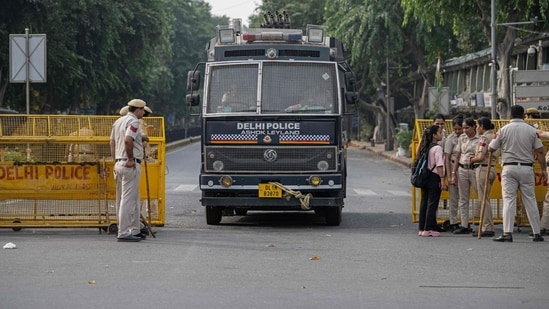
Security personnel detained roughly 7,000 people on Saturday as authorities shut 45 metro stations, cancelled many long-distance trains and suspended internet services near Jantar Mantar. Police indiscriminately detained people across Delhi, many of them mere bystanders, pedestrians and journalists, laid spike strips on arterial roads, erected thousands of yellow barricades that choked traffic, and put up loudspeakers that blared prerecorded police warnings against unlawful gatherings.
Protesters complained they were brutalised by the police and right-wing groups who ran amok in the presence of security forces. Visuals showed many young people being dragged through the streets.
Shweta Singh, a student from IIMC, said, “It’s very scary here. We are not allowed to even enter Jantar Mantar or CP outer circle also. We have been trying since morning. Why can’t we protest? Isn’t it our right?”
Also read: Jantar Mantar in Lutyens’ Delhi de-notified as protest site; 3 new venues named
Boat Club restrictions paved way for Jantar Mantar
The controversial order brings an end to the iconic status of Jantar Mantar, which took over as Delhi’s protest hub after large gatherings once filling the stretch between the Boat Club and India Gate were banned in the 1980s.
In October 1988, farmer leader Mahendra Singh Tikait led a massive gathering of farmers at the Boat Club lawns. Thousands of farmers, accompanied by their cattle, occupied the area for days, putting pressure on the then Rajiv Gandhi government to address their demands.
The agitation brought the issue of who could protest, and where, into sharper focus. The scale of the gathering, its proximity to key government establishments and concerns over security and public order prompted authorities to reconsider the use of the Boat Club as a protest venue. Restrictions on demonstrations followed, and by 1993, Jantar Mantar emerged as an alternative site.
But the growing number of demonstrations also brought complaints from residents over noise, garbage, temporary structures and protesters camping at the site for prolonged periods. On October 5, 2017, the NGT ordered a ban on protests at Jantar Mantar and directed authorities to shift demonstrators to Ramlila Maidan.
Resident complaints led to renewed restrictions
Residents also complained that protesters put up tents and other structures for months or years. The order directed the Delhi government, New Delhi Municipal Council and Delhi police commissioner to stop dharnas, protests, public speeches and loudspeaker use on Jantar Mantar Road. It also ordered the removal of temporary structures and waste, and directed that protesters be shifted to Ramlila Maidan.
The matter reached the Supreme Court, which set aside the blanket prohibition in July 2018. The court said a complete ban was not the solution and called for guidelines to regulate demonstrations while balancing citizens’ right to protest with residents’ right to live peacefully.
It suggested measures such as restricting the number of participants, earmarking specific areas for demonstrations, regulating the use of loudspeakers and preventing prolonged encampments. The judgment said authorities needed to regulate protests so that demonstrators could exercise their rights without causing unnecessary hardship to residents.
The standing order issued by the Delhi police commissioner also mentioned, “This is in partial modification of earlier Standing Order No. L&O/48/22 dated 28.04.2022”.
Also read: Jantar Mantar too central to protest? World has many, from Hyde Park to Union Square
The 2022 order, seen by HT and issued by former commissioner Rakesh Asthana, established strict regulatory guidelines for organising protests and public gatherings around “Jantar Mantar, the Boat Club, and the broader Central Vista area”. The order was framed in response to directions from the Supreme Court of India and NGT.
The order stated that for protests at Jantar Mantar, gatherings were capped at a maximum of 1,000 participants, while larger assemblies must relocate to Ramlila Maidan. Organisers were required to submit a written application at least 10 days in advance. Demonstrations were restricted to a single day between 10am and 5pm, and protesters were strictly barred from marching towards or from the spot, setting up temporary structures or tents, cooking, burning effigies, or damaging public property. The order placed clear restrictions on the use of loudspeakers and vehicular movement.
A senior police officer said that the new guidelines for the other protest sites were likely to be similar. “There will probably be changes made to the nomenclature and names of the sites,” he said.