
 E-Paper



What NDA seat-sharing between JDU, BJP in Bihar shows about Nitish Kumar's party
BJP and JDU have decided to contest 101 seats each, of the 243 assembly segments in Bihar, with remaining going to other partners; that's a climbdown for both

 Prefer HTon Google


The JDU and BJP are finally equal partners in Bihar for the 2025 state assembly election, thanks largely to their strike rates going in opposite directions — the BJP's rising, and the JDU's dropping sharply — over the past few elections.
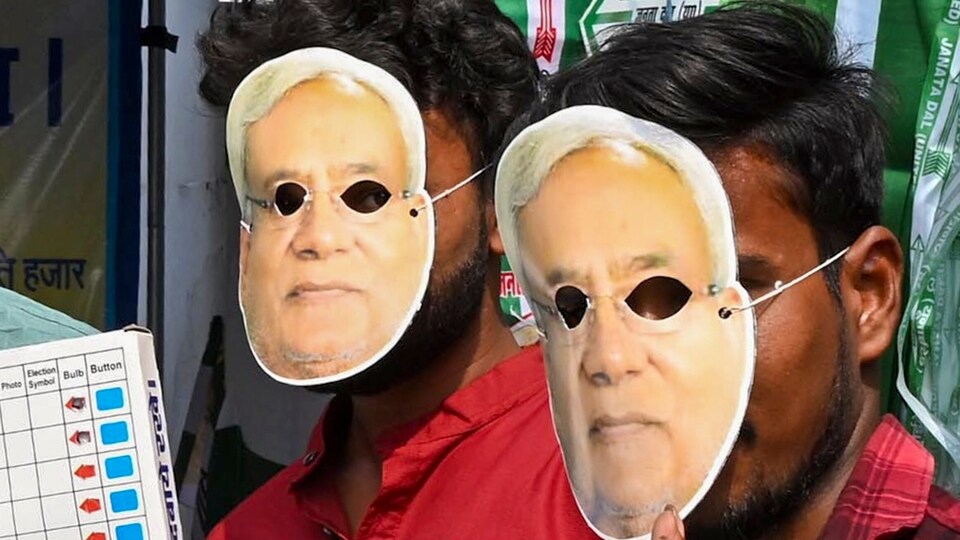
This time, they have decided to contest 101 seats each, of the 243 assembly segments in Bihar, with the remaining going to other partners. That's a climbdown for both, JDU from 115 and BJP from 110. Chirag Paswan's LJP(RV) with 29 seats is a factor that also impacted the math.
But equal numbers for the JDU and BJP mean more than mere math.
Nitish Kumar has been CM for two decades, but his strength has not translated for the JDU that he leads.
In the 2020 Bihar assembly election, the BJP contested 110 seats, and won 74. That's a strike rate of 68%. The JDU's was below 38%.
For the BJP, this meant a revival from 2015, when Nitish-led JDU had gone with old friend Lalu Yadav's RJD and the Congress to give Narendra Modi his first defeat after he came to power at the Centre in 2014.
In that election in 2015, the BJP won about 34% of the 157 seats it contested in a losing effort overall for a diminished NDA.
The JDU, as part of the Mahagathbandhan in 2015, won 71 seats out of the 101 seats it contested — a win rate of 70% — while the alliance won 178 seats out the 243 seats in the assembly.
Nitish Kumar returned to the BJP fold midway, and they contested the 2020 election together.
In the 2020 election, the JDU's vote share in the segments it contested dropped below 33%, from the 41% in 2015. The seat win rate also fell to below 38%, barely half of the 2015 performance, as a MoneyControl analysis noted.
We can cut out 2015 as an anomaly in the NDA journey as the JDU and BJP were in different camps.
A more direct, intra-NDA comparison would be thus: between 2010, when the JDU was the much senior partner, and 2020, when its strike rate plummeted.
In 2010, Nitish Kumar's JDU won 115 of the 141 seats it contested, which meant an 82% strike rate. The BJP was ahead in that sense too, winning 91 of the 102 seats it contested — an 89% winning rate.
By the time 2020 came, as stated earlier, the BJP won 74 of 110 seats, meaning 68%, while the JDU was below 38% with 43 of 115 seats it contested.
Nitish Kumar remained the CM as PM Modi and BJP respected his seniority — and of course keeping in view his openness to switching sides — but the Saffron Party appointed two deputy CMs.
This time, there is talk that Nitish may eventually make way for someone else, maybe even younger, from the BJP. But that's if the NDA wins. And then too the strike rate may or may not matter — as was evident in 2020. For now, the seat division clearly shows the JDU is no longer the dominant partner.


