E-Paper



July likely to be drier, hotter than normal: IMD’s grim forecast
IMD has warned of above-normal temperatures for large swathes of the country, in what is expected to further stress crops during India’s peak sowing period.

 Prefer HTon Google


July this year will be drier than usual, with rainfall across the country expected to be 94% of the long-period average (LPA), the India Meteorological Department (IMD) said on Tuesday, bucking hopes of any major relief after a bruising June that was the fifth-driest in 125 years.
The agency also warned of above-normal temperatures for large swathes of the country, in what is expected to further stress crops during India’s peak sowing period. More than half of India’s kharif-cultivated area is entirely rain-fed, and sowing has already been delayed in several states, according to government data.
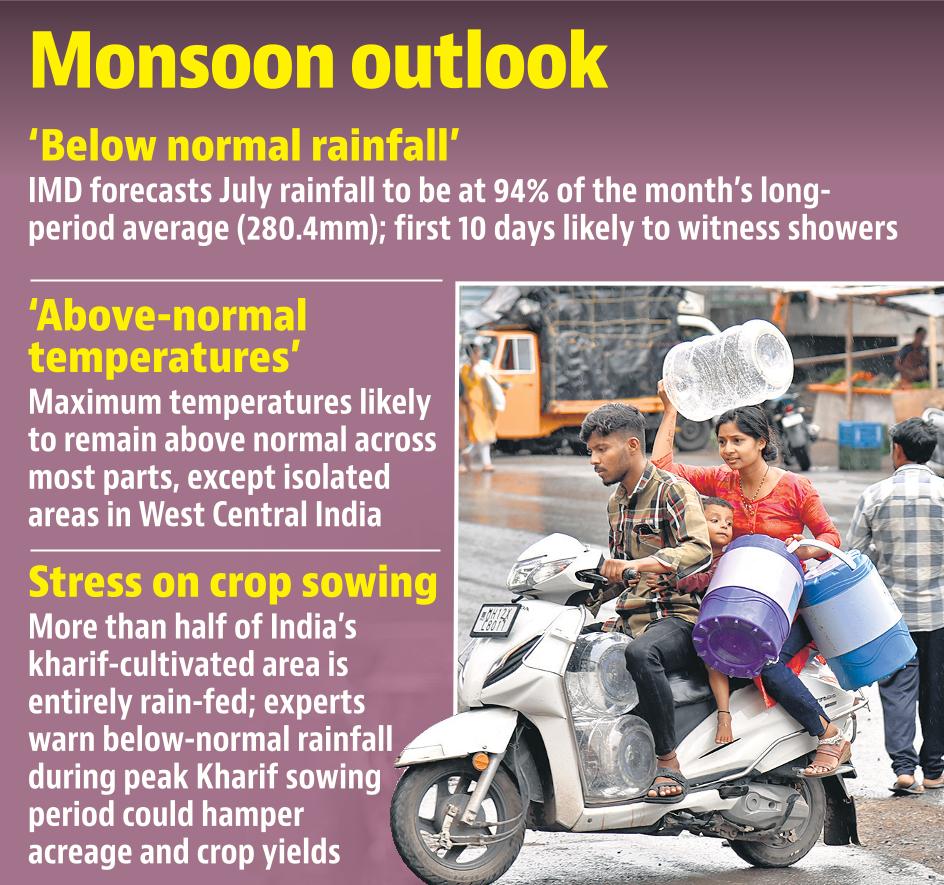
“Below-normal rainfall is likely across most parts of the country except some areas of northwest and northeast India, east-central India and the eastern peninsular region, where normal to above-normal rainfall is likely,” IMD director general Mrutyunjay Mohapatra said in a statement. The agency did, however, predict rain across the country in the first seven to 10 days of the month.
Also Read: Number of ‘dangerous humid heat days’ on the rise: Study
Historically, July is India’s wettest month, accounting for 280.4mm of rain, or 32% of the overall monsoon rain of 870mm, according to IMD’s 1971-2020 LPA, or long-period average. June usually receives 165.3mm of rain, or 19% of the monsoon LPA. However, India logged just 99.5mm of rain, 40% less than the LPA, making it the fifth-driest June since 1901 and the driest since 2014 (92.8mm). The driest June on record was 2009, with just 87.6mm of rain.
IMD pinned the June shortfall on a clutch of adverse factors: the absence of low-pressure systems that draw in rain; the emergence of the rain-crimping El Nino along the central and eastern tropical Pacific Ocean; an unfavourable phase of the Madden-Julian Oscillation (MJO), which is a moving system of wind, cloud, and pressure that brings rain as it circles the equator; and a neutral Indian Ocean Dipole (IOD), which is the difference in temperatures between the western and eastern Indian Ocean. A positive IOD, when the western Indian Ocean is warmer, feeds monsoon clouds with rain.
“We normally see two to three low-pressure areas developing in June, but did not see a single one this June. We also had El Nino conditions and neutral IOD, which could not counteract the El Nino,” said Mohapatra.
Also Read: Monsoon delay, competition may hit urad farming
There was above-normal rain across the country on just one day last month – June 5, he said.
“We are expecting the monsoon to advance further and likely touch Delhi by Thursday or Friday. We also expect rain across the country in the first week of July, possibly the first 10 days,” he said, adding that a low-pressure area had developed over the Bay of Bengal that would give the monsoon some long-overdue impetus.
The drier June has meant sowing has been down by about 23% in the country, with total acreage at 18.272 million hectares as of June 25 compared to 23.646 million hectares a year earlier, data shared by the agriculture ministry showed.
Agriculture experts warned that below-normal rainfall during the peak sowing period could hamper acreage and yields of pulses, oilseeds and coarse grains, even though the forecast for the first week of July may provide temporary relief.
“Central and northwest India are expected to receive rainfall around 20% below normal. These are major growing regions for pulses and oilseeds,” said Deepak Pareek, founder and chief economist at HnyB, an agriculture research and advisory company tracking the global farm economy. Pareek said soybean and tur are among the crops facing the greatest risk if rainfall remains uneven through the month. “Farmers who have already sown might end up facing challenges with sprouting. If there are no good instances of rain in farms in the second half of July, there could be challenges with yields,” he said.
“Kharif production shortfall is imminent if monsoons are deficient,” said Ajay Jakhar, chairman of the Bharat Krishak Samaj.
In its June outlook, IMD revised its seasonal rainfall forecast downward — from 92% of the long-period average issued in April to 90% — and attached a 60% probability to a deficient season, meaning there is a better-than-even chance that total rainfall falls below the threshold that even qualifies as below-normal.
If that prediction bears out, this would mark the lowest monsoon season rainfall in 11 years. The forecast carries a model error of plus or minus 4%.
June was also hotter than usual. The monthly average maximum temperature last month was 35.67°C – 1.06 degrees Celsius above normal, making it the 15th hottest June on record. Forecasts show the maximum is expected to be above normal in most parts of the country in July, barring isolated pockets in west-central India. The minimum temperature too will be above normal in most parts of the country, save for pockets in central and north-east India.