
 E-Paper



Kalkaji temple mishap is the latest in a series of deathtraps for pilgrims
The collapse of an elevated platform at a religious congregation in Delhi on Sunday represents a larger and deeper malaise.

 Prefer HTon Google


Durga Dutt, a resident of south Delhi’s Tughlaqabad, will remember Sunday, January 28, with a shudder, which should not have been the case when he decided to go to the famed Kalkaji temple for a religious congregation.
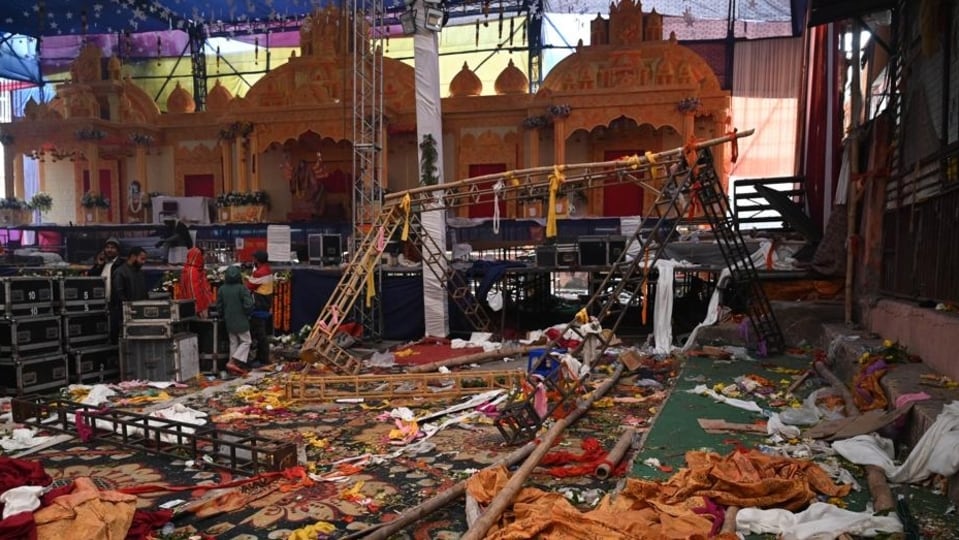
The pravachan (sermon) by a local preacher was in full swing, the devotees swaying under his spell, when the elevated platform where the function was being held, came down with a godawful crash.
"The music stopped suddenly, and people began to run helter-skelter. Everyone was yelling. Later we saw the stage had come down. I was lucky to survive,” Dutt recalls.
While this relatively minor mishap claimed a single life with over a dozen injured, the state of infrastructure at religious places and facilities offered in India is becoming increasingly precarious. Hundreds - if not thousands - die at holy places every year and if the numbers are not higher, it’s got to be some divine intervention.
Also read: 1 killed, 17 hurt as stage set at Kalkaji temple collapses
While the big temples are well managed and organized enough to take in large crowds, they are, but just a few at the top. The country’s religious map is dotted with shrines, places of worship and holy pilgrimages in their millions. And the conditions of many of them are lamentable, to say the least.
Consider the following:
- In April 2023, 36 persons died when roof slabs fell on worshippers who had collected for Ram Navmi prayers at the Jhulelal temple in Indore. An inquiry established that construction in the premises were unauthorised and no permissions of any kind had been sought.
- In October 2022, 140-plus Chhath and Diwali revellers were killed in Morbi, Gujarat, when the hanging bridge collapsed
- In 2022, 40 people went missing after a cloudburst near the holy Amarnath cave shrine in Jammu and Kashmir.
- Six months later, over two dozen pilgrims died in Vaishno Devi and many others went AWOL
- In July 2015, 27 pilgrims died in a stampede on the banks of the Godavari where devotees had gathered on the opening day of 'Pushkaram' festival in Andhra Pradesh's Rajahmundry district
- In October 2014, 32 people perished in a stampede at Patna's Gandhi Maidan, shortly after the conclusion of Dussehra celebrations.
- In October 2013, 115 died and over 100 were injured in a stampede during Navratri festivities near Ratangarh temple in Madhya Pradesh's Datia district.
- In June 2013, more than 100 pilgrims were washed away in Uttarakhand's flash floods while 63 were killed in a sudden rush at the Ram Janki Temple of Kripalu Maharaj in UP's Pratapgarh district in March 2010 as people gathered to collect free clothes and food from the self-styled godman.
- Bihar recorded the highest number of road accidents near religious places in 2022, 2,995 lives, according to the National Crime Records Bureau (NCRB).
Multiple cases of stampedes
The list is endless and in many remote places, minor accidents and small casualties go unreported. In 2013, a study published in the International Journal of Disaster Risk Reduction, an affiliate of the Davos-based Global Risk Forum, came up with some startling conclusions. It said that religious gatherings and pilgrimages account for 79 per cent of all stampedes in India.
"Religious festivals, especially when located in remote rural areas and on hilly terrains, and on the foothills or at riverbanks lacking proper pathways always pose a geographical risk to the pilgrims. Steep slopes, uneven topography of the venue, dead ends, slippery and muddy floors, narrow passages, convergence of pedestrian flow to a single point are among the common risks prevailing in religious gathering sites, compromising safety...," noted the study.
Wrote Bharat Dogra, Honorary Convener, Campaign to Save Earth Now, in an essay: The possibility of such tragedies can be reduced significantly by careful planning and administrative measures implemented with the cooperation of local people and pilgrims. The specific places as well as times when there is greater chance of a stampede or accident should be identified carefully...People can be asked to assemble at a bigger open space and then smaller numbers who can be safely accommodated in more cramped places can be summoned in phases. The movement of people should be in one direction while those coming back should have a different route.”
The importance of crowd management
Experts also point to a feature almost unique to India: crowds tend to grow too large, and too fast, too soon.
The Kalkaji temple mishap, has a similar tale. The congregation, an annual affair, generally is designed to accommodate 2,000 or so people. Suddenly, the numbers had swelled to 15,000-20,000 believers on a Sunday. A Delhi Fire Service officer was quoted as saying that a no-objection certificate (NOC) was not needed for a small gathering on trust property. But what happens when the numbers increase dramatically? Noone can say for sure.
In a country, which gave birth to three of the six major world religions - Hinduism, Buddhism and Sikhism - and is home to Islam and Christianity that took early roots in India, in addition to smaller religions like Zoroastrianism, Bahai, Jain and Jewish faiths, the immediacy of pilgrimages can scarcely be underestimated. For the moment though, that is not on anyone’s priority list.
Ranjit Bhushan is a senior journalist.


