
 E-Paper



KC Venugopal leads Kerala CM race: For Rahul's main man in Delhi, it may be time to head home
Kozhummal Chattadi Venugopal, born on February 4, 1963 in Payyanur, Kannur district of Kerala, came to politics through the student wing of the INC.

 Prefer HTon Google


It was KC Venugopal who formally announced it in June 2024 that Rahul Gandhi was chosen to be the Leader of Opposition in the Lok Sabha.
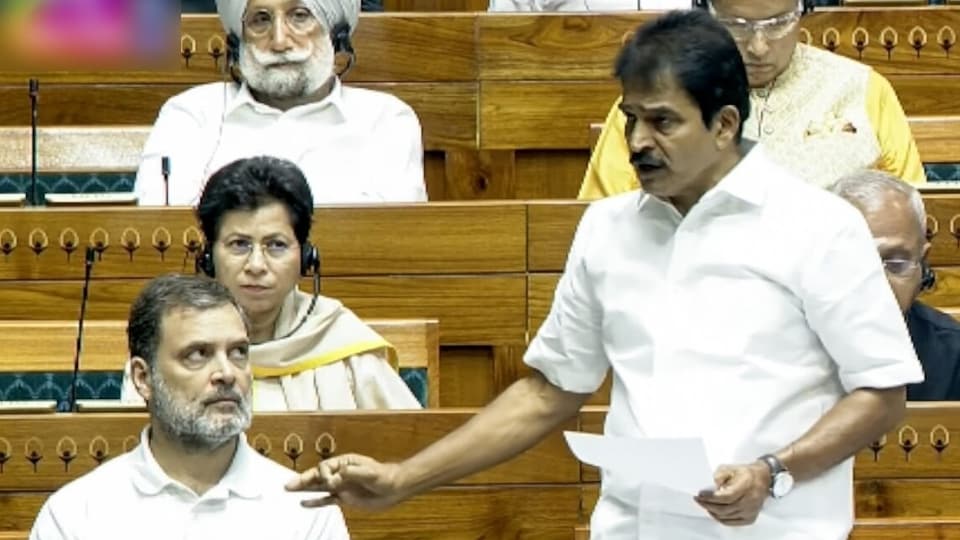
After the Congress secured 99 Lok Sabha seats in the general elections — its best result in a decade, and enough to cross the 10% threshold required to claim the post of Leader of Opposition — that was Venugopal's duty as the All Indian Congress Committee's (AICC) General Secretary (Organisation).
Now it is up to Rahul to decide if Venugopal, widely considered among his closest aides, heads home to Thiruvananthapuram as Kerala's next chief minister.
Career from state to Delhi
Kozhummal Chattadi Venugopal, born on February 4, 1963, in Payyanur, Kannur district of Kerala, came to politics through the student wing of the Indian National Congress.
Now 63, his political career began in the Kerala assembly, where he won from Alappuzha in 1996, 2001 and 2006. Under CM Oommen Chandy, he served as the state's minister for tourism.
After nearly two decades in the state, he went national after winning the Alappuzha Lok Sabha seat in 2009 and 2014. That was the height of Congress era in recent decades. Venugopal remained a junior minister in the UPA-2 government under Manmohan Singh.
He was nominated to the Rajya Sabha from Rajasthan in June 2020 — having not contested in 2019 — and in 2024 returned to the Lok Sabha contest, winning Alappuzha by a wide margin again.
Heft within organisation
It was in April 2017 that he was appointed a general secretary of the AICC, and was subsequently given additional charge as GS (Organisation). That means responsibility, or a major say, in candidate selection, party discipline, membership drives and alliance management.
In the 2026 Kerala campaign, he played a state-level role to, with news agency PTI citing sources to say Venugopal helped bring disgruntled CPI(M) leaders of the then-ruling LDF into the Congress-led UDF fold.
In the 18th Lok Sabha, Congress has Gaurav Gogoi as deputy leader and K Suresh as chief whip, and Venugopal had announced these appointments on social media as per party protocol.
Major role in Lok Sabha
In Parliament, Venugopal sits to Rahul Gandhi's immediate left on the Opposition benches. That proximity has translated into a consistent pattern of formal interventions on Gandhi's behalf across recent sessions.
In June 2024, when Gandhi's microphone was allegedly switched off as he tried to raise the NEET paper leak issue, Venugopal filed an adjournment motion in Lok Sabha demanding a discussion on the paper leaks in NEET-UG (medical entrance) and UGC-NET (teaching eligibility) tests, and the failure of the National Testing Agency (NTA). In December 2024, when Gandhi was stopped from travelling to violence-hit Sambhal in UP, Venugopal filed an adjournment motion.
A more recent parliamentary intervention came in April 2026, after the government's Constitution (131st Amendment) Bill 2026 was defeated in the Lok Sabha and Prime Minister Modi addressed the nation criticising the opposition. The bill was about delimitation — increasing Lok Sabha seats and thus redrawing constituency maps — to immediately implement 33% women's quota, but the Opposition wanted the quota without such delimitation being a prerequisite.
When PM Modi later lambasted the Congress and others in an Address to the Nation, Venugopal filed a breach of privilege notice against him, calling the address “unprecedented, unethical and blatant abuse of power”.
Where he stands against rivals
On the Kerala race itself, Venugopal has been measured. At a joint press conference on May 9 with other contenders VD Satheesan and Ramesh Chennithala — all three having just met the high command — he appealed for calm among party workers.
"Some unfortunate incidents take place in between. We would like to put all those behind. All of us are party workers and our foremost priority is the party and the people," he said, referring to flex boards being put up and rallies being held by competing factions.
The numbers behind him are considerable. After AICC observers Mukul Wasnik and Ajay Maken completed one-on-one meetings with all 63 Congress MLAs and submitted their findings to party president Mallikarjun Kharge, Venugopal emerged with majority support within the legislature party, multiple reports said.
At Rahul Gandhi's consultations with senior Kerala leaders on Tuesday, he secured the backing of seven of the 10 leaders present, HT has reported. Rival Satheesan got two; one stayed neutral. Chennithala, for his part, has already told reporters: "We have conveyed whatever we had to say to the high command. The rest is for them to decide."
Satheesan is a lawyer and six-time MLA, having won continuously from Paravur in Ernakulam district since 2001. He succeeded Ramesh Chennithala as Leader of the Opposition in the Kerala assembly following the 2021 election defeat of the UDF, and spent five years as the most visible face of the UDF's challenge to the Pinarayi Vijayan government.
Before the 2026 campaign, he publicly staked his political career on the outcome, saying: "If the UDF fails, I will retire from politics the very next day and go into exile." He did not have to. His claim to chief ministership rested not just on that personal mandate but on the backing of the IUML, whose 22 legislators make it the second-largest partner in the UDF.
Ramesh Chennithala, who holds the record of being the youngest minister in Kerala's history, has served as KPCC president, Leader of the Opposition, and home minister.
For Venugopal, if chosen by Rahul, party chief Mallikarjun Kharge and the others in the leadership, a key logistical fact remains. He did not contest the 2026 Kerala assembly elections. If appointed CM, he would need to win a bypoll within six months of taking office. But that's just logistics.
The deadline for government formation is May 23.


