
 E-Paper



Kejriwal, under arrest
Kejriwal is the third major AAP leader to be arrested in the probe after his former deputy and senior AAP leader Manish Sisodia as well as the party’s Rajya Sabha MP Sanjay Singh

 Prefer HTon Google


New Delhi The Enforcement Directorate (ED) on Thursday night arrested Delhi chief minister Arvind Kejriwal for his alleged role in the state’s controversial 2021-22 excise policy after questioning him at his residence, hours after the city’s high court turned down his plea for interim protection from arrest — a stunning turn of events that leaves the Capital’s politics in turmoil and pushes to new heights the ongoing conflict between the Union government and the Aam Aadmi Party (AAP) weeks before the general elections
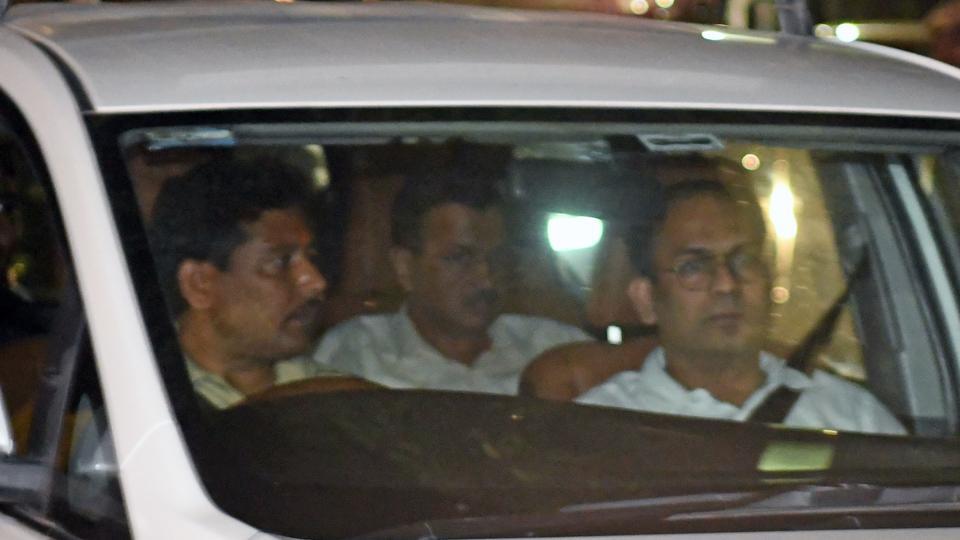
The arrest on corruption charges marks a dramatic moment for a leader who surged to power after platforming himself as an anti-corruption crusader and shook up the Capital’s entrenched political structures.
“He will continue as the chief minister of Delhi. If need be, he will run the government from jail. There is no rule that stops him from running the government from jail,” Atishi said outside Kejriwal’s residence. The party has claimed that a survey it conducted of Delhi’s citizens said he should continue. The AAP has been preparing for his arrest for months, and warned of its imminence several times.
ED officials aware of the matter said he was evasive during interrogations and pointed out that he had skipped all nine summons the agency had issued.
“He has been arrested under Section 19 of the Prevention of Money Laundering Act (PMLA), because there is evidence he was involved in the formulation and implementation of the policy, in which AAP leaders were paid kickbacks of ₹100 crore. He has repeatedly dishonoured summons sent by us. When we went to question him, he was evasive,” said an ED officer who asked not to be named.
ED has not referred to Kejriwal as a suspect in any of its six charge sheets in the liquor policy case. However, one of the charge sheets mentions that the policy was Kejriwal’s “brainchild”.
The Bharatiya Janata Party (BJP), meanwhile, demanded that Kejriwal resign as chief minister.
The arrest is a blow for the AAP, which has built its politics on a fine balance of delivering welfare programmes, providing concessions for various demographic groups and shoring up the Capital’s basic infrastructure.
Kejriwal is the third major AAP leader to be arrested in the probe after his former deputy and senior AAP leader Manish Sisodia as well as the party’s Rajya Sabha MP Sanjay Singh. This apart, ED arrested Bharat Rashtra Samithi leader and Telangana lawmaker K Kavitha in the case last week.
Major drama played out in Civil Lines as a 10-member ED team accompanied by several Delhi Police contingents swooped down on the chief minister’s official residence on Flagstaff Road around 7pm. As police teams set up barricades around the house, top AAP leaders and dozens of party workers swarmed the narrow lane outside in a last bid to keep the chief minister from being taken in.
Rapid Action Force (RAF) personnel and additional companies of central forces were also called in, even as Section 144 was imposed.
After his arrest, Kejriwal was taken to the ED headquarters at APJ Abdul Kalam Road, where he will be kept in custody overnight and questioned by the probe team.
He will be produced before the special court at Rouse Avenue on Friday where ED will seek his custody.
His arrest came hours after the Delhi high court turned down his plea to protect him from arrest.
“After hearing both the parties, we are not inclined to grant the relief at this stage,” a bench of justice Suresh Kumar Kait and justice Manoj Jain said in the order. The court also asked Kejriwal why he had not approached the lower court seeking anticipatory bail if he was apprehending arrest.
Kejriwal has skipped summonses on the grounds that they are “illegal”, and because ED has not specified in which capacity he is being called in — as an accused or witness, as Delhi CM or as national convener of the Aam Aadmi Party.
“Until and unless you attend any of the calls, how would you know what information they want? The summons started from the month of October. If you had apprehension that if you attend their call ... then why did you not challenge? What prevented you to not go to the court below from filing an anticipatory bail?” the bench asked senior advocate Abhishek Manu Singhvi, who represented Kejriwal.
The court asked the probe agency what prevented it from arresting the minister. “What prevented you not to arrest? You are sending him summons after summons,” the bench asked additional solicitor general SV Raju, who represented ED. Raju also clarified to the court that Kejriwal was being summoned in his individual capacity in the case.
But the series of events that culminated in Kejriwal’s arrest on Thursday evening germinated nearly three years ago, when then deputy chief minister Sisodia launched the Delhi excise policy — a regime that was meant to revolutionise the city’s liquor business.
It aimed to revitalise the city’s flagging liquor business by replacing a sales-volume based regime with a licence fee one for traders, and promised swankier stores and a better customer experience. The policy also offered customers discounts on liquor for the first time, ever.
It, however, came to an abrupt end after Delhi’s lieutenant governor VK Saxena recommended a probe into alleged irregularities in the regime in July 2022. This resulted in the policy being scrapped and being replaced by the previous policy.
While not named as an accused in the case yet, Kejriwal’s name has found mention in court documents, including charge sheets and remand papers, in reference to alleged meetings, fixing commissions for private players, and the entry of political players and businesspeople from the south into Delhi’s liquor business.
The first major arrest in the case was Sisodia’s, in February last year, in what was the first sign that the excise policy was beginning to embroil the AAP. Singh was arrested months later, on October 4.
ED has claimed in past court documents, including charge sheets, that the decision to carve out a 12% profit margin for wholesale private entities in the excise policy was taken at Kejriwal’s residence in March 2021.
Thursday leaves the AAP in a moment of reckoning. Delhi voted overwhelmingly for the AAP in two straight elections, giving it 67 seats in the 70-member assembly in 2015 and 62 in 2019. The AAP also garnered upwards of 50% of the vote share both times.
But the party has fared poorly in the Lok Sabha elections, winning no seats both in 2014 and 2019. Delhi goes to polls in 2025.
Kejriwal was first anointed Delhi chief minister in December 2013, when he dislodged three-term CM and formidable Congress leader Sheila Dikshit. That year, he beat Dikshit from her bastion from – New Delhi.
He rose to the echelons of Delhi’s local politics as an angry disruptor and a leader of the India Against Corruption (IAC) movement, aiming his anger at the Congress and the alleged corruption in the system.
Still, he allied with the Congress the 2013 polls, after the Bharatiya Janata Party, which fell short of a majority with just 32 seats, refused to form a government. The AAP won 28 and the Congress was relegated to a distant third with just eight, a pale shadow of its former self.
Yet, Kejriwal snapped those ties in dramatic circumstances just 49 days later, arguing that he was unable to deliver in a coalition government.
Just over 14 months later, Kejriwal stormed back to power, leaving the BJP with just three seats in the assembly and the Congress zero.
Opposition parties and the AAP’s partners in the INDIA grouping condemned the arrest.
Congress leader Rahul Gandhi in a post on X said: “A scared dictator wants to create a dead democracy… While capturing all the institutions including the media, breaking up the parties, extorting money from companies, freezing the account of the main opposition party was not enough for the ‘devilish power’, now the arrest of the elected Chief Ministers has also become a common thing.”
Tamil Nadu chief minister MK Stalin said the BJP had “sunk to despicable depths”.
“Ahead of #Elections2024, driven by fear of a decade of failures and the imminent defeat, the Fascist BJP Govt sinks to despicable depths by arresting Hon’ble Delhi CM @ArvindKejriwal, following the unjust targeting of brother @HemantSorenJMM,” Stalin said in a post on X.


