
 E-Paper



'This is an insult': Kharge vs Shah after Priyanka's jibes at PM Modi over Bengal polls, debating Nehru's legacy
Home minister Amit Shah attacks Congress leaders for “questioning” need for a “debate” on national song; Kharge says “ploy to attack Nehru”

 Prefer HTon Google


Union home minister Amit Shah on Tuesday sought to rebut the charge that a discussion on the national song Vande Mataram in Parliament was called by the BJP-led NDA for political benefit in the upcoming West Bengal election. In his speech in the Rajya Sabha, he was reacting apparently to Congress leader Priyanka Gandhi Vadra's charge in the Lok Sabha on Monday.
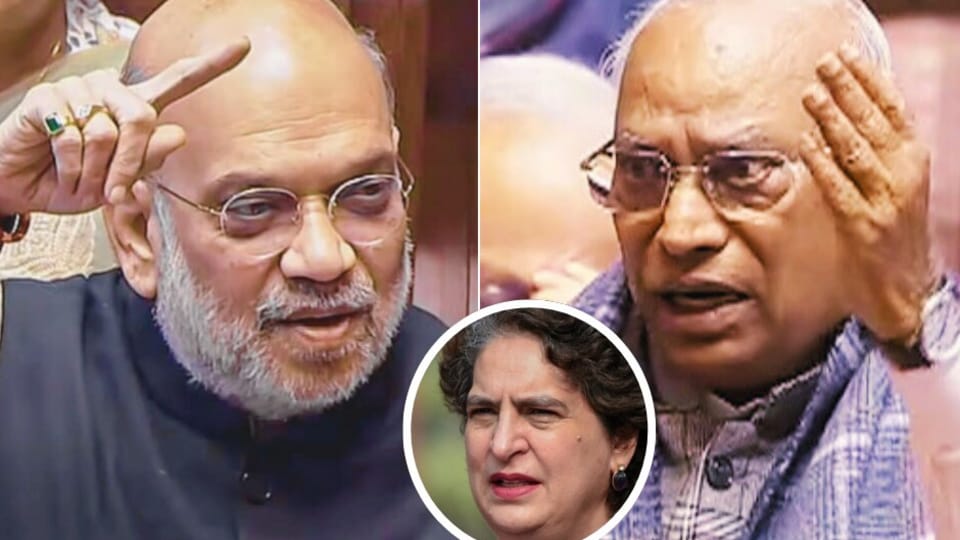
“Those linking the Vande Mataram discussion to the Bengal polls must reconsider their understanding,” Amit Shah remarked.
Priyanka Gandhi had said holding a “debate” on the national song — focused on why only two stanzas of the original poem were adopted — was “an insult” to freedom fighters and makers of the Constitution who had made the decision.
Follow | Live updates from Parliament winter session 2025
Congress president Mallikarjun Kharge spoke after Shah and backed Priyanka Gandhi's contentions made a day before. He said the discussion on Vande Mataram was being held “to deflect attention from the problems country is facing”.
“PM Modi and Amit Shah leave no chance to insult Jawaharlal Nehru, and other Congress leaders,” Kharge, Leader of Opposition in the Rajya Sabha, added.
“But that is only natural,” he quipped, “Wherever PM goes, Amit Shah follows!”
What Amit Shah said on Priyanka's charge
Initiating the discussion in the Upper House of Parliament, Shah said Vande Mataram was the "mantra" that awakened India's cultural nationalism".
He attacked Congress leaders in general — not naming Priyanka — for “questioning” the need for a debate on Vande Mataram.
"Some people believe that because there are elections in Bengal, this discussion is being held. They want to link the glorification of Vande Mataram with the West Bengal elections. This is unfortunate," Shah said.
He then accused India's first prime minister Jawaharlal Nehru of "dividing" the poem and limiting it to two stanzas in 1937. Shah called it the “beginning of appeasement politics”, and said it “led to partition of India”.
He noted that the song was written by Bankim Chandra Chattopadhyay (also spelt Chatterjee) in Bengal, “but it spread across the nation, and became the chant for India's freedom struggle”.
The home minister also said the song was written years after India tolerated "Islamic attacks", and the British tried to impose a “new culture” on the country. “The song reestablished the culture of seeing the nation as a mother,” he added.
He apparently reacted to Priyanka Gandhi's suggestion that her great-grandfather Nehru's legacy be discussed “once and for all” since PM Modi “repeatedly insults" him. “We are ready to discuss anything and everything in the House,” Shah said, not specifying.
What's the row over stanzas, Bengal?
Mallikarjun Kharge replied to this, but it's important to understand here what the controversy over “selection of some stanzas” and the connection to Bengal is.
- PM Modi accused the Congress, particularly Nehru, of “bowing” to Muslim League leader and Pakistan proponent Mohammed Ali Jinnah's contention that the song could “irritate" Muslims.
- Only the first two stanzas of the song were adopted, first at a 1937 session of the Congress and later in the Constitution in 1950. These two stanzas refer to mother and motherland at large, while the latter four refer directly to Hindu goddesses by name, invoking strong religious imagery. The contention was that the first two, thus, were more inclusive for a diverse country.
- The song was written by a Bengali, Bankim Chandra Chatterjee, as a poem in Sanskritised Bengali in the 1870s. This "Bande Mataram" — Bengali language or Bangla does not have a 'V' sound — was put to music by Jadunath Bhattacharya, another Bengali.
Kharge's counter charge at Shah
In his speech after Shah, Mallikarjun Kharge cited correspondence among freedom fighters to stress that the decision to use only the first two stanzas as the national song was taken collectively by leaders like Mahatma Gandhi, Rabindranath Tagore, Subhash Chandra Bose, besides Nehru.
“We have always been singing Vande Mataram. But those who did not sing it have also started singing it now. It is the power of Vande Mataram,” Kharge jibed. He alleged that the RSS and Hindu Mahasabha, considered precursors or patron bodies to the BJP, were “serving the British” when Congress members were “going to jail chanting Vande Mataram”.
‘Nehru not alone in making choice’
“I heard the Prime Minister blamed Nehru for stanzas being ‘removed’,” Kharge noted, and explained that the 1937 resolution on the stanzas' selection was passed by the Congress Working Committee, “not by Nehru alone”. Leaders like Mahatma Gandhi, Subhash Chandra Bose, Madan Mohan Malaviya, and Acharya JB Kripalani were present too, he added.
The Congress president then quoted Rabindranath Tagore, who had said he found "no difficulty" in dissociating the first two stanzas of the poem from the rest of the song.
"You are insulting all these tall leaders. It was their combined decision. Why do you target Nehru ji alone?" Kharge said.


