
 E-Paper



How Vande Mataram debate spotlighted Bengal, where assembly election is due soon: PM Modi vs Priyanka, explained
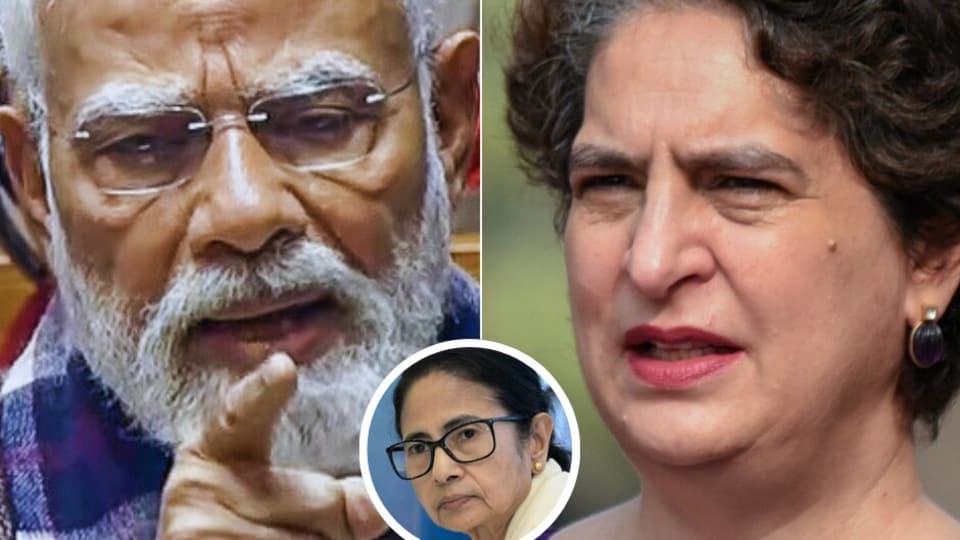
PM Modi enters to “ab Bengal ki baari” chants for discussion on Vande Mataram; Priyanka Gandhi says nothing to “debate” and “govt is eyeing Bengal election”

 Prefer HTon Google


"Bihar ki jeet hamari hai, ab Bengal ki baari hai" — this slogan accompanied chants of "Vande Mataram" by BJP-led NDA members as Prime Minister Narendra Modi entered the Lok Sabha to initiate a discussion to mark the 150th anniversary year of the national song, in New Delhi on Monday.
Follow | Live updates from Parliament
“We have won Bihar, it's now the turn of Bengal,” the slogan meant, pointing towards the West Bengal state assembly election due early next year. That was, of course, not a stated reason why Bengal — the wider region encompassing Bangladesh — remained central to the Vande Mataram discussion.
Congress leader Priyanka Gandhi Vadra, however, pointedly accused the BJP-led NDA government of politicising the national song "with an eye on the election in Bengal".
Song's Bengali origins: The song was written by a Bengali, Bankim Chandra Chatterjee, as a poem in Sanskritised Bengali in a literary tradition of the 1870s. This "Bande Mataram" — Bengali language or Bangla does not have a 'V' sound — of six stanzas was later composed to music by Jadunath Bhattacharya, another Bengali. It became more famous after it was published in the 1880s as part of Chatterjee's Bengali novel ‘Anand Math’.
‘Division of Bengal, Vande Mataram, India’: PM Modi on partitions
Prime Minister Modi, opening the discussion, recalled the British colonial regime's divide-and-rule politics and said, “When they divided Bengal in 1905, Vande Mataram stood like a rock.”
“They (British regime) used Bengal as their laboratory. Even they knew that Bengal's intellectual capability gave direction, strength, and inspiration to the country. They knew Bengal's capabilities were the focal point of the country. This is why they divided Bengal,” he said.
“They believed that if Bengal was divided, the country would be divided too," he argued.
What's the row over stanzas?
On Vande Mataram not being adopted in full as the national song, PM Modi accused the Congress, particularly Jawaharlal Nehru, of “bowing” to Muslim League leader Mohammed Ali Jinnah's contention that the song could “irritate" Muslims.
Only the first two stanzas of the song are adopted, starting with a 1937 session of the Congress and later the Constitution adopted in 1950. Unlike the first two stanzas, which refer to mother and motherland at large, the latter four refer directly to Hindu goddesses by name, invoking strong religious imagery.
Modi said the Congress convened a session in “Bankim Chandra Chatterjee's Bengal” to review the use of Vande Mataram — a reference to a Congress Working Committee meeting in Kolkata (then Calcutta) in 1937 on the matter. They “partitioned” Vande Mataram in 1937, Modi said, speaking in Hindi — “tukde kar diye” — and linked the party's “appeasement politics” to "what led to the partition of India in 1947”.
In his tribute to the song, Modi also recalled some slogans in Bengali raised after Vande Mataram was banned by the British regime between 1905 and 1908.
‘Babu, not da’: PM interrupted, changes word
There was hiccup, and a quick recovery, when PM Modi's reference to Bankim Chandra Chatterjee as “Bankim da” — was objected to by a Trinamool Congress MP from West Bengal. “Da” is short for ‘dada’, meaning brother in everyday Bangla.
MP Saugata Roy asked the PM to use the suffix “babu”, instead. It's a word closer to the more respectful “sir”.
Modi responded immediately: "I will say ‘Bankim Babu’. Thank you, I respect your sentiments." Modi then asked if he could still refer to Roy as 'dada'. It was not clear if Roy replied.
What Congress said: ‘He insulted Tagore’
Speaking in the Lok Sabha after the PM completed his speech and left, Congress leader Gaurav Gogoi also referred to Bengal's role in the national struggle. Gogoi said his party ensured that it was not just seen as a political slogan but given the status of national song.
It was in the 1896 Calcutta Session of the Congress that Rabindranath Tagore first sang Vande Mataram, Gogoi noted. "He (Tagore) wrote to Nehru that ‘the privilege of originally setting the first stanza of Vande Mataram to the tune was mine when the author was still alive’," the Congress MP from Assam said.
Priyanka Gandhi Vadra was more direct, saying there was no scope for a “debate” on the national song. The government, she said, “wanted a debate on Vande Mataram because the Bengal polls are coming soon”.
"The government wants us to keep delving in past because it does not want to look at present and future," she added in her speech, in Hindi.
"You (BJP) are for the elections, we are for the country. No matter how many elections we lose, we will sit here and keep fighting you and your ideology. We will keep fighting for our country. You cannot stop us," Priyanka Gandhi said, when taunted by some ruling party MPs about the recent loss in Bihar.
Reacting on X, Congress MP Jairam Ramesh said the PM had “insulted” Rabindranath Tagore, the Bengali literary giant, who is also reported to have agreed that the first two stanzas were more inclusive. Ramesh accused the Hindu Mahasabha and RSS of being pro-partition at the time.
Recalling row over ‘Aamar Sonar Bangla’
This is only the latest in a series of controversies over national songs, or anthems, written in Bangla or by Bengalis. Just weeks ago, after a senior Congress leader in Assam sang “Aamar Sonar Bangla” (My Golden Bengal) written by Rabindranath Tagore, the BJP termed his act “anti-national” because the song is the national anthem of Bangladesh.
But Bengalis on this side of the border, too, were displeased as Tagore wrote both “Aamar Sonar Bangla” and India’s national anthem “Jana Gana Mana”. Students at some universities in West Bengal sang “Aamar Sonar Bangla” in protest.
West Bengal has been a major political project for the BJP, but the ruling TMC of CM Mamata Banerjee has often invoked Bengali cultural pride to label the BJP an “outsider”.
She was asked about the Parliament discussion on Vande Mataram. “Let them have it. I have no objection,” she told reporters, as per news agency PTI. But she accused the BJP of not appreciating freedom fighters, and disliking “Netaji” Subhas Chandra Bose and “Gurudev” Rabindranath Tagore.
2026 West Bengal election soon
Election to the 294-member legislative assembly of West Bengal is due in March-April 2026.
Mamata Banerjee has been in power since 2011 after defeating the Communist government of multiple decades.
The BJP managed to get 77 seats, its highest ever in the state, in the 2021 contest.
PM Modi had expressly listed West Bengal as the “next target” in his speech after the BJP-JD(U) alliance's massive win in Bihar in November. This commitment was on Monday reflected in slogans at his entry to Parliament on Monday.


