
 E-Paper



Krishna was not a “rogue” elephant, Assam forest officials clarify
The elephant had killed five people before it was captured on November 11.


The adult wild elephant which died at a training facility Assam’s Orang National Park on Sunday six days after it was captured was not declared “rogue”, an Assam forest department official said on Monday.
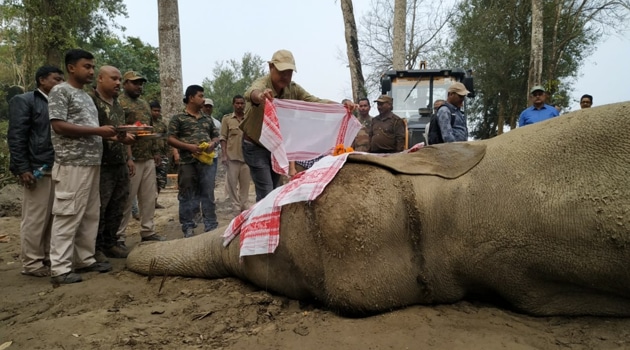
“This elephant was not officially declared rogue. For that to happen you have to bring out a notification with details of the animal. An elephant is declared rogue when you want to eliminate the animal. In this case the intention was only to translocate,” said MK Yadava, Chief Wildlife Warden, Assam. He said once the animal is declared rogue, the forest department has to subsequently issue orders of its hunting, too.
Krishna, as the elephant was named after its capture was brought to training facility at the Orang National Park in the early hours of November 13, a fortnight after Assam chief minister Sarbananda Sonowal on October 29 ordered the “rogue” elephant’s capture within hours of it allegedly killing five people in Matia area of Goalpara district.
While the locals started calling the elephant Laden, as it often happens in Assam with elephants who are known to have killed humans, officials said it was a loner which was in a state of musth that is characterized by highly aggressive behavior and accompanied by a large rise in reproductive hormones. It had also separated from its herd. Forest department officials also said the original elephant named Laden had died in 2018.
Krishna died early Sunday morning after a massive cardiac arrest. “The animal had a bad heart which led to a massive cardiac arrest… The stress that the animal had undergone during its capture and translocation definitely acted as a precipitating cause of its death, not a primary cause,” said KK Sarma, a veterinarian, who led the team which conducted the postmortem.
After the October 29 incident and Sonowal’s stern orders, the forest department had announced a committee to track down the elephant and decide the future course of action as the animal had taken refuge inside Kanyakuchi reserve forest in the neighborhood.
On November 1, the forest department officials with help of a drone were able to locate it. Days later on November 11, forest officials along with ruling Bharatiya Janata Party lawmaker Padma Hazarika, tranquillised and captured Krishna. Sonowal congratulated Hazarika after the elephant’s capture and described the MLA’s feat as highly praiseworthy.
A senior Assam forest department official who was part of the committee to track down the elephant said on condition of anonymity that Krishna the elephant was not a “habitual” killer.
“The five persons who died were all chance encounter deaths not case of a killer elephant deliberately targeting humans. It did not trample anyone,” said this official.
The animal was brought to the training facility at the Orang National Park after locals protested its release in Lumding Reserve Forest.
K K Sarma said at the training facility in Assam only young elephants between the age of four and nine are trained. Krishna, however, was over 35-year-old. The 9 foot 8 inches tall jumbo which weighed around 550 kilograms was a bad candidate to be trained, Sarma said.
“We wanted to release him [Krishna]. But people did not allow us to release it in the forest,” Sarma said on Sunday.
Hazarika, meanwhile, defended elephant’s capture and said on Sunday, “if the elephant was not captured it would have killed more people.”
Human-elephant conflict is common in Assam and has left 761 humans and 249 elephants dead in the state since 2010, according to data tabled in the state assembly in February.
Assam had the highest number of elephants (5,719) after Karnataka (6,049), according to Elephant Census 2017. There were 27, 312 elephants across the country as per the survey.
Assam’s forest cover is under severe pressure according to a study by Indian Institute of Remote Sensing titled Forest Cover Monitoring and Prediction in a Lesser Himalayan Elephant Landscape, published in Current Science in August 2018. It said 9,007.14 square kilometres of forest may face depletion by 2028 in parts of Assam and Arunachal Pradesh.
The study which monitored forest cover depletion in parts of Assam and Arunachal Pradesh over an area of 42,375 square kilometres of elephant landscape showed continuous high loss of forest cover.
“The total loss in forest cover was estimated to be about 7,590 sq km from 1924 to 2009,” the study said.


