
 E-Paper



K’taka weighs Cauvery order amid water stress
Karnataka will review its water availability before deciding whether to comply with an order to release 12,000 cusecs of Cauvery water to Tamil Nadu for 15 days

 Prefer HTon Google


Karnataka will review its water availability before deciding whether to comply with an order to release 12,000 cusecs of Cauvery water to Tamil Nadu for 15 days, chief minister D.K. Shivakumar said on Tuesday.
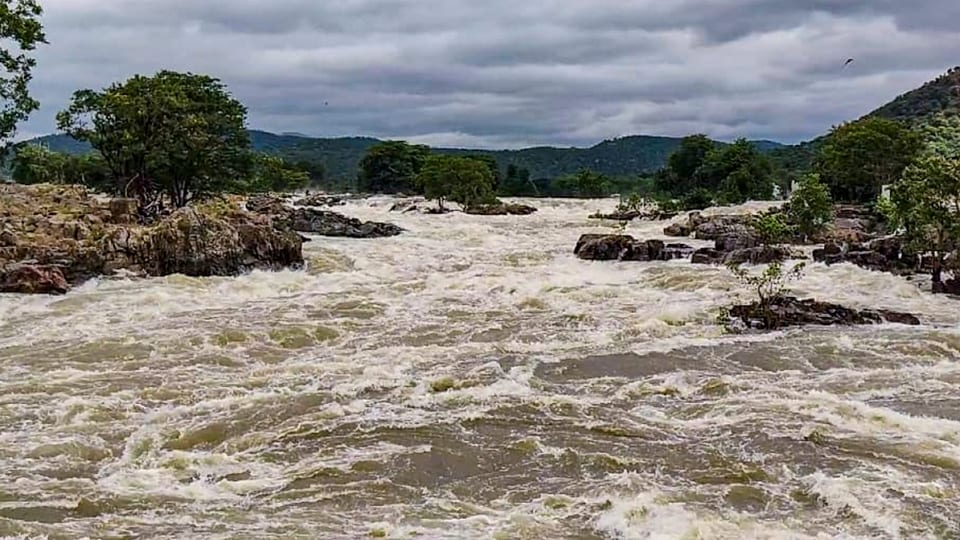
The Cauvery Water Management Authority (CWMA) endorsed the order at its 55th meeting, directing Karnataka to ensure a flow of 12,000 cusecs reaches Biligundlu from 8am on August 12 for 15 days.
It also directed the state to ensure a total of 37 TMC reaches Biligundlu by the end of August, including accumulated backlog and water due between August 13 and August 31. “Further action will be taken regarding the order of the Cauvery Water Control Committee (CWRC) to release 12,000 cusecs of Cauvery water to Tamil Nadu after a thorough review of the state’s water situation,” Shivakumar told reporters at Vidhana Soudha.
He said the government would protect farmers while complying with court orders.
“Our duty is to protect farmers. Farmers’ interests should be protected and court orders should be followed,” Shivakumar said, adding that he had discussed the issue with the irrigation minister. The government was monitoring inflows into the state’s rivers and would consider water availability when deciding what crops could be cultivated, he said.
“The inflow into the state’s rivers is being closely monitored. Local meetings should be held with farmers and crops should be discussed. Decisions should be taken on crop cultivation keeping in mind the water storage in all reservoirs, including not just Cauvery but Tungabhadra and Almatti,” he said.
Karnataka’s position
Karnataka told the CWMA that its four Cauvery reservoirs were under severe hydrological stress and that further releases would affect water available for drinking, essential uses and Kharif agriculture. The reservoirs had received 77.746 TMC, about 47% below the 30-year average, and inflows were declining, the state said. Karnataka also said it had already exceeded the prescribed flow at Biligundlu.
“Karnataka has already ensured 86,942 cusecs at Biligundlu, against the prescribed 52,500 cusecs, with substantial additional flow in transit and further augmentation expected,” the state said. It sought either a postponement of further release decisions or a reduction of the order from 12,000 cusecs to 10,000 cusecs.
“Given deficient monsoon, dwindling inflows and limited storage, Karnataka needs to conserve water for drinking, essential uses and Kharif agriculture,” it said. The state argued that water distress should be assessed across the Cauvery basin rather than only through inflows into its four reservoirs.
“Distress should not be assessed merely on inflows to Karnataka’s four reservoirs, but up to the Lower Coleroon Anicut (LCA), representing the wider basin hydrology,” it said.
It sought “daily LCA and tail end regulator data” and the “establishment of independent gauging stations for a reliable basin wide water balance”.
Karnataka also said Tamil Nadu had access to reservoir storage, groundwater and the benefit of the North East Monsoon and downstream catchments.
It said the substantial downstream flow was currently coming largely from surplus and spills from Kabini. It also pointed to the operation of the Krishna Raja Sagar reservoir, saying improved inflows into the KRS catchment had not resulted in increased releases.
“Monitor the evolving monsoon, inflows and end season storages,” the state said, seeking “a considered decision based on actual hydrological realities at the end of the season”.
Tamil Nadu’s response
Tamil Nadu rejected Karnataka’s argument over Bengaluru’s drinking water reserves. “Maintaining one year’s drinking water requirement for Bengaluru as a contingency against a worst case scenario is not justified and should not be used to deny Tamil Nadu its legitimate share,” it submitted.
Tamil Nadu cited India Meteorological Department data showing rainfall deficiency from June 1 to August 10 was 9% upstream of KRS and 19% upstream of Kabini. Downstream of Biligundlu, the deficit was 36%, it said.
Shivakumar appeals for restraint
Shivakumar also sought to ease tensions amid the possibility of farmer protests. “I work transparently. Decisions will not be taken for those who do politics or speak in front of the media. No one can withhold water. People should be restrained. We are with you, we are for you,” he said.
“A political meeting has been called on Wednesday with ministers and 15 party leaders to provide guidance and discuss the party’s future plans. A Cabinet meeting is scheduled for Thursday,” Shivakumar said.


