
 E-Paper



Law in time of strife: How judges coped with Manipur divide
The violence made the judges’ ethnic identities, instead of their status as judges, decide their place of work


The day began like any other. In Manipur’s capital Imphal, district and sessions judge Lamkhanpau Tonsing was hard at work. Around the same time, his brother judge Keertichand Singh was on his way from Imphal to his court in the hills. Their ethnicities – Tonsing a Kuki and Singh a Meitei – had never come in the way of their judicial work before. Yet, after that day, May 3, 2023, it would become a primary fault line.
By midday, urgent messages began to filter in, carrying the ominous news of escalating violence. Long-standing tensions between the two communities had erupted into full-blown conflict. “I was posted at the family court in Imphal. Soon after the violence, I started receiving frantic calls and messages from my family and friends. Initially, it felt like a distant disturbance, but soon the gravity of the situation became undeniable,” said Tonsing, 51.
CM did not attend Delhi security meet since it was not political: Manipur PWD minister
Singh, who was posted in Senapati — a Kuki-dominated district — echoed similar sentiments. “It was like a wildfire. I was getting ready to travel to the Senapati court complex from Imphal. I had pronounced a conviction order a day ago and was to schedule the sentencing,” he said.
The two judges knew immediately they had to seek safety. Tonsing left his official residence under the cover of darkness, his heart pounding with fear. “Every step felt like a gamble with our lives. I knew that being discovered by hostile groups could mean certain death,” he remembered.
He packed his suitcase in a rush. “White shirts and a black coat are what I carried. The choice was natural. I had to return to judicial duties as soon as possible,” said Tonsing.
His first refuge was the house of a Naga lawmaker, but word quickly spread, rendering it unsafe. He finally walked to a paramilitary camp a kilometre away. Here, among thousands of refugees, Tonsing found the conditions dire, with resources scant and usual comforts absent.
“An open basketball court was the only place available. We were sleeping on newspapers since there were no mattresses or sheets. Children curled up under thin sheets of newsprint, their parents trying to provide warmth with whatever little they had. With no plates, we turned to using polythene bags as makeshift bowls and plates for the basic rations — rice and lentils,” said Tonsing.
The Meitei judge, Singh, was on the road to Senapati when news broke. “I spoke to the SP at Senapati in the morning to ensure I reached the court safely,” he recounted.
As he approached the boundary of the Kuki-majority district, the judge expected a response to secure his passage and safety. But every call to the police went unanswered, each ring deepening his vulnerability. “I had to eventually turn back to Imphal.”
After three days of uncertainty, central forces arrived with evacuation plans for both.
The journey to safety was fraught with danger. As they moved, Tonsing saw the devastating aftermath of the violence — homes burned, lives shattered, communities divided.
It was a haunting journey, a vivid testament to the cruelty of ethnic strife. “In that moment, I felt utterly powerless,” Tonsing recounted, his voice trembling. “As someone tasked with upholding justice, I had never felt so helpless in my entire life,” the judicial officer added, struggling to hold back tears that brimmed in his eyes.
Singh echoed his sentiment. “It felt like our entire world was crumbling...the sense of despair was overwhelming. We were supposed to be the ones delivering justice, yet there we were, helpless, confined by ethnicity, geographical boundaries and displaced.”
The desperate escapeThe ethnic strife that erupted on May 3, 2023, disrupted the lives of tens of thousands of people and killed at least 220 people. Among those caught in the crossfire were judges who served in regions dominated by the other ethnic group. Their harrowing journeys to safety highlighted the deep sense of helplessness felt by those empowered to deliver justice, and the near-total breakdown of the administrative and legal systems.
The violence made the judges’ ethnic identities, instead of their status as judges, decide their place of work. Relocated by the Manipur high court to the respective strongholds of their communities, judges began the long process of rebuilding their lives and shaping their judicial perspectives even as they found it impossible to navigate deep-rooted ethnic divisions, complicating their ability to serve impartially and heightening their personal risks.
“When we meet during our training programmes or conferences, we stand as one unit, and it does not matter who is a Meitei or a Kuki. We stand for one purpose – to play our roles in the justice delivery system. But yes, these meetings are always outside the state – in neutral territories,” rued Tonsing.
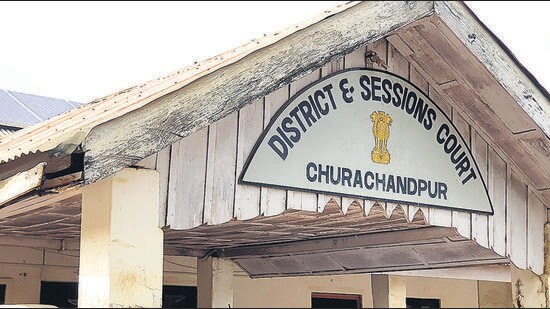
The administrative directives to shift judges came within a fortnight of May 3, 2023. Singh joined the Bishnupur court while a Kuki judge from that court went to Senapati. Similarly, Tonsing joined the Churachandpur court while a Meitei judge posted there came to Imphal.
“We have seen the worst of humanity, but also the best. In those dark days, the solidarity and support we received from the high court administration and fellow judicial officers were a testament to the enduring spirit of the institution and our people,” Tonsing and Singh said in unison.
Yet, these judges – who once held supreme powers to deliver justice – found themselves powerless in the face of overwhelming violence.
“As a judge, my role is to protect the innocent and uphold the law. But during those days, I felt completely powerless. I had to flee as the state found itself divided into communities. We are supposed to be the protectors of justice, yet we found ourselves finding it difficult to protect even our own lives,” said Tonsing.
Ethnic identity and lingering helplessness
The judicial reassignments were marred by unique challenges – from access to courts to the emergence of non-State actors trying to create a parallel system of adjudication.
Singh, now a district and sessions judge at Bishnupur, highlighted how the town, a critical junction on the highway that connects Imphal to Churachandpur, is a focal point of concern.
“The highway through Bishnupur has witnessed numerous incidents of violence and roadblocks, making travel dangerous. There have been regular reports of armed groups and agitators frequently targeting this route. For the initial 8-9 months, I could not travel from Imphal to Bishnupur for more than two days a week. Sporadic clashes, curfews and protests, either at Imphal or in Bishnupur, would make my travel impossible. One such day, I witnessed an official vehicle of a high-ranking police officer getting burnt down by the protestors,” recounted Singh.
For Sarungbam Mangaleibi, the last year has been even more agonising. The 34-year-old Meitei was once the only woman judicial officer in Kuki-dominated Moreh. But she fled the troubled border town in the early hours of May 4, 2023 large fires blazing in the distance conforming her worst fears. “I could see the big fires from my residence. It was a chilling sight,” she said. “It felt as if every semblance of law and order had been obliterated.”
Her relief upon reaching her hometown of Imphal was short-lived. Her vehicle, marked with a sticker from the Moreh court, drew the ire of a Meitei mob, who mistook her for a Kuki. Mangaleibi was forced to confront the mob, demanding safe passage. “I had to stand my ground and assert my identity. It was a moment of intense fear but also bravery,” she recounted.
Challenges and predicament
Now serving as a judicial magistrate, first class, cum civil judge in Imphal East, Mangaleibi paints a grim picture of law and order in Manipur. “The situation is completely shattered,” she said. “There is not much that the courts can do when the police and the executive fail to complement judicial processes. If the police do not produce an accused, cannot make arrests or make out a tenable case, what do you expect the courts to do?”
“Sometimes, our orders may not be worth the piece of paper they are written on with law enforcement agencies’ utter failure,” she said.
Mangaleibi recalled a particularly harrowing incident where a fellow judge’s court was besieged by at least 500 women demanding the release of a village volunteer. “Every remand, every appearance of an accused brings with it the fear of mob violence...the criminal justice system cannot survive in such a situation,” she rued.
Singh and Mangaleibi also flagged the issue of the increasing influence of non-State actors and their attempts to run a parallel system. “I have come across instances where after an order on the custody of a child has been issued, the aggrieved party has refused to comply with the directive, saying he or she would rather go to these non-state actors for a decision,” Singh said.
One of the most troubling aspects of the current crisis, Mangaleibi said, is the increasing influence of non-State actors who are attempting to run a parallel system of adjudication.
“This shadow system undermines the authority of the judiciary and erodes public trust. People are losing faith in us,” she said. “Litigants and even some lawyers openly talk about taking their disputes to these non-state actors. It’s a direct challenge to the rule of law,” she added.
Manipur: 10 political parties submit memorandum to guv, CM seeking end to crisis
The presence of these non-State actors, often armed and influential, creates an atmosphere of intimidation. “Parties and lawyers sometimes openly express their frustrations to the judges, admitting they feel safer and more assured of resolution through these unofficial channels. It’s heartbreaking to hear,” Mangaleibi said.
But she also warned against the indiscriminate use of the Unlawful Activities (Prevention) Act, or UAPA, in the current volatile environment. “These cases will drag on for years and years, destroying hundreds of lives eventually. Such indiscriminate or mindless use of UAPA will only deepen the crisis,” Mangaleibi cautioned.
She also highlighted the burgeoning social fallout stemming from prolonged displacement. “There is going to be a sharp increase in cases of juvenile delinquency, drug addiction and sex trafficking. With the internally displaced persons (IDPs) housed indefinitely in relief camps and their future uncertain, these problems are only escalating while the judicial system seems unable to do anything,” said Mangaleibi.
Singh highlighted another serious challenge facing the judicial system. “Even though we have received our formal posting orders, we have been informed that malkhanas (police storerooms for evidence) have been looted or burnt down in several locations. How can we proceed with a criminal case without evidence? Additionally, many accused individuals are either at large or cannot be produced in courts located in districts dominated by the opposing community,” Singh said.
Lack of proper infrastructure is also a major issue. Judges have no proper housing facilities or other amenities in several districts. One judicial officer, speaking on the condition of anonymity, revealed the dire conditions they face. “I have to sleep on the floor since the doors and windows of my official residence remain unrepaired. The water system in the washroom does not work, and when it rains, my house gets completely flooded, leaving me no choice but to seek shelter in the court building at night.”
The stories of these judges are a reminder of the profound human cost of ethnic strife and the precarious position of the judiciary in Manipur.
Their journeys, filled with fear, helplessness and resilience, resonate deeply within Manipur and beyond. Their reassignment based on ethnicity might safeguard their security and enable the judiciary to resume function, but also underscores the complex and fragile environment in which the State is operating. “Our experience is a stark reminder of the fragility of justice in times of conflict. But we must strive to ensure that the judiciary remains a bastion of hope and protection, even in the face of such overwhelming adversity,” said Tonsing.


