
 E-Paper



Legal experts question ban on Muslim traders around Hindu temples
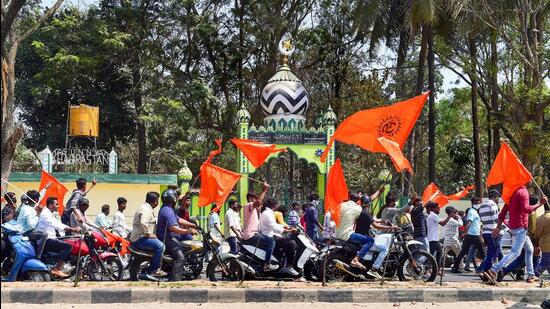
In Nelamangala, on the outskirts of Bengaluru, organisers of the Basaveshwara Temple Festival have also enforced similar rules while the Hindu Janajagruthi Samithi forcibly closed shops owned by Muslims in Upparpete in the central business district of Bengaluru.


Legal experts have questioned the Karnataka Hindu Religious Institutions and Charitable Endowments Act, 1997 provisions which have been used by rightwing groups to stop Muslims to do business in and around Hindu temples in the state.
“Firstly, the said Rule is delegated legislation under the 1997 Act, which deals in immovable property belonging to, or given, or endowed to the institution. This cannot at all be said to govern public property through which ‘jathras’ or processions pass. The applicability of such a Rule is constrained by its parent legislation,” All India Lawyers Association for Justice (AILAJ) said in a recent statement.
The Basavaraj Bommai government has been accused of using– or misusing – provisions of the endowments law not to intervene against right-wing groups who continue to force Muslim traders to close their shops and even publicly ask Hindus not to do any business with them.
While the BJP leaders have made scathing remarks in favour of such a call, the BJP government too is yet to make its stand clear on the issue, fueling speculation that it was tacitly backing these bans.
On Wednesday, Bommai remained non-committal in making the state government’s stand clear. “Several organisations will keep banning things, so we know what to respond to and what not to respond to. Whichever subject requires a response, we will respond and where it is not required, we will not give one,” Bommai said on Wednesday.
The temple committee at Mahalingeshwara Temple in Puttur district of Dakshina Kannada, Hosa Marigudi Temple in Udupi and Sri Durgaparameshwari Temple in Dakshina Kannada among others have enforced such bans.
In Nelamangala, on the outskirts of Bengaluru, organisers of the Basaveshwara Temple Festival have also enforced similar rules while the Hindu Janajagruthi Samithi forcibly closed shops owned by Muslims in Upparpete in the central business district of Bengaluru.
In 2016, the Karnataka High Court allowed Muslim traders to participate in the Laxmi Janardhana Temple in Mandya after 11 Muslim shop owners challenged the 2002 notification, Bengalore Mirror reported in April 2016.
Maitreyi Krishnan, Co-Convenor of AILAJ, said the Supreme Court has recently stayed the operation of the judgment of the Andhra Pradesh high court at Amaravati relating to a similar provision in the AP Charitable and Hindu Religious Institutions and Endowments Immovable Properties and Other Rights (other than Agricultural Lands) Leases and Licenses Rules, 2003, prohibiting non-Hindus in participation of tender-cum-auction process of shops.
“Whereas the Hon’ble High Court had upheld the same, the Supreme Court stayed the High Court judgment vide Order dated 27 January 2020, in SLP(C) No 1989 of 2020. Thereafter, the government proceeded to implement the Rule and contempt proceedings were initiated,” she said in the statement.
In an order on December 17 last year, the apex court said: “It is impermissible for the respondent – contemnors to either exclude the license holders from participating in the auction or from being granted leases, including in the shopping complex constructed by the State, on the ground of their religion.”
“The definition of ‘Hindu’ for the purposes of the 1997 Act, excludes Buddhists, Sikhs and Jains. Therefore, all persons who are Muslims, Christians, Buddhists, Sikhs and Jains would be excluded from vending around Hindu temples,” AILAJ said.
JC Madhuswamy, Karnataka’s minister for law, parliamentary affairs and minor irrigation, on Wednesday informed the legislative assembly that these laws were made in 2002 when the Congress itself was in power.
“Under rule no 12, any nearby land, building and housing included, none of them should be given to anyone from other communities,” Madhuswamy said.
Senior advocate and former Advocate General of Karnataka, Ravi Varma Kumar told HT that it was a discrimination purely on the basis of religion and the act itself has to be challenged. “If they are private temples the question of raising the constitutional issue does not arise. Because fundamental rights are guaranteed only against the government. But temples under Muzrai department, these (constitutional rights) are applicable,” he said.
The forum says the economic boycott was in direct violation of Article 15 of the Constitution which prohibits discrimination on the grounds of, inter alia, religion. It added that such differntiation is a form of “social apartheid”.


