
 E-Paper



Life lessons from a broken system
Twenty -four students have killed themselves across Telangana in response to the intermediate (Class 11 and 12) state board results.


It never once occurred to him, says Pravin Kukatla, 17, that his poor marks in the Telangana State Board of Intermediate Education (TSBIE) exam, were not his fault. On April 18, when the results were declared, he found he had scored 170 out of 500. In Class 10, his grade point average was 8.5 (10 is the highest in the state’s grading system). Pravin came home, to Venkatraopalle village in Mustabad mandal of Telangana’s Rajanna Sircilla district, had lunch, and went to the fields, where he consumed pesticide at about 3pm. He then played two cricket matches as a last hurrah. He was batting when he began foaming at the mouth. His friends rushed him to hospital and called his parents.
Kukatla has been under observation at the People’s Hospital in Mustabad town, 135km north of Hyderabad. A fortnight later, he isn’t eating. Hooked to a saline drip, he says he still thinks of dying. The only child of his parents, he studied at the privately run Akshara junior college. It didn’t occur to him, he says, that the people who correct also make mistakes, but he is coming to understand that is a possibility. He will be sent home this week.
But some others weren’t so fortunate.
Sixty kilometres north of Kukatla’s home, Kamindla Lavanya, 17, in Vattimalla village, Konaraopeta mandal, died on April 20 at the Karimnagar government hospital. She committed suicide after discovering she failed in three papers. She was the seventeenth victim. The first was A Anamika, 16
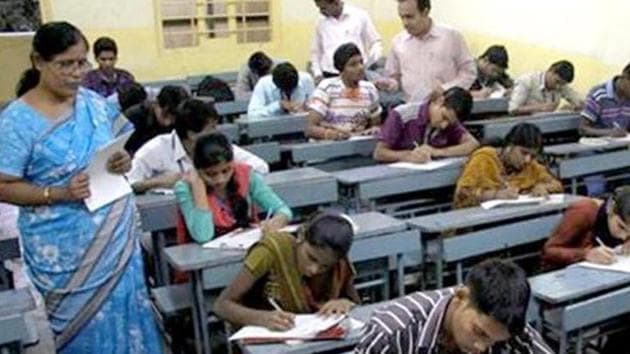
Twenty-four students have killed themselves across Telangana in response to the intermediate (Class 11 and 12) state board results. Sixteen of the dead are first-year students. Over 320,000 students have been declared failed in the examination. Many who scored well in the past have found themselves with poor marks and many who were poor students have emerged toppers.
This was the first year when the correction of the answer papers was outsourced to a private firm, Globarena Technologies Pvt Ltd., via an open tender in a bid to privatise the process. Until 2017, the papers were corrected by the Centre for Good Governance, a government body that worked with government teachers. Parents and students have been protesting in front of the board headquarters in Nampally, Hyderabad; at the official residence of chief minister K Chandrasekhar Rao (KCR), Pragathi bhavan; and outside the offices of Globarena in Jubilee Hills.
TVS Raju, CEO of Globarena, spoke to Telugu news outlets in the immediate aftermath and blamed bubbling errors in the Optical Mark Recognition software. He said it was rectified as soon as results were found to be faulty.
Globarena was already under litigation with the Jawaharlal Nehru Technological University, Kakinada, Andhra Pradesh, which has alleged fraud, a failure to deliver quality content, and evasion of service tax disputing a bill of ₹20 crore. Globarena says it was merely a financial dispute. The JNTUK contract had been terminated by 2017, when the firm was awarded the tender of the Telangana state board. This caused the opposition Congress party working president A Revantha Reddy to level allegations that Globarena was awarded the tender when TRS working president KT Rama Rao was IT minister due to their long-standing friendship — charges the firm has publicly denied.
Janardhan Reddy, who took charge as education secretary this February, initially defended the correction process calling the failures routine, but the government was forced to give in to public outcry. He says Globarena’s role has been over-hyped. “Globarena had a 30-member team and is only a data collection and analysis agency. There is a motivated perception that it was involved in correction, but it was not. Papers have been verified by intermediate lecturers this year,” he said.
Reddy says they have identified four kinds of errors that have occurred: in geography papers, practical marks have not been displayed; in 4,200 papers, single-digit marks were displayed (if the mark was 90, only ‘9’ was shown); 400 students had their centres shifted in the last minute and the wrong code was applied on their barcode, marking them absent in their original centres; and in some cases, there was human error with the teacher pencilling in ‘00’ in the OMR form instead of ‘99’.
Every year, out of 1 million students, Reddy says, some 18,000 to 20,000 apply for re-verification and about 600-800 errors are detected. This year, he says, the hype was stirred up before the re-verification process began. “We did not want to make announcements out of respect to students who have died, but out of 22 cases that applied for re-verification, none of them were found to have subsequently passed. Every year, 35% of students do fail these exams,” he said.
The results of re-virification will be announced this week. Later this month, supplementary exams for those who have failed will be held. Reddy says the results will be tabulated by two data agencies, Globarena and a second data analysis company, and cross-checked with scanned and barcoded answer sheets uploaded for public access.
But the problem is deeper than a software glitch. Experts say that the amplified pressure is indicative of crumbling public faith in an already failing system.
The outsourcing of correcting papers marks Telangana’s move towards the CM’s vision of a privatised education system. In 2018, he vowed to get residential corporate education to poor students, holding it up as an ideal.
This push is evident in the decline in the government’s education budget. Since Telangana state was formed in 2014, the education budget has dropped in percentage terms every year. In 2014-15, it was ₹11,216 crore or 10.88 % of the total budget. It fell to 7.61 % or ₹13,278 crore in 2018-2019. It was slashed to ₹12,220.75 crore or 6.71 % in 2019-2020. The BR Kher committee of 1951 had recommended that education should be at least 10% of a state’s budget.
A Comptroller & Auditor General (CAG) report presented in 2018 noted a clear thrust towards private schools over government schools in Telangana. More private schools were opening than government schools and enrolment in the latter was declining. Nearly 75% schools had no basic infrastructure, 45% had no playground, and 39% lacked fences. The government failed to constitute a State Advisory Council or implement the Right to Education, it said.
In 2016, the Supreme Court had rapped Telangana for claiming 400 government schools had “zero enrolments” and advocating for them to be closed. The state government said in response that it wanted to close 4,000 schools due to less than the stipulated 60 students per school.
By 2017, the number had risen to 10,000 according to the government.
In 2015-2016, a District Information System for Education report found over 95% of the schools or 40,507 out of 42,632 schools to be without full-time principals. The chief minister, in the meanwhile, has been inaugurating several private schools. According to the National Achievement Survey of the NCERT, by 2018, more than half of the state’s 4.8 million students were in private schools.
It has been accompanied by a systematic erosion of the teaching system. In 2018, the Hyderabad High Court came down on TSBIE for leaving regular teaching positions vacant and filling them with guest and contract lecturer positions. Out of 6,000 positions, only 840 were filled in 2018.
Reddy denied that government spending on education has come down and claimed ₹14,000 crore was spent on education with a special focus on residential schools for the minority and backward communities. “We have over 4.5 lakhs minority students in residential schools and we spend over a lakh on each student with free meals books and resources. Our teacher to student ratio is 1:17 which is greater than the USA,” Reddy said.
He admitted that 52% of students were attending private schools and that while the government was proposing to shut down schools in the past, they weren’t shut down. “While in the 1970s and ’80s, access was the biggest problem, now with enrolment near 100% we are thinking of ways of clubbing 4-5 schools with fewer students and providing viable transport options instead,” he said.
These changes have created a three-tier college system in Telangana. The first tier is formed by a string of what are now known as “corporate” college franchises. Backed by high-profile politicians, they charge fees in the range of ₹3-5 lakhs a student per year. The second tier is comprised of smaller private and aided colleges that charge between ₹50,000 to ₹1.5 lakhs. The third tier are the government colleges, at ₹2,500 a student per year.
Many corporate colleges are predatory. They advertise ranks won by their students in competitive exams, but a closer examination of advertisements reveals that several names and photographs are repeated across posters. Here, students tell of strict regimes, waking at 4am and studying till 11pm with only 20-minute breaks for meals. Hostels and classrooms are monitored by CCTV, mobile phones are confiscated, and students do not have extracurricular activities or any exercise. They are categorised into groups according to marks and made to compete against each other, and are publicly shamed for low marks.
The phenomenon of these “concentration camps” was documented by the Professor Neerada Reddy Commission back in 2001. It was tabled by the then vice-chairperson of the Andhra Pradesh State Council of Higher Education (APSCHE) in the aftermath of a spate of suicides. Things appear to have only gotten worse — there are multiple reports of students committing suicide or escaping from the hostels.
In 2001, the founder director of the Sri Chaitanya Institutes, BS Rao, publicly called for a Central Bureau of Investigation probe into suicides in his own residential colleges. Janardhan Reddy responded to queries on the Neerada Reddy commission not being implemented, saying, “This government is willing to analyse errors and institute reform all around. We recognise the need for it and are in the process of constituting a panel to execute it. Such tragic events create the shock that acts as a stimulus that pushes us to change.”
This State is advocating this new system for poor students as well. Parents who complain say they receive the child’s transfer certificate by courier. It is alleged that FIRs against suicides are hushed up.
The Telangana Vidhyarthi Vedika, an independent student group, has been agitating against this corporatised system for the past decade, advocating for free, democratic and scientific education for the state. Maddiletti, 27, the president of the group and a journalism major at Osmania University, says this is all the outcome of corporate college industry. He says that bright students from government schools are scouted and offered free admissions in corporate colleges, only to be told by the end of their tenure they owe a bill in lakhs. Several, too poor to pay, kill themselves, he says.
“The top ranks used to be scored by government inter college students. So the corporate colleges have been lobbying for privatisation of the correction process to have a say in how the results are given out. If it was merely a computer error, everybody should be randomly affected. Why is there not one student from a corporate college standing and protesting with us?” he asked.
Some parents have noticed the discrepancy too.
Murali Radha, a father of two young girls in the Bowenpally, on the outskirts, first began to agitate against the annual 20% rise in school fees three years ago. His children were kicked out of the franchise school in retaliation, he says. When the results were first released, some corporate college students were affected but their lack of protest is indicative of back door channels that are open to them, he says.
“To the government, parents are puppets, and to the corporates parents are ATMs.” Reddy says that while the government is not consciously pushing to a corporatised structure, organic indications are moving towards corporate and private education on their own.
The politicisation of the issue is inevitable with corporate colleges wielding political and monetary clout and parents and students living in fear. Numerous parties, political and student, independent and ideological are joining the chorus. A suppression of suicides derives from the political response to the formation of the state of Telangana itself, says N Narayana Rao, general secretary of the Civil Liberties Committee.
In this battle over education, it is the children who end up isolated, points out Murali Radha. CCTVs make teachers wary. Classrooms are devoid of banter and student-teachers bereft of any relationship of mentoring and guidance. Students are not encouraged to make friends, communicate with the home, de-stress, play, or exercise. All they can do is study. Marks thus, become their whole life. When their marks fail, they give up.
Ajay Katakapalli, 17, is finally home in Venkatapur village, Nangannur mandal, Siddipet district after two weeks in the hospital and can only eat fruit and milk. The doctor has asked him not to step out in the sun for three months now. That’s fine by him.
He has never made friends anyway. A first-year inter student who consumed pesticide on April 19th, a day after he learned he had scored 183 out of 470, all he did was study from 4am to 11 at night. He had an 8.7 GPA in his SSC exams in his Zilla Parishad school. Without his marks, he doesn’t know what to do.


