The Madras high court has directed the Tamil Nadu director general of police (DGP) to issue a circular requiring police personnel appearing before courts to wear proper uniforms and maintain “absolute integrity, discipline and devotion to duty”, after a police officer allegedly appeared intoxicated while deposing as a prosecution witness.
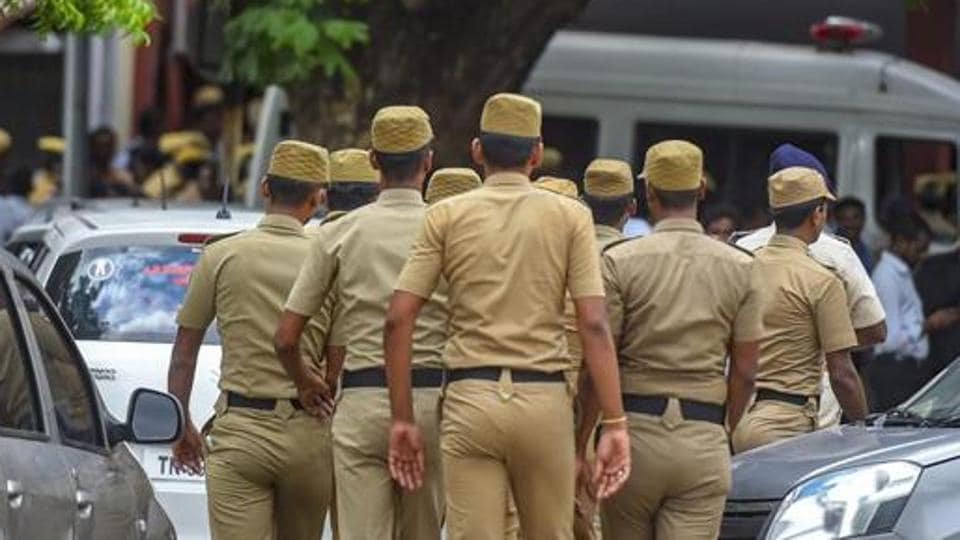
Police personnel outside a court n Chennai. (PTI File)
Judgment Overview
In its July 14 judgment, a division bench of justices SM Subramaniam and N Senthilkumar also directed that if any police personnel, medical officer or other government official appears before a court in a disorderly manner, the presiding judicial officer must report the conduct to the competent authority so that disciplinary proceedings can be initiated.
“Such indifferent attitude of attending Court in a drunken state has to be viewed seriously. Departmental action is purely based on preponderance of probability and his act had totally degraded the image of police force in the Court hall and it has to be curbed, otherwise, the misconduct committed by the respondent will ruin the entire police force,” the court said.
Background of the Case
The directions came while deciding an appeal filed by the Tamil Nadu government against a single judge’s order that had set aside disciplinary action against police constable V Arumugam.
Arumugam had challenged the punishment imposed on him for his conduct while appearing as an official witness before a judicial magistrate.
In 2014, while serving as a special sub-inspector of police, Arumugam appeared as a prosecution witness in a criminal case investigated by him. During his testimony, the magistrate observed “signs of intoxication”, including the “smell of alcohol, incoherent speech, and shouting”, and directed him to undergo a medical examination.
The medical officer recorded the smell of alcohol on his breath and issued a “drunkenness certificate”. Following departmental proceedings, Arumugam was initially awarded compulsory retirement. The punishment was later modified, allowing him to resume duty, but with the stoppage of annual increments for three years.
Legal Proceedings
He subsequently approached the HC, and in 2020 a single judge quashed both the disciplinary proceedings and the punishment. The state challenged that order before a division bench.
Allowing the state’s appeal, the division bench set aside the single judge’s order and held that Arumugam’s conduct amounted to serious misconduct that undermined the dignity of the court and the image of the police force.
The bench observed that departmental proceedings are governed by the principle of preponderance of probabilities and that misconduct by official witnesses inside a courtroom cannot be condoned.
The court further held that judicial officers are duty-bound to report any indiscipline, misconduct or unusual behaviour by official witnesses to the competent authority for appropriate disciplinary action.
Expanding the scope of its directions, the bench said all official witnesses, particularly police personnel, are required to maintain decorum and discipline while deposing before courts and must give truthful evidence. “Any misconduct committed inside a court hall cannot, under any circumstances, be tolerated,” the high court said.
Implementation of Directives
The bench directed the DGP to issue the circular within four weeks. It also instructed the Madras high court Registry to circulate the directions to all courts in Tamil Nadu to ensure uniform compliance with the standards laid down in the judgment.
Ayesha Arvind is a Senior Assistant Editor specialising in legal and judicial reportage. She covers High Courts and tribunals across southern India, and believes that important legal developments do not only come from New Delhi. Her work focuses on bringing significant decisions and developments from the region to a wider audience and explaining what they mean beyond the courtroom.
She tries to make legal material accessible by translating legal jargon into clear, readable prose and putting pleas, lawsuits, judgments and legal developments in context. She also looks at their political realities and practical consequences for people.
Ayesha is committed to the standards of integrity journalism requires. She places a premium on accuracy and fairness, and believes that journalism's powerful voice must be tempered by humility and a sense of proportion.
Over almost two decades in journalism, she has covered law and order, civil law, crime and other areas of legal affairs. Her work includes breaking news, legal affairs stories, online analysis and commentary.
Ayesha is deeply interested in the law, court judgments and the Constitution because they shape everyday life. She believes every citizen should have a basic understanding of them. What she enjoys most about covering courts is that every story brings something new to learn.Read More
Get the latest India News, breaking headlines, and real-time updates from across the nation. Stay informed on politics, government policies, crime, weather, and major national developments.
Home/India News/Madras HC Mandates Discipline For Police, Officials Appearing Before Courts

 E-Paper