
 E-Paper



Maestro who took the Indian santoor to the world
Born in Jammu on January 13, 1938, Sharma was initiated into music by his father Pandit Uma Dutt Sharma. After learning vocals and tabla, and even performing for the Jammu radio station when he was 12, he was drawn to the sound of the santoor, which was played commonly in the Kashmir region.

 Prefer HTon Google


The look of pride was unmistakeable in Pandit Shivkumar Sharma’s eyes on December 25, 1997, the day the Santoor Viraasat concert series was launched. His son Rahul, then 25, was making his debut, accompanying his father in a duet. With Ustad Zakir Hussain on tabla, their rendition of ragas Hansadhwani and Mishra Khamaj was memorable.
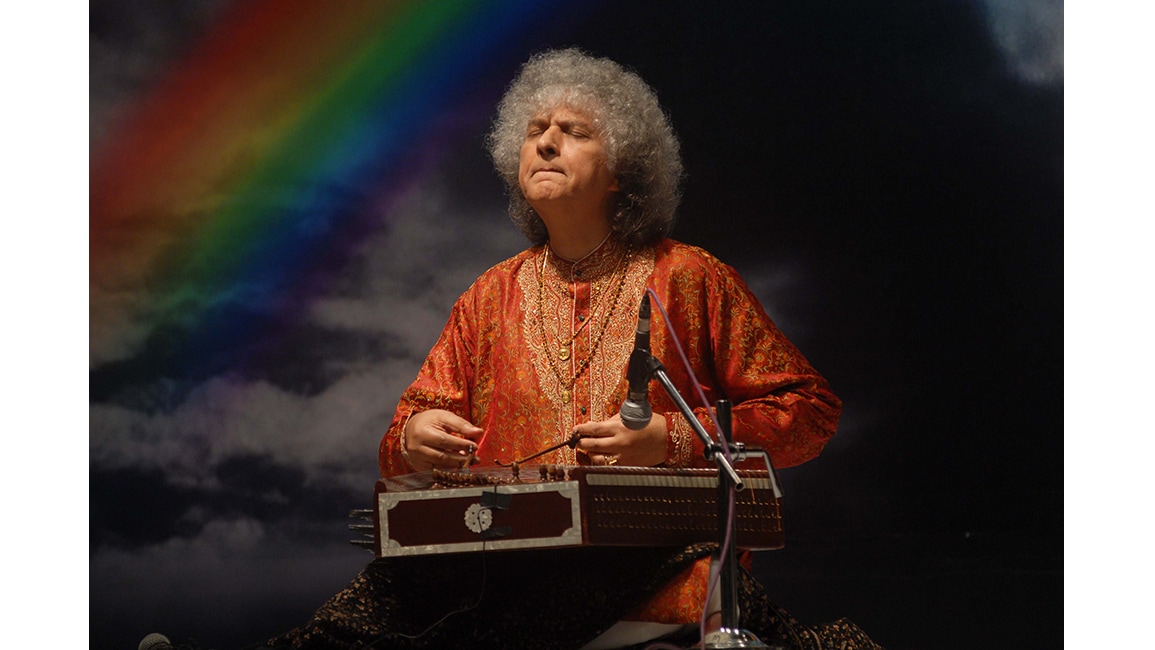
Clearly, Sharma’s life revolved around the santoor, and he is singularly credited with the instrument’s adaptation and elevation to Hindustani classical music. Earlier, it was played in folk and Sufiana music, but he worked on a new technique and style. To quote from the title of his autobiography, as told to and written by Ina Puri, it was a “journey with a hundred strings”.
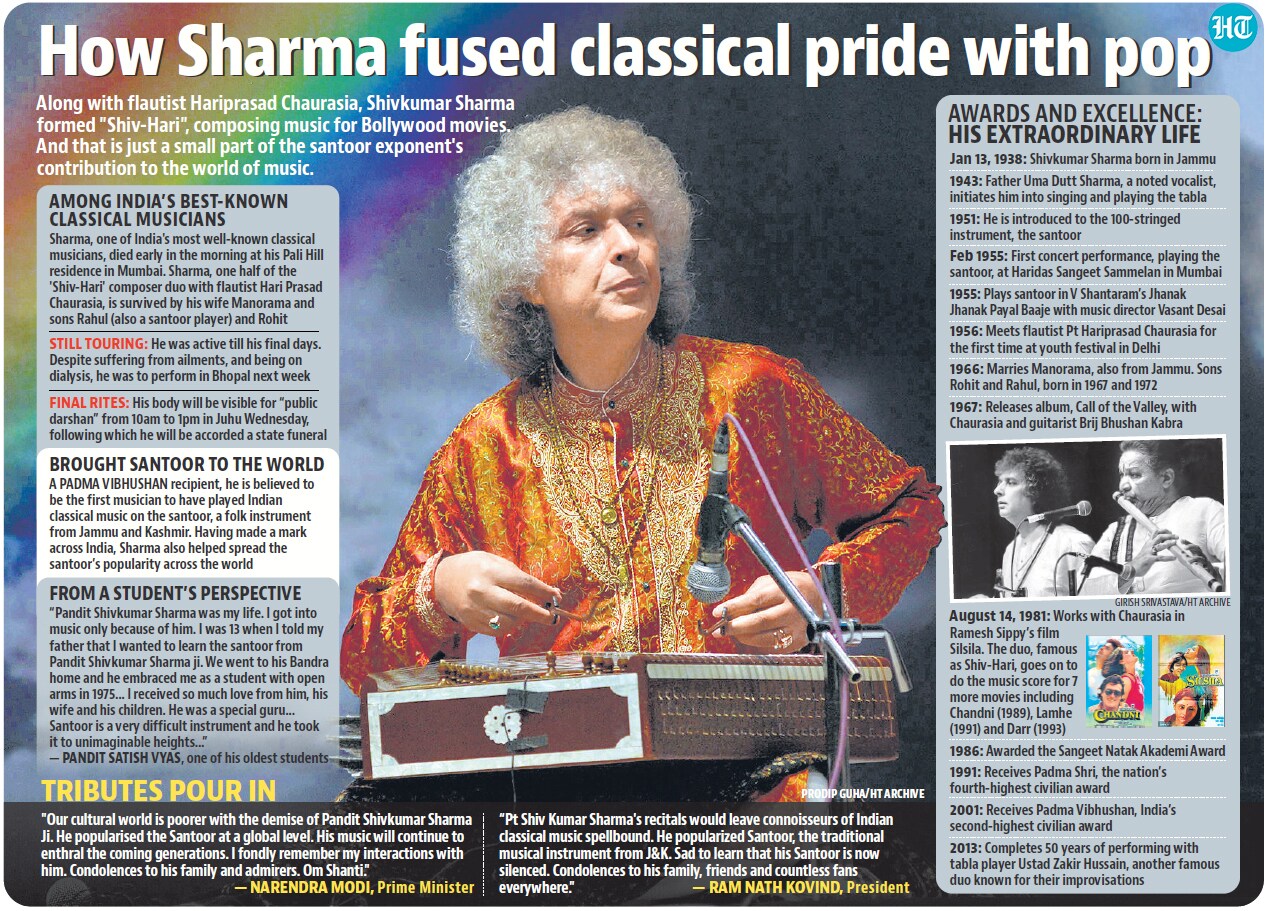
Sharma, who died in Mumbai on Tuesday, aged 84, leaves behind a treasure trove of memories. In every concert, he dazzled audiences with his magical renditions. In film music, he teamed up with flautist Pandit Hariprasad Chaurasia to form the duo Shiv-Hari. The music of the films Silsila (1981), Chandni (1989), Lamhe (1991) and Darr (1993) was much acclaimed. After working on eight films, both musicians decided to focus on classical music.
Born in Jammu on January 13, 1938, Sharma was initiated into music by his father Pandit Uma Dutt Sharma. After learning vocals and tabla, and even performing for the Jammu radio station when he was 12, he was drawn to the sound of the santoor, which was played commonly in the Kashmir region.
The instrument is considered to be part of the dulcimer family; other similar instruments include the hammered dulcimer (as it is called in the US, UK and Canada), hackbrett (mainland Europe) and cimbalom (East Europe and Russia). Iran, Japan, Korea and China have their own types of dulcimers, too.
The Indian santoor, which derives its name from the shata-tantri veena or 100-stringed instrument, is played when the strings are struck by a pair of mallets. With his father’s guidance, Sharma spent a lot of time studying its features and possibilities to devise a unique style. Because of his background in playing the tabla, he understood the instrument’s rhythmic possibilities too.
He had his critics, as traditionalists felt the santoor could not replicate certain features typical to Indian classical music. But Sharma increased its melodic range, changed its tuning, and reworked his technique to make it more conducive to classical music.
He played raga Yaman on the santoor in his first concert at the Haridas Sangeet Sammelan in Mumbai in 1955. At the same time, he looked for other avenues of performing. He played the santoor in V Shantaram’s 1955 film, Jhanak Jhanak Payal Baaje, whose music was composed by Vasant Desai. He was only 17 at the time.
Though Sharma slowly began gaining popularity as a solo artiste, the 1967 album Call of the Valley gave him the much-needed boost. A trio with Chaurasia and guitarist Brij Bhushan Kabra, it remains one of the highest selling albums of Indian classical music.
Having made a mark across India, Sharma helped spread the santoor’s popularity abroad. Foreign audiences were attracted to the meditative and serene nature of the music. For his part, the maestro focused on the purer form of classical music, rarely doing fusion experiments. There was the rare exception, like his guest appearance at the Remember Shakti concert in Mumbai in 2000, where he played the piece Shringar, with guitarist John McLaughlin.
Known to follow a strict schedule, Sharma regularly practised pranayam and meditation. In interviews with this writer, he often talked of his approach to music with characteristic humility. “I cannot pre-plan anything. My mental frame is not like that. I will just decide and play as things go,” he said.
He also believed there were two types of riyaaz, or practice. “One is the physical type, which I do as and when I get time. The other is mental riyaaz. Mentally, I am always thinking of music,” he would say. “Whether I am in a flight or in a hotel, music is always on my mind. As they say, I eat, drink and sleep music.”


