
 E-Paper



Maha assembly clears 10% Maratha quota bill
Maharashtra Legislature passes bill reserving 10% seats in education and government jobs for Maratha community, citing exceptional backwardness.

 Prefer HTon Google


The Maharashtra Legislature unanimously passed a bill reserving 10% of the seats in educational institutions and the same proportion of government jobs for people from the Maratha community in the third such attempt by the state government to carve out a quota for the once-dominant agrarian community, after similar laws enacted in 2014 and 2019 were struck down by the courts.
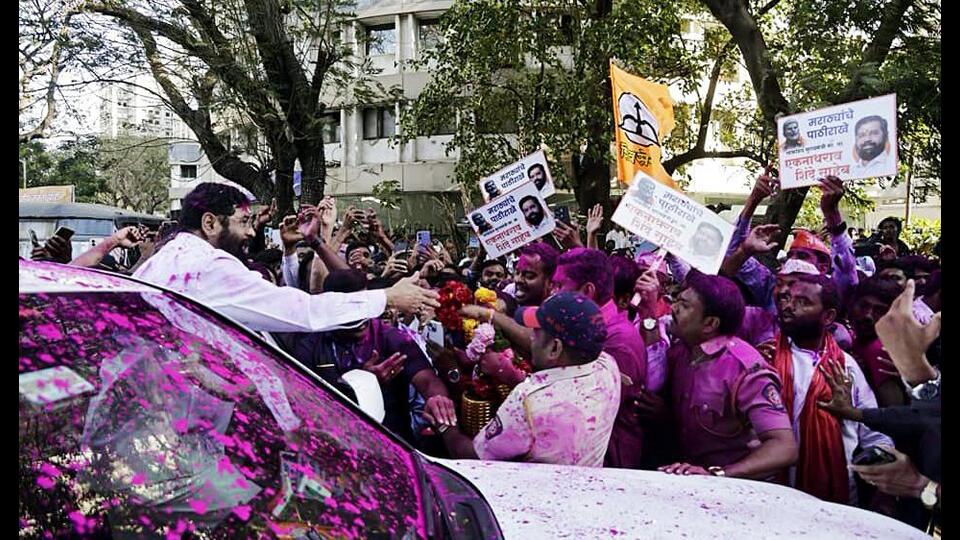
In the bill passed by both houses of the state legislature, the Maharashtra government cited the findings of a report submitted by the Maharashtra State Commission for Backward Classes (MSCBC) as the basis for the reservation. The report stated that the Marathas account for 28% of Maharashtra’s population, and are in an “exceptional circumstances and extraordinary condition” of backwardness, making it a fit case for reservation over the 50% ceiling mandated by the Supreme Court. The 10% quota is over and above the existing 62% reservation in the state, which includes 10% for those belonging to economically weaker sections (EWS) and remaining 52% caste based quota.
Chief minister Eknath Shinde, who tabled the bill in both houses, said that the Supreme Court, in its verdict in May 2021, empowered the government to list the backward classes for reservation. “The reservation has been given on firm grounds without disturbing the existing quota. The reservation will withstand legal scrutiny and be sustained entirely as we have addressed the flaws pointed out by the Supreme Court while quashing the previous quota given in 2018,” he said.
The bill, Maharashtra State Reservation for Socially and Educationally Backward Classes Act 2024, stated that the community does not require reservation in politics as it is adequately represented in the political field of the state. If the reservation if not provided on urgent basis, the community would denigrate even further leading to complete social imbalance, social exclusion and inequation and social injustice, it stated.
MSCBC was constituted under retired judge Sunil Shukre in December to study the backwardness of the community. The move by the Shinde government comes against the backdrop of an agitation by the community for the quota, led by Manoj Jarange-Patil over the last five months. Jarange-Patil has been demanding the inclusion of Marathas in Other Backward Classes by issuing them Kunbi (a peasant sub-caste of the Maratha community falls under the OBC category) certificates. CM Shinde said that the draft notification issued on January 26 will be finalized after thorough scrutiny of the suggestions and objections the government has received.
Jarange-Patil has expressed his doubt over tenability of the reservation given by the government. “We want our inclusion in the OBC category by issuing Kunbi certificates to close relatives based on Kunbi antecedents. What would our children and youth do if the reservation was quashed by the court in future. I trusted chief minister Eknath Shinde believing on his words for last six months, but this was not expected from him,” he said.
CM Shinde said that the law will bring the community into the mainstream.
“It is a historic day for all of us. I have taken an oath that I will give reservation which will sustain in the court. Today I tabled the Maratha reservation bill and the legislature passed it. I kept my word and fulfilled that oath and promise to ‘Sakal Marath Samaj’. This Maratha reservation law will bring the Maratha community into the mainstream,” Shinde said.
“Today is a day of joy for the Maratha community and all of us as state legislature unanimously passed the Maratha reservation bill. We have rectified errors pointed out by the Supreme Court while giving verdict on the earlier Maratha reservation bill. Now it will pave the way for 10% reservation for the Maratha community in education and government jobs,” deputy chief minister Devendra Fadnavis said.
To justify the attempt to breach the 50% cap, the bill has cited the case of 69% reservation in Tamil Nadu. The 1992 Indra Sawhney ruling of the Supreme Court — the Tamil Nadu reservation predates it — caps the quota at 50%. Shinde said that as many as 22 states have more than 50% reservation. “Apart from Tamil Nadu, there’s 67% in Haryana, 69% in Bihar, 55% in West Bengal, 59% in Gujarat,” he said in the Assembly after the bill was passed.
The report also cited the recent enactment in Bihar, in 2023, accommodating the extremely backward classes among the backward classes. “Such reservation in excess of 50% would stand to rationale of the test of reasonableness and/or intelligible differentia under Article 14 of the Constitution of India,” the statement of objects said.
MSCBC surveyed 15.8 million families across the state and arrived at the conclusion of the backwardness of the Marathas. The survey was conducted between January 23 and February 2 by 196,000 enumerators who administered a questionnaire with 154 questions through door-to-door surveys. MSCBC submitted the report to the state government on February 16.
The report that 21.22% of the community is below the poverty line, which is more than the state average of 17.4% of the population. It also added that 94% of farmers who died by suicide over last one decade are from the community. And it found that the so-called non-creamy layer (households earning less than ₹8 lakh) comprises 84% of the community, which therefore deserves appropriate protection in terms of adequate reservation in employment and education, as held in the Indra Sawhney case.
“Article 342-C of the Constitution empowers the state to list the backward communities as per the provisions of Articles 15(4) and 16(4),” the bill stated.
“The Maratha class has suffered abject poverty for decades together on account of its primary source of income being agriculture and the same being depleted every passing year. The community has been largely dependent on types of work performed by labourers, mathadi kamgar, hamal, peon, sweepers, helpers household job workers, etc. The statistics of the percentage of the population drawn that such a large number of the population has remained inadequately represented in employment, services, and avenues of education. The empirical and quantifiable data have revealed that the Maratha class is completely left out of the mainstream not only in purely economic sense of backwardness but equally on the aspect of social and educational backwardness,” the bill added.
The bill also has provided for the periodic review of the reservation after 10 years.
Two similar bills tabled by the then governments in 2014 and 2018 were quashed by the courts, subsequently. The 2014 Maratha reservation law provided a 16% quota in jobs and education, but it was quashed by the Bombay high court. The 2018 Maratha reservation provided a similar quantum of reservation, which the Bombay HC brought down to 12% and 13% respectively. The quota was quashed by the Supreme Court in May 2021.
Constitutional expert Ulhas Bapat said, “The reservation is difficult to pass the legal scrutiny as the courts had time and again clarified that it should not cross the cap of 50%. If the Maratha community is educationally and socially backward, they should have included in OBC category.”


