An eerie calm prevails in this coastal district of Karnataka where no civilian traffic is plying on the roads. Understandable because a curfew is in place and the only visible presence on the roads are the numerous police check points and patrol cars, and emergency service vehicles.
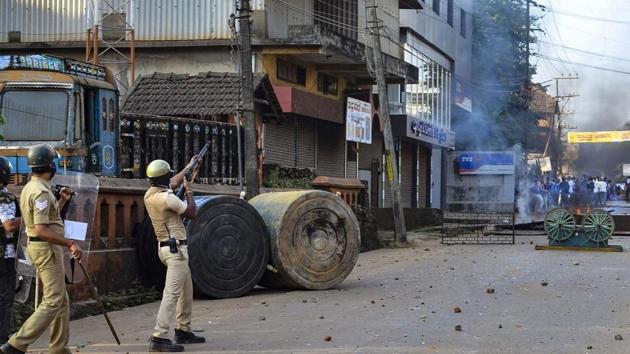
Since two protestors against the Citizenship (Amendment) Act, or CAA, were killed in police firing on Thursday in Mangaluru, several observers have been puzzled why things spun out of control in this vibrant commercial hub whereas larger demonstrations in other parts of Karnataka like Bengaluru, Mysuru, Huballi and Kalburgi did not descend into violence.
Local leaders, both of political parties and communities, say that this is because coastal Karnataka,which consists of Mangaluru and Udupi, has always been a tinderbox just waiting to be lit, given its unique mix of religion and language and the influence of neighbouring states.
While the 2011 Census says that 68% of the region’s population is Hindu, there is a strong Muslim and Christian presence; the Jains also have a small footprint. The people here speak a number of languages, including Kannada, Tulu, Konkani, Beary, Urdu and Malayalam.
Neighbouring Kasrgod in Kerala is less than 50 kilometres from Mangaluru city and has a big influence. Historically, people from coastal Karnataka have moved in big numbers to Mumbai in search of economic opportunities (all the Udupi restaurants in Mumbai being an example), but in the recent past Malyalees returning from the Gulf have made the coastal Karnataka districts their home. So there is underlying social friction.
{{/usCountry}}Neighbouring Kasrgod in Kerala is less than 50 kilometres from Mangaluru city and has a big influence. Historically, people from coastal Karnataka have moved in big numbers to Mumbai in search of economic opportunities (all the Udupi restaurants in Mumbai being an example), but in the recent past Malyalees returning from the Gulf have made the coastal Karnataka districts their home. So there is underlying social friction.
{{/usCountry}}First the facts, though.
On Thursday, about 2,000-2,500 largely Muslim men started a protest in front of the district collector’s office against the CAA. This in spite of the fact that the previous night the police had imposed Section 144 – which prohibits the assembly of four or more people in a public place – across Karnataka including Mangaluru.
The CAA is aimed at fast-tracking Indian citizenship for members of the religious minorities from the Muslim-majority countries of Afghanistan, Bangladesh and Pakistan,
It was not just in Mangaluru that anti-CAA protesters congregated. Similar protests took place across the main cities of the state including the capital Bengaluru.
According to the district administration officials, they initially warned the protesters not to break the law and to disperse, but the protestors refused to heed the warning.
The police then resorted to a lathicharge and in return the crowd threw stones and became violent, threatening the lives of the officers. From hereon, there are conflicting versions and the matters seem to have escalated, with the police opening fire, resulting in the death of two men, aged 49 and 23 years. Seven others were seriously injured and are still being treated at the intensive care units of Unity Hospital and Highland Hospital.
Why is this part of Karnataka so sensitive? To find out the answer, HT spoke to a range of politicians, community leaders and district administration officials.
Alhaj K S Mohammed Masood is a former chairman of the Karnataka State Minorities Commission and an ex-member of the legislative council (MLC) who heads the Central Committee, an apex body representing all Muslim organisations in the city.
Masood is clear that the grievance of the Muslim community is not just against the implementation of the CAA or the proposed National Register of Citizens (NRC).
“It is a sense of alienation in our own land where we are now being looked at with suspicion. First they came with Triple Talaq law, then Article 370 was abrogated, then, even though it pained us when the Babri verdict was given, the community did not utter a word. Now they want to disenfranchise and make us non-citizens in the name of CAA and NRC. We will never allow that to happen.”
The central government has held out reassurances that the CAA will not affect the citizenship of Indian Muslims.
K M Shareef, former chairman of the Jammat-e-Islami Hind, said: “They may say CAA is not religion-based, then why exclude only Muslims? We know they are testing waters with CAA and NRC”
This seems to be the underlying theme for a cross-section of the protesters.
Abdul Hakim, who was one of the protesters present on the day the firing took place, says that things would not have turned out the way they had if the police had just allowed the crowd to raise slogans and make speeches.
Instead, he said, the police started a brutal lathicharge and in retaliation, the protestors picked up and threw stones. Then the police opened gunfire, resulting is the loss of two lives.
“When an unruly mob of thousands tries to corner the police and when their lives are under threat, they have no choice except to retaliate,” said a senior police officer who did not want to be identified because he is not authorized to speak to the media. “Who are the people who came in vehicles without number plates and assembled in thousands inspite of Section 144. What do you expect us to do?. They even set a truck on fire.”
Muslim community leaders dispute this version. D M Aslam, chairman of district football association, says the police were squarely to blame.
To be sure, there are contrarian voices too in the community. Rahim Uchil , president of the Karnataka Beary Sahitya Academy -- Beary is a language spoken by just about 1.5 million people only in this part of the world -- says deliberate distortion and miscommunication inflamed passions and brought matters to a head.
“Some youngsters, those who are less educated and hotheads who are present in every religion, are misled by so-called religious and community elders instead of being given correct information,” he said.
Haji Ibrahim Kodijal, who is general secretary of the All India Milli Council of the district and who is also a senior Congress leader, says that historically the Rashtriya Swayamsevak Sangh (RSS) and its affiliates had viewed the coastal districts as a Hindutva laboratory.
“Didn’t the country see how innocent schoolchildren in an institution run by RSS ideologue Kalladaka Prabhakar Bhat were made to re-enact the Babri (mosque) demolition?. Whatever the court verdict ,does it not hurt when a religious structure is demolished?. CAA was only the last straw on the camel’s back. It was the fire which lit the tinderbox as the community is being cornered,” he said.
Another senior Muslim leader, who did not want to be identified, countered Kodijal.
“This city harboured Yasin Bhatkal {leader of the proscribed Indian Mujahideen}, his henchman Ahmed Bawa and others. It is easy to blame BJP {Bharatiya Janata Party }and RSS. We also have to look inside. Unlike in the past, where there used to be easy intermingling between faiths, now the conservative Islamic influence, specially by Gulf returnees, is increasing. This is worrisome,” this leader said.
Vedavyas Kamath, the soft-spoken BJP MLA from Mangaluru South, says the incident was the outcome of meddling by outsiders and a deliberate misinformation campaign. Kamath says that 38% of his constituency is made up of members of the minority community and he believes in taking everybody along.
“As PM says ‘Sabka Saath, Sabka Vikas.’ However some vested interests who cross over from Kerala are trying to whip up communal passions and stir up trouble,” said Kamath.
Pointing out how leaders at the Centre and the state including chief minister B S Yediyurappa and state BJP unit chief Nalin Kumar Kateel, who is also a local MP, have repeatedly said that CAA was not applicable to Indians,he asked: “Why should there be any apprehension?”
Had Section 144 been respected, there would not have been any trouble, he said.
Congress leader Abhaychandra Jain, a former minister and sitting MLA of neighbouring Moodbidri constitutency, said the police should have shown more restraint. “Even if the assembly was illegal, didn’t similar protest happen elsewhere?. They could have used water cannons, fired in the air or used rubber bullets. The action of the administration is unacceptable,” he said.
S Angara, a six-term BJP MLA from neighbouring Sullia, said that what had transpired was “deeply unfortunate.” He said vested interests were stoking the fire.
“Coastal districts have always had a mix of people from all backgrounds. Our government will ensure that justice is done to everybody and will take everybody along. Outsiders should not meddle here. We want people to stop spreading rumours,” he said.