
 E-Paper



Manipur crisis: Ensure there are no hurdles to access justice, says SC
Giving audience to those affected by the protracted ethnic strife in Manipur is a “part of the healing process”, the Supreme Court said on Monday.

 Prefer HTon Google


Giving audience to those affected by the protracted ethnic strife in Manipur is a “part of the healing process”, the Supreme Court said on Monday as it directed the state government to ascertain that all district court complexes have video-conferencing facility available within a week so that lawyers and litigants of all communities could have unhindered access to justice.
“Our conscience has to be satisfied that members of the bar or litigants are not being denied access to courts on religion or community lines...We have to ensure that the platform of this court is not misused. Equally, our conscience has to be satisfied that there are no barriers to access to justice,” observed a bench led by Chief Justice of India Dhananjaya Y Chandrachud.
The bench, also comprising justices JB Pardiwala and Manoj Misra, cautioned members of the bar to ensure that no lawyer is restrained from appearing in court, adding any such endeavour would be construed as contempt of the Supreme Court’s order.
The directive came as the bench heard a clutch of petitions pertaining to violence between the Meitei and Kuki communities since early May, and some of the lawyers complained about not being able to appear in the high court due to threats.
Solicitor general Tushar Mehta, appearing for the Manipur government, refuted the claims about restricted access to the high court while contending that attempts were being made to mislead the court by presenting a “distorted” picture.
The bench agreed with Mehta that the Manipur high court is completely operational but added: “We don’t want to aggravate the situation on the ground but at the same time, our conscience has to be also satisfied. We are a people’s court but at the same time, we know our remit. Giving a hearing is a part of the healing process. Equally, we know where to draw the line.”
The court, during the proceedings, also made it clear that all complaints and grievances should be first registered with the committee of retired women judges, appointed by it to assess the efficacy of relief and rehabilitation measures, and that it will not allow duplication of work.
“Either we scrap the committee or we hear this matter after every four weeks...because we don’t have the time to hear it every week. We have already appointed the committee that is working in tandem with the government. If the process is going on, we must allow it to continue. Whenever we pass any order, it’s reported as if nothing is happening on the ground...We do not propose to run the administration of Manipur here in the Supreme Court,” it remarked.
The bench also took note of a statement of senior lawyer Vibha Dutt Makhija, representing the judges’ committee, that various steps have been taken by the Union and the state government to ensure that the committee’s directions are followed.
Based on the committee’s recommendations, the bench recorded in its order that the state government and the UIDAI make certain that Aadhaar cards are issued to all displaced persons, who may have lost them due to their displacement and whose records are already available with the UIDAI. The departments concerned will also take expeditious steps to make available the details of all bank accounts of the displaced persons for direct bank transfers as well as for issuance of disability certificates to the specially abled persons in relief camps, it added.
The court also directed the Centre to nominate one nodal officer in Delhi for guiding complaints and grievances of displaced persons to appropriate channels.
It gave the state government a week to submit a response regarding reconstruction of places of worship and the mechanism to identify victims of violence for providing compensation.
About a confidential report submitted by the state government on the recovery of arms and ammunition stolen from the police and state armouries during the strife, the bench said that it would take up the issue after a week when it has perused the report.
The report was submitted by the state government in a sealed cover, as allowed by the court on September 6. On that day, the court observed that the issue of stolen arms and their recovery was “sensitive” and that it must be looked into seriously irrespective of which side is involved. It had then directed that the report be shared only with the court for now after the state government claimed that publicising the report could lead to “panic”. By an order on August 7, the bench had directed the state government to investigate the looting of arms and ammunition from the police and state armouries.
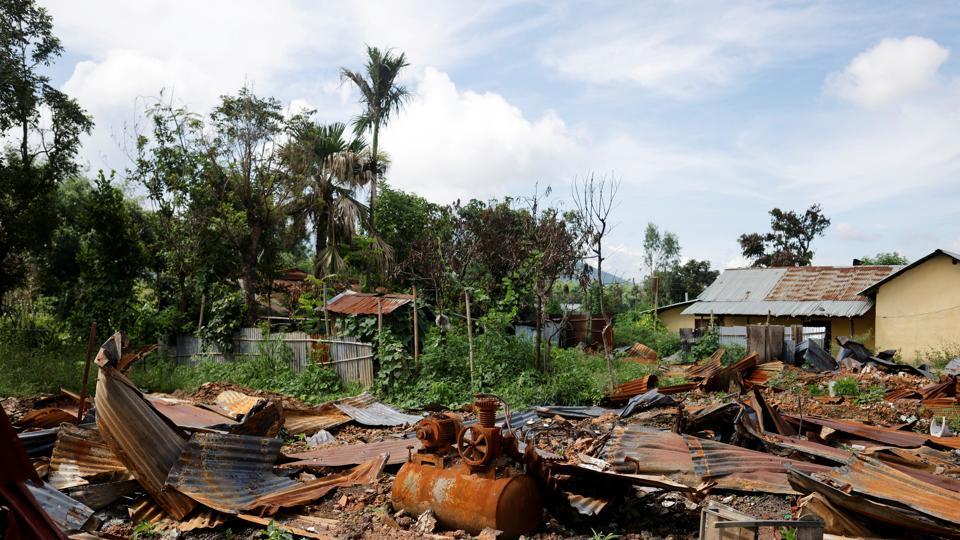
Ethnic clashes between the tribal Kukis and dominant Meiteis first erupted on May 3 during a protest against a court-ordered tweak to the state’s reservation matrix, granting Scheduled Tribe status to the latter. The violence quickly engulfed the state where ethnic fault lines run deep, displacing tens of thousands of people who fled burning homes and neighbourhoods into jungles, often across state borders. At least 163 people have been killed in the violence.



