
 E-Paper



Mathura court to begin dat-to-day hearing in Shahi Eidgah mosque case from July 25
A local court in Uttar Pradesh’s Mathura decided to conduct day-to-day hearing starting July 25 on the maintainability of the petition in the Sri Krishna Janmabhoomi-Shahi Eidgah mosque case


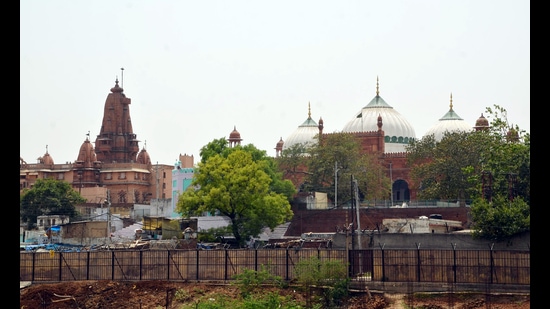
Agra: A local court in Uttar Pradesh’s Mathura on Thursday decided to conduct day-to-day hearing starting July 25 on the maintainability of the petition in the Sri Krishna Janmabhoomi-Shahi Eidgah mosque case.
The order passed by the court of civil judge (senior division) Jyoti Singh in Mathura, stated that hearing on the maintainability of the petition will be done first.
The petition filed by Bhagwan Sri Krishna Virajman (the personification of Lord Krishna) and three others in September 2020, seeking the removal of Shahi Eidgah mosque and the handing over of land measuring 13.37 acre to Sri Krishna Janmabhoomi Trust.
“The court also clarified that no adjournments will be allowed and the matter will be taken up at 3pm on every working day,” a senior lawyer said, requesting anonymity.
An application moved in May sought the appointment of an advocate commissioner for survey, photography and videography within the Shahi Eidgah mosque, the sealing of the mosque premises, enhancement of security, and “purification” of the mosque premises (claimed as the original birth place of Lord Krishna).
The Hindu petitioners argued in the court that a survey of the Shahi Eidgah mosque be carried before disposal of the application challenging maintainability of the petition.
On Thursday evening, lawyer Mahendra Pratap Singh, one of the petitioners in the case, said they will file a revision against the civil judge’s order.
“Certain important aspects were overlooked and we will file for a revision against the order passed by the court of the civil judge (senior division) Mathura,” Singh said.
The application challenging the maintainability of the case was filed by the management committee of the Shahi Eidgah mosque under Order 7 Rule 11 of the Code of Civil Procedure. The application was being heard in the court, when those appearing for the Hindu deity filed an application in May for a survey of the mosque.
The Hindu side has claimed there are material evidence within the premises of the mosque, including Hindu religious markings such as Om, Swastika and Sheshnaga (Hindu mythological serpent), which could be removed by those managing and visiting the mosque.
“Thus, it is necessary that a survey, including videography and photography of the mosque premises, be conducted...,” petitioner Singh had claimed in the court.
The mosque management committee, however, welcomed the civil judge’s order.
“…The case no. 950 of 2020 has been filed on wrong basis and has no legal substance and so have challenged the maintainability of the case by moving an application under Order 7 Rule 11 of the Civil Procedure Code,” said Tanveer Ahmed, secretary and counsel for the management committee of Shahi Eidgah mosque.
“What is the logic of a survey in a case that is not even maintainable in the eyes of the law… petitioners have been filing baseless applications, including that for survey of Shahi Eidgah Mosque, just to delay the matter,” he claimed.
The application challenging the maintainability of the ongoing suit is based on the provision laid in the Places of Worship (Special Provisions) Act, 1991, which prohibits conversion of any place of worship and provides for the maintenance of the religious character of any place of worship as it existed on August 15, 1947, Ahmed had earlier told HT.
The petitioners in the case have challenged the settlement dated October 12, 1968 between the Sri Krishna Janmasthan Seva Sangh and Shahi Masjid Eidgah, which was part of suit no. 43 of 1967. The petitioners have alleged that the settlement had no legal validity because the Sri Krishna Janmabhoomi Trust, having ownership and title, was not party to it and sought an order on transfer of the Eidgah mosque land to the deity.
However, the management committee of Shahi Eidgah mosque objected to the petition, claiming it has been filed after a long delay as the compromise entered was in 1968 while the judgment and decree in case no. 43 of 1967 were passed in 1974.


