E-Paper



Modi calls Op Sindoor not just military action but expression of Indian spirit
Modi arrived in his home state of Gujarat for the first time since Operation Sindoor was launched and on the 11th anniversary of taking office as the prime minister in 2014

 Prefer HTon Google


Prime Minister Narendra Modi on Monday called Operation Sindoor not just a military action but an expression of Indian values and spirit, underlining that those harbouring terrorists could not have imagined even in their dreams how difficult it would be to face his resolve.
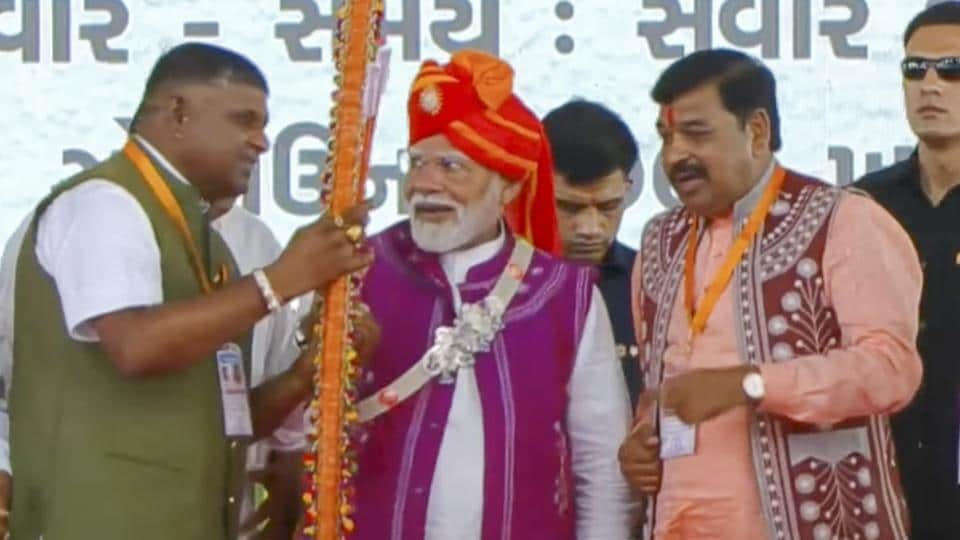
Modi, who arrived in his home state of Gujarat for the first time since Operation Sindoor was launched and on the 11th anniversary of taking office as the prime minister in 2014, said he gave the armed forces complete freedom. “...our valiant soldiers achieved a feat unseen by the world in decades. We pinpointed and confirmed the locations of nine major terrorist camps across the border,” he said in Gujarat’s Dahod, referring to the May 7 strikes on nine terror camps in Pakistan and Pakistan-occupied Kashmir.
The strikes in retaliation for the April 22 terror attack in Jammu and Kashmir’s Pahalgam sparked a series of attacks and counter-attacks. The military hostilities ended on May 10 as New Delhi and Islamabad reached an understanding after a four-day fight.
Modi referred to the April 22 attack and said India reduced terror camps to rubble in just 22 minutes in response. He added India responded firmly, forcing Pakistani troops to retreat in humiliation when they attempted to retaliate.
Modi referred to the personal milestone of completing 11 years in office and said Gujarat’s people placed their faith in him first. “...on this day in 2014, I took oath as Prime Minister for the first time. The people of Gujarat placed their faith in me first, and then the entire nation joined hands. Since then, I have carried that responsibility with full dedication. We have taken decisions that were once unimaginable and unprecedented...today, India stands transformed, moving forward boldly in every sector.”
He cited his roadshow in Vadodara before arriving in Dahod and said thousands of women gathered to honour and celebrate the armed forces. “And here [Dahod] too, I see you waving the tricolour, showering your blessings on Operation Sindoor…”
The family of Colonel Sofiya Qureshi, one of the two women military officers who held briefings on Operation Sindoor, joined Modi’s roadshow in Gujarat’s Vadodara.
Modi said the images from the Pahalgam attack made the blood of every Indian boil. “The terrorists challenged 1.4 billion people of this country...So, I did exactly what the people of this nation expected of the Prime Minister they elected.”
Modi, who was speaking after inaugurating India’s first 9000 HP locomotive engine, highlighted India’s potential for self-reliance and asked why India should use imported products when the world uses Indian products.
Modi recalled when he travelled in the tribal-dominated areas of Dahod on a bicycle as a Bharatiya Janata Party worker. “In Dabhoi, there used to be a train so slow that you could hop off and get back on while it was still moving,” Modi said.
He recalled a time when many tribal areas of Dahod had no schools. “I got to spend a long time in these tribal regions,” he said. He added that the transformation since then has been remarkable. “Today, from Umargam to Ambaji, there are colleges, including a medical college, two tribal universities, ITIs, and several other institutes. This change reflects the growing aspirations of our tribal youth and our commitment to meeting them.”
On Monday, Modi also inaugurated the Locomotive Manufacturing Shop at the Dahod Rolling Stock Workshop, a landmark production facility built for ₹21,405 crore. Developed in collaboration with Siemens AG, a German multinational, this factory will manufacture 1,200 high-power electric locomotives over the next decade, including India’s first indigenously built 9,000 HP freight engine capable of hauling 4,600 tonnes of cargo.
The project, which is part of the Make in India initiative, is expected to generate 10,000 jobs and position Dahod as a hub for advanced railway technology, said officials.
Modi inaugurated ₹2,287 crore railway projects, including the doubling of the Anand-Godhra, Mehsana-Palanpur, and Rajkot-Hadmatiya railway lines, the electrification of the Sabarmati-Botad section, and gauge conversion of the Kalol-Kadi-Katosan route. These upgrades aim to decongest rail networks, enhance freight efficiency, and support Indian Railways’ transition to 100% electrification.
Modi launched four drinking water schemes to provide 100 litres of clean water per person daily to 193 villages and one town in Mahisagar and Dahod districts. He inaugurated urban development projects worth ₹233 crore under the Dahod Smart City Mission and laid the foundation for road infrastructure worth ₹706 crore.
Modi said he supported the bifurcation of Panchmahal district as the chief minister to create Mahisagar to bring more focused development in this tribal-dominated region. He spoke about the Dharti Aaba Janjatiya Gram Utkarsh Abhiyan, named in honour of freedom fighter Birsa Munda, a major government initiative launched in November 2024 for tribal villages across India.