
 E-Paper



More stubble trouble in Punjab: Fires fewer but area affected more
The data, made available by the state’s own remote sensing centre highlights the apathy with which state and Centre administrators have approached the problem

 Prefer HTon Google


Punjab has touted the fact that the number of farm fires came down from 49,922 in 2022 to 36,623 last year, a fall of 26% in a pollution source blamed for the national capital’s poor air in October and November, but it now emerges that stubble on 19 lakh hectares was burnt in 2023, an increase of 26% over the stubble on 15 lakh hectares burnt in 2022.
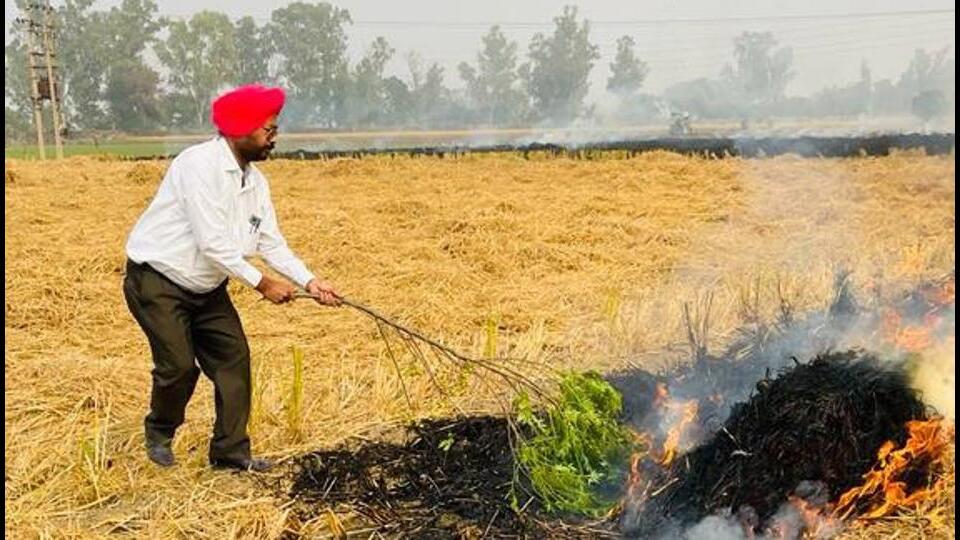
That area also corresponds to two-thirds of the area of paddy (rice) in the state.
The data, made available by the state’s own remote sensing centre highlights the apathy with which administrators, both in the state and the Centre, have approached the problem. To be sure, Delhi’s air quality is bad around the year, but stubble fires, mostly from Punjab — Haryana and Uttar Pradesh also contribute a bit — are a major source of pollutants in October and November.
“There is no doubt about the fact that the trend is very worrisome, and Punjab’s prestige is also at stake. So we need to take serious steps,” said KAP Sinha, special chief secretary rank Indian Administrative Service (IAS) officer who heads the state’s agriculture department, while addressing a day-long workshop on Wednesday to discuss steps to curb stubble burning.
He added that the agriculture department and other state entities would not wait until the middle of the year to start preparations, but start this month itself. Sinha said the process to supply subsidized machines to farmers for in-situ (mixing stubble into the soil) management of crop residue management will start immediately.
The director of the state remote sensing centre Dr. B. Pateriya added that the solution requires “technological advancements and a strong political will.” Farmers constitute a strong political lobby and the Aam Aadmi Party, which runs Delhi, and which was extremely critical of Punjab’s handling of the stubble fires in the past, has effected a U-turn after it came to power in the state.
Pateriya stood by the data that showed an increase in the area of fires: “One can camouflage the number of fires but satellite reads the area burnt accurately, so is the story of fall in number of cases and increase in the area,” he added, pointing out that a satellite imaging system cannot be cheated.
There are several reasons why Punjab’s farmers prefer to burn the stubble. The dependance on mechanised harvesting means fields are left with a stubble which is easily, inexpensively, and quickly removed by burning. Speed is important because the gap between the harvest of paddy and the planting of wheat is slim — in turn an effect of a water conservation law that dictates when the paddy crop can be planted. Then, there’s the issue of availability of machines that can deal with the stubble, and the expertise to use them.
Bhartiya Kisan Union president Balbir Singh Rajewal claimed farmers are a soft target, and insisted that industry and vehicular traffic cause more pollution. He accepted that burning should stop, while demanding that the farmers are already in distress and they need support from the government beyond the supply of subsidised machines.
About 20 million tonne of paddy straw is generated in the paddy harvest season, which also includes 3.3 million tonne stubble of the premium aromatic basmati variety. Out of the total paddy straw, the state government manages around 11.5 million tonne through various in-situ management measures and 4.67 million tonne by the ex-situ (evacuating stubble from the fields) method.
In 2018, with the intervention of the Prime Minister’s Office, a scheme for the supply of subsidized machines to manage stubble was launched. Till 2022 a total of ₹1,370 crore was given to farmers for purchase of machines; in all 1.17 lakh machines were acquired. In 2023, the Centre sanctioned ₹350 crore , and the state had to ₹140 crore.


