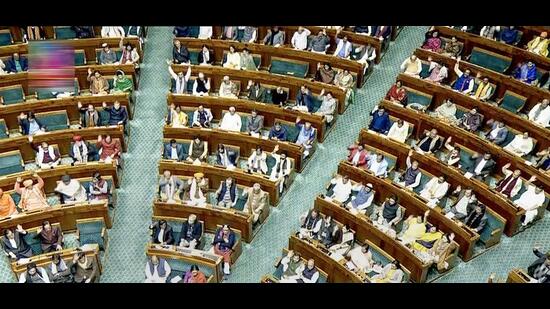
MPs may be able to pick assistants from expert pool
Lok Sabha MPs may soon choose professional assistants to enhance their performance, reducing dependence on aides, following the cash-for-queries scandal.
In the next Lok Sabha, MPs may be able to pick an assistant from a pool of experts to help improve their (the lawmakers’) performance, and reduce their dependence on personal assistants, people familiar with the matter said, adding that one trigger for the idea, which is in the works, was the fallout of the so-called cash-for-queries scandal involving the TMC’s Mahua Moitra.
Senior Lok Sabha officials are involved in developing the new system. (PTI)
The Lok Sabha secretariat is working on a plan to create a pool of professionals including retired House officials and external experts familiar with the various facets of parliamentary functioning. MPs, HT learns, will be free to choose an expert from that pool.
Senior Lok Sabha officials are involved in developing the new system, the people cited above added. To be sure, any such pool can be created only after the approval of the Speaker of the 18th Lok Sabha.
One of the people said that NIC’s decision to change the protocol and limit access of the personal assistants of lawmakers to the system following the scandal involving Moitra — she was expelled from the House on December 8 last year — was one of the factors considered.
But there was a larger issue, that of MPs giving the job of personal assistant to relatives or someone known from their constituency, said a second person. “We have seen that many of them are not accustomed to parliamentary functioning. This affects the MP’s performance in the House.”
“To help the MPs, we have decided to provide them professional support. We will hire both retired officials from the secretariat and also young professionals from colleges and universities who are aware of the procedures,” said the second official.
The Lok Sabha secretariat will decide a monthly remuneration for these experts. The first official pointed out that PRS Legislative Research runs a similar programme called The Legislative Assistants to Members of Parliament or LAMP. A fellowship programme, it offers an opportunity for young Indians to understand law-making and public policy. “LAMP Fellows are mentored by a Member of Parliament (MP) and work full-time with the assigned MP during a given year, starting from the Monsoon session of Parliament till the end of the Budget session,” according to the PRS website.
Chakshu Roy, Head of Legislative and Civic Engagement, PRS Legislative Research, said, “Our MPs are responsible for holding the government accountable, discussing complex legislation, the union budget and national policy issues. To strengthen their role as legislators, there is an urgent need to support them with high-quality research and secretarial staff. And every initiative taken by the Lok Sabha secretariat towards this end will lead to a more deliberative Parliament. It will add to the quality of discussions and is an urgent requirement for deepening democracy.”
“The primary role of a LAMP Fellow is to provide extensive research support to her/his MP for their parliamentary work. This includes drafting parliamentary questions for the MP, preparing the MP’s speeches for zero-hour debates, raising matters of public importance, and drafting private members’ bills,” he added.
The Lok Sabha’s assistance programme will be based on the same model, said a third official familiar with the plan.
The Lok Sabha already has two established channels to assist MPs. PRISM or parliament’s research wing provides well-researched documents on bills to the lawmaker. There is also a 24x7 helpline to give general information.
After the cash-for-questions scandal last year, NIC and the secretariat brought about significant changes in the access to PAs. They could earlier access the Digital Sansad system to file documents such as parliament questions, requests for short-duration, zero-hour discussions, draft bills, amendments, etc through their accounts. They can now only save these as drafts and the lawmakers have to submit/file them.
The PAs and staff of lawmakers will still have their own accounts with the Digital Sansad portal and OTP (one-time password) delivered on their mobile numbers. But they can’t post notices. That can only be done by lawmakers. To be sure, this is effected through a One Time Password (OTP) sent to the MP’s phone, and they can still share these, or even give the phones, to their PAs.

 E-Paper