
 E-Paper



NC, Cong finalise 51-32 deal for J&K elections
The NC and Congress sealed a seat-sharing pact for J&K assembly elections, with NC contesting 51 seats and Congress 32. They face BJP and other local parties.


The National Conference (NC) and the Congress on Monday sealed a seat-sharing pact for the upcoming assembly elections in Jammu and Kashmir, with the former agreeing to fight 51 out of the 90 seats and the latter contesting 32. The two parties will have a “friendly contest” on five other seats, and one seat each will be fought by allies Communist Party of India (Marxist) and Panthers Party.
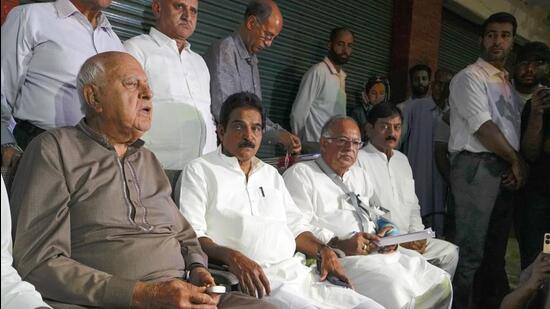
The announcement came after days of hectic negotiations and two back-to-back meetings at the residence of NC patriarch Farooq Abdullah.
“Our alliance had been forged against those forces who want to divide country on communal lines. We completed our negotiations in a cordial atmosphere and Congress and the NC will jointly contest this election,” he said at a joint press conference in Srinagar, flanked by senior Congress leaders.
Congress general secretary KC Venugopal said that the idea of this alliance was to save the soul of Jammu and Kashmir. “On one side, the BJP is trying to destroy the soul of Jammu & Kashmir and main idea of the INDIA bloc is to save this soul of J&K. We will fight together and form government in Jammu and Kashmir,” he said.
The first assembly elections in Jammu and Kashmir in a decade will be held in three phases on September 18 and 25, and October 1. This is also the first assembly polls in the restive region since its special status and statehood were scrapped five years ago and is likely to be the last step before the Union territory’s statehood is restored.
There are a total of 90 assembly constituencies in the Union Territory, of which 74 are general, nine are reserved for scheduled tribes and seven for scheduled castes. The announcement comes against the backdrop of a major police reshuffle in J&K which has been convulsed by mounting terror attacks in the Jammu region over the last two years. A month ago, the Union government also widened the scope of the lieutenant governor’s (LG) powers, in what is likely to be a significant poll issue.
The NC-Congress alliance will be up against the Peoples Democratic Party (PDP), also a member of the INDIA bloc, as well as the BJP and a host of local parties such as the People’s Conference, the Apni Party and the Democratic Progressive Azad Party.
After the announcement, former chief minister Omar Abdullah, who had vowed not to participate in the assembly elections till the restoration of statehood, hinted that he might change his mind.
“I am conscious of one thing which I had not thought over fully, which is my mistake. If I was not ready to contest election for an assembly, how can I get the people ready to vote for that assembly?”How can I hope that my colleagues will seek votes for an assembly which I am not ready to accept or may be suggesting that I look down upon? It has put a pressure on me and I do not want to give a wrong signal to the people,” he said.
On Monday morning, Venugopal and senior leader Salman Khurshid arrived in Srinagar and held two rounds of talks with the NC leadership at Abdullah’s residence. After four hours of meeting, both parties reached an agreement.
“We have agreed to hold friendly contest on five seats in very cordial and disciplined manner. We have left one seat for CPI(M) and one for the Panthers Party. We have stated numbers for each phase of polls for both Congress and the NC and will start issuing mandates from right now,” said J&K Congress chief Tariq Hameed Karra.
Venugopal said that the alliance will form a government and will have common minimum programme.
“The people of Kashmir have been cheated by the BJP. Here the state became UT, and it was done by the BJP. They cheated the people of J&K and we now want a BJP-free government in J&K,” he said, adding that the unemployment problem in J&K was mounting by the day.
The NC and Congress formed a post-poll alliance in 2008, with Omar Abdullah leading the coalition government for the full term as the chief minister.
The two parties did not tie-up for the 2014 polls and contested all seats separately. The PDP emerged as the single-largest party with 28 seats and formed an alliance of ideological extremes with the BJP, which had 25 seats. But the coalition collapsed early in 2018 after the BJP withdrew support and governor’s rule was imposed in June. The NC won 15 seats in 2014, and the Congress 12.
On August 5, 2019, the Union government revoked Article 370 of the Constitution and bifurcated the erstwhile region. Last year, the Supreme Court upheld the abrogation of Article 370 but fixed a deadline of September 30 for assembly elections to be held in the region.
This is the first assembly polls in the Union territory since a controversial delimitation exercise earmarked 47 assembly seats for Kashmir and 43 for Jammu in its final order. The panel gave Jammu six additional seats and Kashmir one, sparking allegations from the Opposition that the balance was tilting in favour of Hindu-majority Jammu. The panel also reserved nine seats for scheduled tribes, a first, renamed some assembly constituencies, and redrew some others.
The polls are likely to revolve around issues of statehood, Kashmiri identity, the impact of Article 370’s abrogation and the spike in terror in Jammu, as well as everyday developmental and civic issues.


