
 E-Paper



‘Need to break mental walls to avoid another trauma of partition’: Ram Madhav
Ram Madhav said there was a need to learn from the mistakes of the past and ‘build bridges’. Speaking at JNU, he said the partition of India was not just between territories but also a partition of minds

 Prefer HTon Google


Rashtriya Swayamsevak Sangh (RSS) functionary Ram Madhav on Saturday said “mental walls of separation” within the country needed to be pulled down and elements backing “separatism” and “communal separation” needed to be discouraged to build one united Indian society and avoid another trauma of partition.
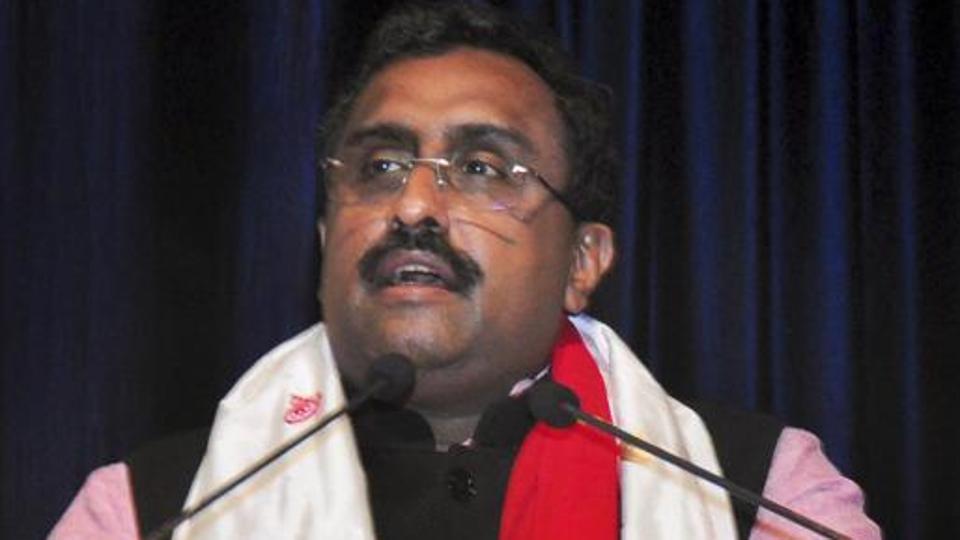
While speaking during a webinar hosted by the Jawaharlal Nehru University (JNU), themed “India, Partition and its Aftermath: Remembering the Horrors of History”, Madhav described the partition as a “cataclysmic event” and a result of “errors of judgement”. He also alleged that Pakistan’s founder Mohammad Ali Jinnah was allowed to “grow into a monster” during the partition struggle.
The event was held in the light of Prime Minister Narendra Modi’s announcement to observe August 14 as the ‘Partition Horrors Remembrance Day’ in the memory of the struggles and sacrifices of people during the partition.
“Partition of India, unlike many other partitions seen in other countries in that period, was not a simple redrawing of boundaries... and it also took place on a false premise that Hindus and Muslims were separate nations, even though they had been living together despite their different practices...It is a known fact that the driving force behind India’s partition was the Muslim League. But it’s also a fact that the Muslim League never represented the entire Muslim community,” he said.
Madhav added that there was a need to learn from the “mistakes of the past”, and attempts should be made to “build bridges”. “The Partition of India was not just a partition of territories but also a partition of minds... We need to build a united Indian society. And, that can happen only if the leadership and elements believing in separatism and communal separation are discouraged, and the sense of one nationhood is encouraged,” he said.
“We need to pull down the walls of mental separation and create one united Indian society so that India shall not have to bear another trauma of partition. And, the next step will be to build bridges with those who left us to become another entity...We need to find ways to build bridges that will be the real undoing of the Partition. Maybe, geographical, political and physical boundaries will remain, but the mental boundaries, the boundaries of divided hearts can be erased,” he added.
JNU vice-chancellor M Jagadesh Kumar said the writings on the history of the partition of India are “largely influenced by western thought process and a prejudiced mindset”. “These historians seem to have underplayed and deliberately tried to suppress the fact that partition and creation of Pakistan was the result of religious fundamentalism and the idea of (a) religiously-defined community. In India, on the other hand, for centuries, we always welcomed and respected anyone irrespective of what personal faith they followed. The collective memories of suffering resulting from the partition of our country cannot be forgotten. It should be visited and revisited so that we learn lessons and should not repeat the horrific history,” Kumar said.
A Bharatiya Janata Party (BJP) Member Of Parliament (MP) in Rajya Sabha and the president of Indian Council for Cultural Relations (ICCR) Vinay Sahasrabudhhe also participated in the webinar.


