
 E-Paper



Nehru to Savarkar, PM Modi praises leaders from across divide
PM Modi recalled the role of over 30 leaders, including women freedom fighters and tribal revolutionaries, in the freedom struggle.


From India’s first Prime Minister Jawaharlal Nehru to right-wing ideologue Vinayak Damodar Savarkar, tribal leader Birsa Munda to social reformist Ram Manohar Lohia – Prime Minister Narendra Modi on Monday paid tribute to freedom fighters, social revolutionaries and leaders from across political spectrum for their contribution in the freedom struggle as India marked 75 years of Independence.
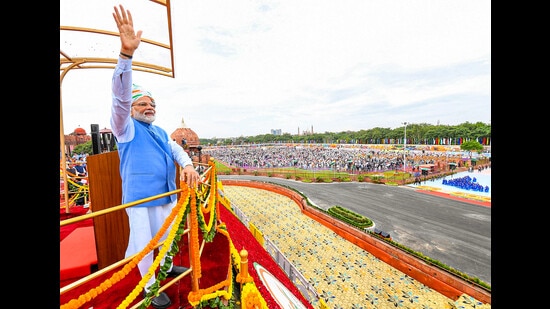
Independence Day is an opportunity for the country to “bow down and salute all such brave hearts”, Modi said during his address to the nation from the ramparts of the Red Fort, as he recalled the role of over 30 leaders, including women freedom fighters and tribal revolutionaries, in the freedom struggle.
“The legends of every sacrifice made by every great soul. This is an opportunity to also solemnly acknowledge their debt and pledge to fulfil their dreams at the earliest with deep resolve,” he added.
Recalling the contribution of leaders from diverse political backgrounds, including Mahatma Gandhi, Netaji Subhas Chandra Bose, Bhim Rao Ambedkar and Savarkar, Modi said the country is “deeply indebted” to them for devoting their lives to the “path of duty towards the nation”.
He also dedicated himself to fulfilling Gandhi’s dream of “empowering and uplifting the person sitting at the last mile”.
“Today is an opportunity to pay homage to countless such great men like Dr Rajendra Prasad ji, Nehru ji, Sardar Vallabhbhai Patel, Syama Prasad Mookerjee, Lal Bahadur Shastri, Deendayal Upadhyay, Jaya Prakash Narayan, Ram Manohar Lohia, Acharya Vinoba Bhave, Nanaji Deshmukh, and Subramania Bharati who fought the war of Independence and built the country after Independence,” Modi told the crowd.
The “country is also grateful” to freedom fighters such as Bhagat Singh, Sukhdev Thapar, and Shivaram Rajguru – all of whom were hanged to death on March 23, 1931 in the Lahore Conspiracy case – Chandra Shekhar Azad, Ashfaq Ulla Khan, Ram Prasad Bismil, for “shaking the foundation of British rule”, Modi said.
He also lauded women freedom fighters from across the country, including Rani Lakshmibai, Jhalkari Bai, Durgavati Devi, popularly known as Durga Bhabhi, Rani Gaidinliu, Rani Chennamma, Begum Hazrat Mahal and Velu Nachiyar, for showing “the mettle of women power of India”.
Gaidinliu was a spiritual and a Naga political leader who was arrested at the age of 16 by the Britishers and sentenced to life imprisonment. Nachiyar, who was the queen of Sivaganga state (present-day Tamil Nadu), had rebelled against the East India Company. She is known as Veeramangai (brave woman) among Tamils.
“What is the resolve of India’s ‘Nari Shakti’? Every Indian is filled with pride while remembering the countless brave women who achieved the pinnacle of sacrifice,” he said.
Modi also hailed tribal revolutionaries such as Bhagwan Birsa Munda, Sidhu and Kanhu Murmu, Alluri Sitarama Raju, and Govind Guru, among others, for becoming the “voice of freedom movement in the remotest jungles to live and die for the motherland”.
Birsa, a folk hero from Munda tribe in Ranchi, was arrested for his activism against the British rule, and died in prison at the young age of 25 in 1900.
Sidhu Murmu and Kanhu Murmu, who belonged to the Santhal tribe in present-day Jharkhand, were also known for their rebellion against British rule. India’s President Droupadi Murmu also belongs to the Santhal tribe.
The Prime Minister also highlighted the contributions of social reformers and philosophers such as Narayana Guru, Swami Vivekananda, Sri Aurobindo and Rabindranath Tagore for “awakening the consciousness of India in every corner and every village of India, and keeping this consciousness alive”.


