
 E-Paper



Newly harvested crops selling below MSPs despite price rise
According to government data for October, harvest prices are lower than MSP for at least eight major crops, including groundnut (which yields edible oil), bajra (pearl millet), jowar (sorghum), maize, tur, arhar, moong, and paddy, even as the country pays high import prices for edible oils.


Freshly harvested summer-sown produce is selling below federally fixed minimum support prices (MSPs) in several parts of India despite a global commodity price surge -- a long and familiar trend that benefits consumers but stokes farmers’ angst.
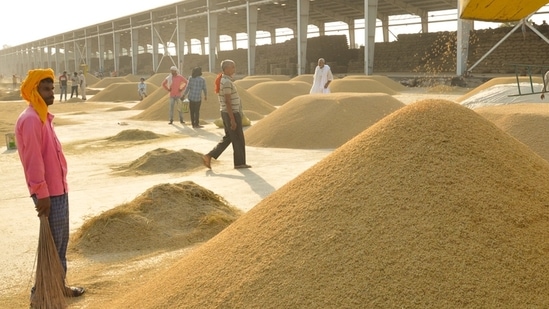
According to government data for October, harvest prices are lower than MSP for at least eight major crops, including groundnut (which yields edible oil), bajra (pearl millet), jowar (sorghum), maize, tur, arhar, moong, and paddy, even as the country pays high import prices for edible oils.
Lower food prices help to keep inflation in check, but hurt farm incomes. Getting markets to maintain a balance between profitable rates for farmers while keeping food inflation in check has been an increasingly tough policy goal. On Friday, the government said in a statement that its move to cut basic customs duty on edible oils brought down prices from a historical peak this year by ₹4-7 a litre by this week in major wholesale markets of the country.
Data from the official Agmarknet platform for 14 agricultural markets shows that, in October, average prices of produce from the summer-sown season were up to a third (33%) lower than MSPs for crops such as paddy, coarse cereals, pulses, and some crops that yield edible oil, such as groundnut.
Bajra or pearl millet was a third lower than the benchmark MSP, while maize prices were lower by 12% last month, the data shows.
A large number of farm unions are on strike since last year, demanding the government scrap three new laws brought to liberalise agricultural trade. Farmers also want a law that guarantees MSPs for all produce.
MSP is a benchmark rate that assures a minimum 50% profits over a narrower measure of cost of cultivation and farmers say any price below MSP meaning selling at a loss. It is also meant to stave off distress sale. Non-realisation of MSP is at the heart of the politically challenging farm protests.
Ahead of the summer-sown season in June 2021, the Union Cabinet raised MSP of summer-sown crops by between 1.8% and 6.7% in keeping with a policy to offer farmers at least 50% returns over the cost of cultivation.
Relief to consumers can come at cost of farmers. The farm sector offers livelihood to half of all Indians and rural incomes drive countryside demand. “What is the use of such MSP announcements when we don’t get them in reality?” asked Amrik Singh, a farmer from Haryana’s Babain area over the phone.
For instance, lowering of tariffs on imported edible oil will depresses local prices because traders find it cheaper to import, although absolute prices remain high. The move to cut edible oil duties has made groundnut oil cheaper, and this will impact locally produced groundnut too, according to previous trends.
Retail inflation, as measured by the official Consumer Price Index, dipped to a five-month low in September, led by lower inflation across a number of food items. The index climbed 4.35% in September 2021, compared with a 5.3% rise in August 2021, according to official data.
“One reason why many commodities are fetching lower prices this time around is the high moisture content during heavy rains this year,” said Ashok Agrawal of Comtrade, a commodities trading firm.
The government buys large quantities of cereals from farmers at MSP rates, and distributes them to beneficiaries through the public distribution system at subsidised rates. This is primarily how farmers benefit from the MSP system. However, the government largely buys only wheat and rice and purchases only token quantities of other produce like oilseeds and pulses. Oilseeds and pulses procured are no more than 2.5% of total produce, official data show. This means the government’s intervention in the markets does not quite improve rates.
MSPs for crops have failed to keep pace with input costs, or expenses farmers incur towards cultivation, according to data from the Commission for Agricultural Costs and Prices — one reason for farmers protests across the country that could have significant economic and political impact.
The cost of cultivation varies across states, while MSPs are based on a weighted all-India average, another reason farmers don’t get guaranteed profits.
Calculations by economist the late T Haque, who formerly headed the NITI Aayog’s land cell and died of Covid-19 earlier this year, show that input costs have risen faster than MSPs in some cases. For instance, between 2004–05 and 2014–15, cultivation costs of paddy grew by 11.2% annually in Bihar and 11.9% in West Bengal, while the MSP of paddy increased at the rate of 10.6% per year.
Haque used a more comprehensive definition of a farmer’s cultivation cost known as C2, which includes imputed costs of capital assets and rental value of land. In deciding MSPs, the government continues to use a narrower yardstick, the so-called “A2+FL” measure, which includes all out-of-pocket expenses plus the value of family labour used.
“Many reasons can make MSPs ineffective. Low demand or policies that discourage exports, especially at a time when international prices are high are examples,” said R Mani, a former economist with the Tamil Nadu Agricultural University.


