
 E-Paper



NSA Ajit Doval holds meet with Hindu, Muslim leaders after Ayodhya verdict
According to the NSA office, Ajit Doval’s residence was the meeting point of 18 Hindu religious leaders and intellectuals with 12 prominent Muslim clerics and scholars.

 Prefer HTon Google


National Security Advisor Ajit Doval acted as a bridge for an inter-faith dialogue between eminent Hindu and Muslim religious leaders and intellectuals to strengthen communication, amity and brotherhood on Saturday, a day after the Supreme Court’s judgement on the decades-long Ayodhya issue.
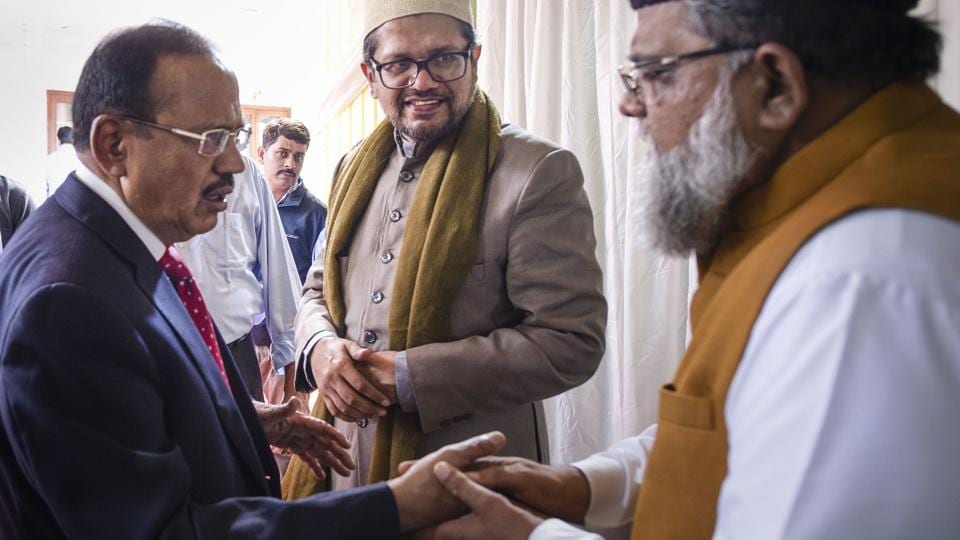
According to the NSA office, Ajit Doval’s residence was the meeting point of 18 Hindu religious leaders and intellectuals with 12 prominent Muslim clerics and scholars. Since his days as NSA, Doval has always kept in touch with religious scholars on both sides with the national security perspective in mind.
The meeting had the blessings of Prime Minister Narendra Modi, who wants to seek closure on the entire dispute and does not want this to be a festering wound. In spite of all the pressures, the PM was clear from day one that the solution has to come from the court rather than legislation.
ALSO WATCH: Ayodhya ruling | PM to Opposition, litigants to babas: How India reacted
It is understood that all the participants reposed full faith in the rule of law and the Constitution of India. The leaders resolved to honour the decision of the Supreme Court and appealed to all the countrymen to abide by it, emphasising that national interest overrides all considerations.
The scholars from both communities extended their full cooperation to the Modi government in ensuring peace, communal harmony and upholding the rule of law.
The Hindu scholars and eminent persons were represented by : Shri Avadheshanand; Swami Parmatamananda; Vishwesha Teertha Pejawar Swami; Swamis Shruti Siddhanand; Nirmalanand Natha; Bodhasarananda; Mitranand; Perur Adheenam; Chinna Ramanuja Jeeyar; Chidanand; Baba Ram Dev; Jananand; Jagadguru Sri Shivarathri Deshikendra Mahaswami of Suttur Math; VHP working president Alok Kumar; VHP leaders Champat Rai, Surinder Jain, Jiveshwar and Swami Kamaldas.
The Muslim scholars and clerics were represented by Prof Akhtrul Wasey, president, of Maulana Azad University, Jodhpur, Navaid Hamid, president All India Muslim Majlis-e-Mushawrat, Maulana Saeed Ahmed Noori, president of Mumbai’s Raza Academy; Maulana Mahmood Ahmed Khan Daryabadi, general secretary of All India Ulema Council, Mumbai and Shia leader Maulana Kalbe Jawad.
Janab Sirajuddin Qureshi, president of India Islamic Culture Centre; Janab Mujtaba Farooq, secretary-general of All India Muslim Majlis-e-Mushawrat; Maulana Ashgar Ali Imam Mehdi Sufi, president of Anjuman-I-Islam, Mumbai; Syed Nasuruddin Chisty, Mohammed Engineer Slim, vice-president of Jamait-e-Islami Hind and Pir Farid Ahmed Nizami of Dargah Nizamuddin Auliya were also present.
The interaction took place at 11.30 am followed by lunch.
According to NSA office, those attending the meeting were alive to the fact that certain anti-national and hostile elements, both within and outside the country, may attempt to exploit the situation and hit at the national interest.
The religious leaders pledged their unstinted support to the Modi government in all the measures it may take to maintain peace, law and order in the society.
Both the sides noted with satisfaction that the millions of Indians, belonging to both communities, displayed a great sense of responsibility, sensitivity and restraint in accepting the court verdict.
All the participants appreciated the initiative on part of the NSA and emphasised on a continuous dialogue between communities in future so that security of all Indian is ensured.


