E-Paper



Number Theory: How little snowfall has India received this January?
Historical average shows that this time of the year, more than half of J&K, Himachal Pradesh, Uttarakhand, and almost all of Ladakh should be covered with snow
Updated on: Jan 29, 2024, 07:54:45 IST


Share via


Copy link

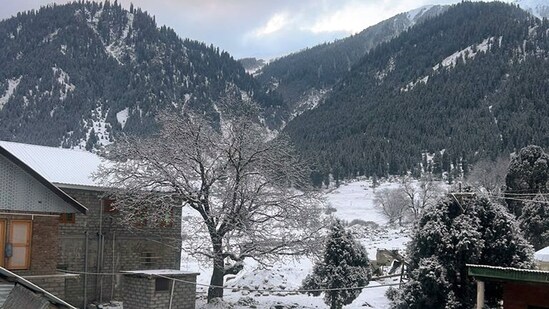
Anecdotal accounts suggest that India’s hills and mountains have not received as much snow this winter as they did in the past despite the spell of snowfall late last week. While snowfall data is not available from the India Meteorological Department (IMD), its rainfall statistics suggest that this could be the case.
However, rainfall data alone cannot show the presence or lack of snow, which is also a function of temperature. It is in solving this problem of measurement that satellites can help. HT analysed NASA’s FLDAS2 Noah-MP GDAS Land Surface Model data for the Central Asia region – it gives daily data on snow from October 1, 2000 – to find how much snow India’s northern states have received this winter. This is what the data shows.
How little snowfall has India received this January?
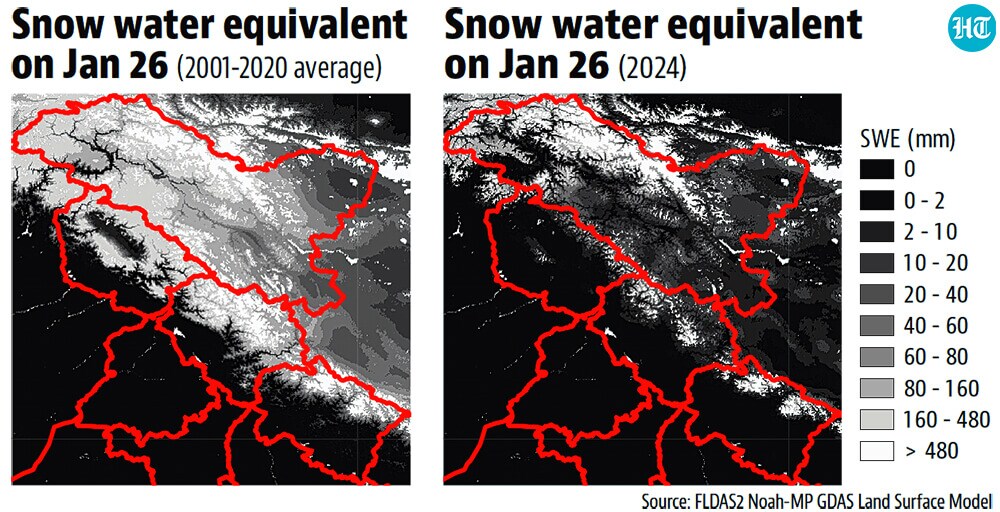
 This January is far greyer in India’s hilly states than in the pastMaps of accumulated snow show just how far from normal this winter’s snowfall is. The two accompanying maps show the accumulated snow – represented throughout this analysis by snow water equivalent (SWE) or the water content of snow – in India’s northern states on January 26. The first map shows the average SWE on January 26 for the 2001-2020 period and the second map shows the SWE on January 26, 2024, the latest available data. The historical average shows that at this time of the year, more than half of Jammu and Kashmir, Himachal Pradesh, and Uttarakhand; and almost all of Ladakh should be covered with some snow. In sharp contrast to the past, all these four territories are severely lacking in snow this year. Jammu and Kashmir, Ladakh, Himachal Pradesh, and Uttarakhand are far greyer than they should be despite the ongoing spell of snowfall.
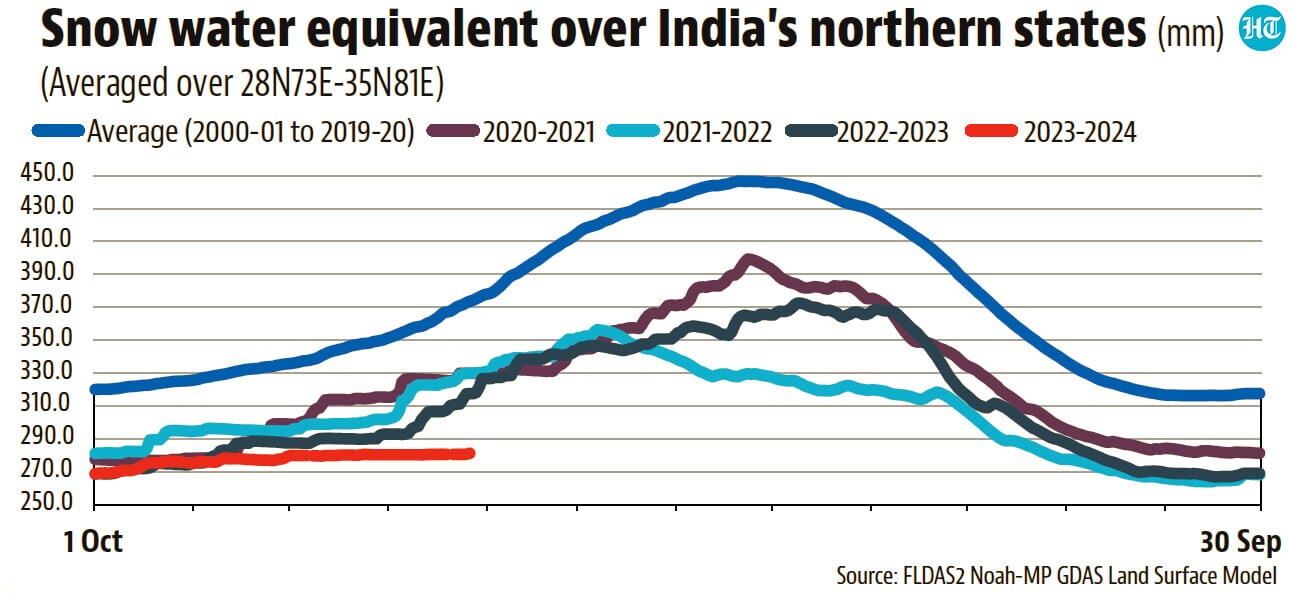
- How much snow is missing from India’s northern hills and mountains?While the maps above show 2024 snow pack’s contrast with the past clearly, it is important to calculate its degree of departure. This is because a departure from expected snow pack may not always be visible on a map. However, numbers confirm the trend seen on the maps. The average SWE over India’s hilly states (this average covers the full rectangle shown in the map, an area somewhat bigger than the political boundaries of India’s northern states) is the lowest for January 26 since 2001, the first year for which the NASA dataset has January data. It is almost 25% less than the average snow pack for January 26 during 2001-2020. This deviation is also more than the beginning of India’s snow pack season. As the accompanying chart shows, India’s snow pack usually starts building gradually around October and picks up pace during January. This year, on the other hand, there has hardly been any change in India’s snow pack since October. This is why SWE’s deviation has increased from around 16% on October 1 to 25% on January 26. To be sure, the snowfall on January 26 added around 0.5 mm of SWE to the snowpack, the ninth biggest single-day addition since October. However, this did nothing to change the deficit compared to the past.
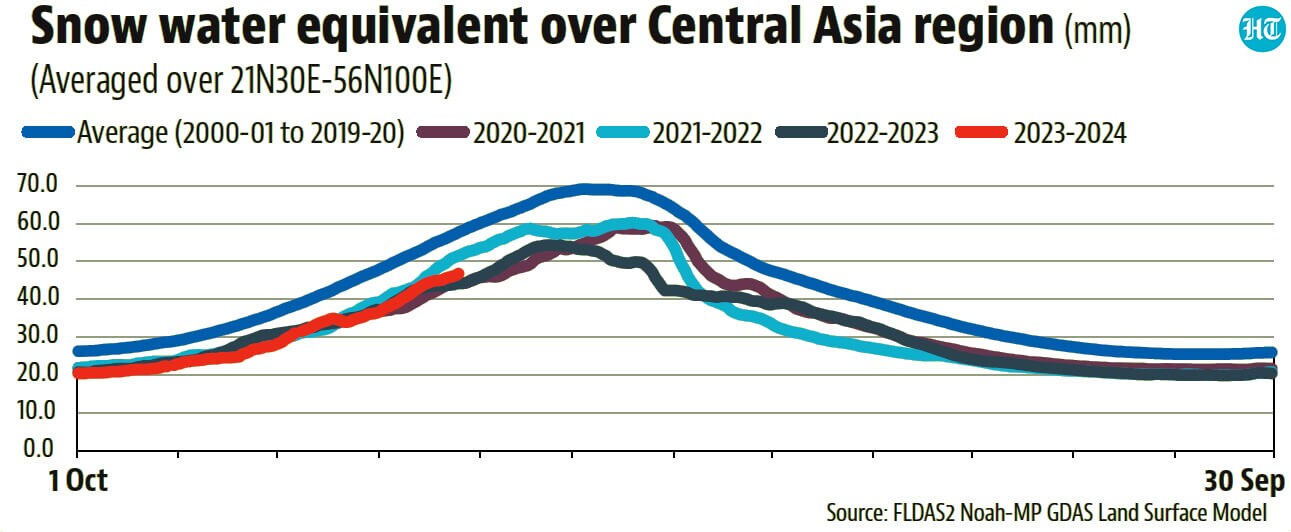
- Dry winter in the mountains is also the case across Central AsiaThe trend seen above is not affecting just India. SWE averaged over the entire Central Asia region for which this data is available (30-100°E, 21-56°N) shows that region is also suffering from a dry winter. On January 25, the average SWE over the Central Asia was the fourth lowest since 2001 and 19% less than the past 20 years’ average. As these numbers suggest, the wider Central Asia region isn’t running as dry as India’s northern states, although it is not doing very well either. Moreover, the Central Asia region as a whole has moved slightly closer to past averages in January. On October 1, the region had a 22% deficit in SWE compared to the 20 years’ average, which has now decreased to 19%.
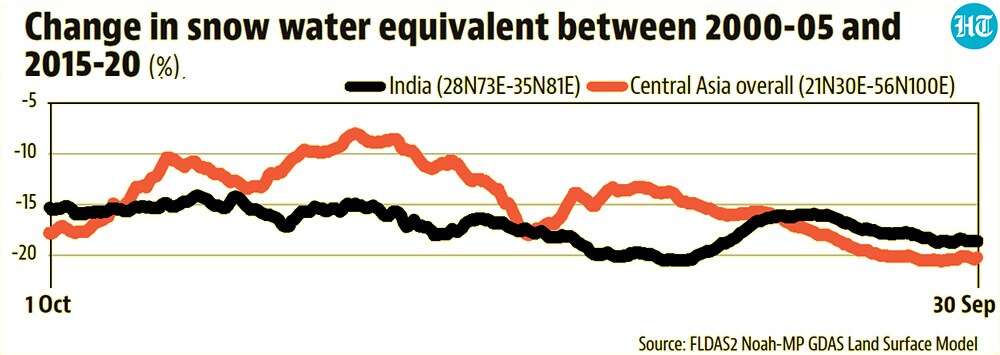
- Snow has been decreasing on India's hills and mountains for several yearsTo be sure, snow-less winters in India’s mountains should not be surprising. In the NASA dataset, the average SWE over India’s hilly states has been decreasing almost continuously if averaged over five-year periods. Each day of the October-September snow cycle during 2015-2020 had at least 14% less snow than during 2000-2005 on average. This trend is also mirrored by the wider Central Asia region, but to a smaller degree. These trends can only be expected to intensify in the future as global warming picks up pace.