E-Paper



Odisha: ASI starts sand removal at Konark Sun Temple’s ‘Jagamohan’ after a century
ASI begins sand removal from Konark Sun Temple’s assembly hall Jagamohan after 123 years, using controlled drilling and robotics to ensure safe conservation of the monument

 Prefer HTon Google


Archaeological Survey of India (ASI) has begun the sand extraction process in the assembly hall, Jagamohan, of the Konark Sun Temple in Odisha, in a carefully planned effort to stabilise and conserve the 13th-century monument.
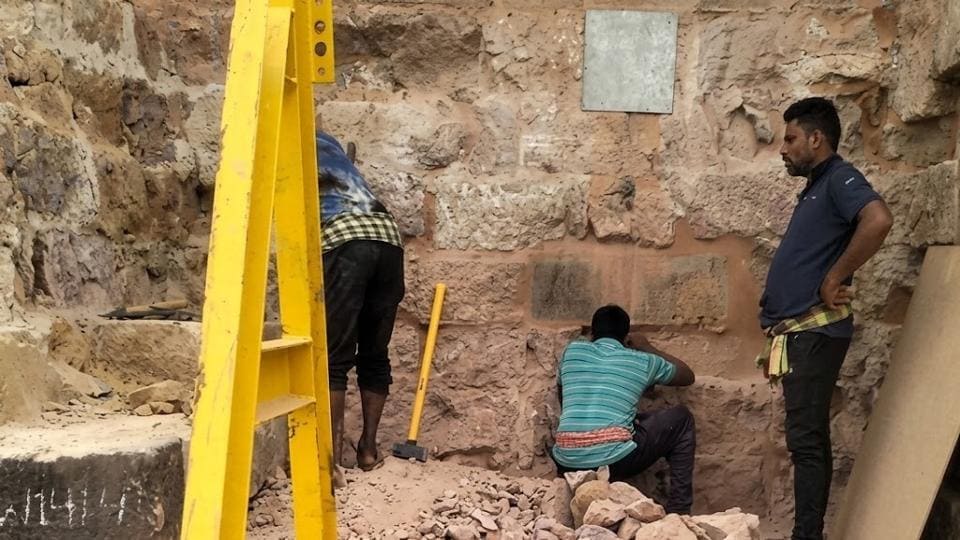
The sand extraction process in the Jagamohan, which has remained sealed for about 123 years, is likely to be completed in three months, ASI officials said.
Controlled drilling, robotic systems to aid conservation effort
The agency has started creating a narrow passage between the first and second “pidha” on the western wall to manually remove sand and conserve the inner structure. “The dimension of the passage will be 6 ft by 5 ft, through which sand will be removed manually,” Superintending Archaeologist of ASI’s Puri Circle Dibishada Garnayak said.
Garnayak added that the process began after receiving approval from ASI Director General Yadubir Singh Rawat and technical clearance from the Indian Institute of Technology Madras, which assessed that sand removal would not endanger the structure.
Engineers have constructed a working platform to transport sand using trolleys, while drilling of the passage is being carried out slowly to avoid stress on the ancient monument. Earlier, two core drillings were conducted on the western wall under controlled, vibration-free conditions using diamond drilling techniques.
In parallel, a larger engineering operation is underway to access the inner sanctum. A tunnel approximately 9 feet wide is being cut at a height of around 80 feet on the western side of the temple. Officials said no personnel will enter the tunnel directly due to safety concerns. Instead, robotic trolleys will be deployed to collect sand from inside the chamber.
The extracted material will be transported through pipelines and stored at a designated location on the north-western side of the temple complex. Experts said laboratory analysis confirmed that the sand had historically supported the structure but could now pose risks due to weight and moisture accumulation.
22 years of planning and scientific assessment
The project follows nearly 22 years of planning and technical studies, including laser measurements, endoscopic imaging and sample testing. Around 30 teams of engineers, archaeologists and conservation specialists are involved, using zero-vibration equipment to prevent damage to the temple’s thick stone walls.
The Jagamohan was filled with sand between 1901 and 1904 by British engineers to prevent collapse after structural weakening caused by weathering and lightning. Over time, however, the sand compacted unevenly, creating voids and raising concerns about internal stress on the stone and iron beams.
Preliminary estimates suggest that several metres of sand accumulated inside the structure. Officials said the removal process is highly sensitive and could take months to complete, with real-time monitoring systems in place to track any structural changes.
The 800-year-old monument, built by Ganga dynasty king Langula Narasingha Deva I to worship the Sun God, has already lost its main sanctum and Natya Mandap to the vagaries of nature, with only the Jagamohan (porch) surviving. Historical records indicate that around 1,200 stone craftsmen and artisans constructed the temple over 16 years using chlorite and sandstone.
The temple, a UNESCO World Heritage Site and a major tourist attraction, draws millions of visitors annually. Though some conservationists have raised concerns about the risks involved in removing the sand from such an ancient structure, ASI officials said the work is being carried out under strict supervision using advanced engineering methods.
“This is not ordinary excavation but a scientific conservation exercise aimed at ensuring the monument’s long-term stability,” said Gadnaik.