
Odisha watchman bitten by krait, cycles to hospital with snake in bag; critical
An Odisha watchman cycled to hospital with a venomous common krait in a polythene bag after it bit him, before his condition deteriorated.
A watchman in Odisha cycled to a hospital with a venomous common krait in a polythene bag after the snake bit him on the leg while he was on duty, doctors said. Mochiram Tudu, from Mayurbhanj district, later developed complications and was referred to a hospital in Baripada for further treatment.

A watchman in Odisha cycled to a hospital with a venomous common krait in a polythene bag after the snake bit him on the leg while he was on duty, doctors said.
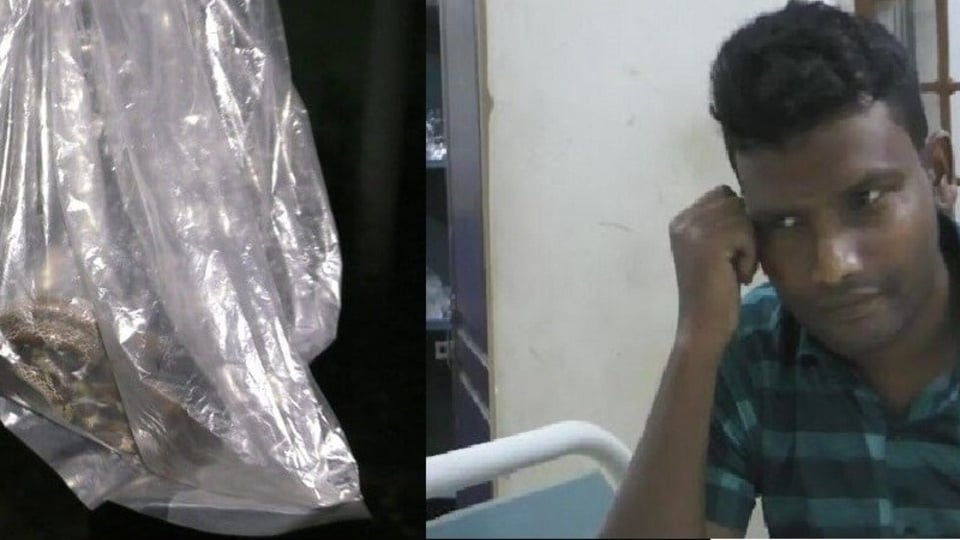
Mochiram Tudu, from Mayurbhanj district, later developed complications and was referred to a hospital in Baripada for further treatment.
Tudu was on duty at the office of the assistant engineer of a lift irrigation project in Ward No. 10 of Udala town when the snake bit him at around 8 pm on Friday.
Tudu initially did not realise that he had been bitten by a common krait and could not identify the reptile. Once he understood the seriousness of the incident, he caught the snake, killed it and packed it in a polythene bag. He then cycled to the Udala Sub-Divisional Hospital, carrying the dead reptile with him.
Doctors at the hospital identified the reptile as a common krait and immediately began treating Tudu. His condition deteriorated later in the night, prompting doctors to refer him to the PRM Medical College and Hospital in Baripada for further treatment.
“His treatment was started immediately, but his condition deteriorated during the night,” said Dr D. Jena, in-charge additional district medical officer at the Udala Sub-Divisional Hospital.
Tudu still remains under observation at the Baripada hospital.
Snakebite is a major cause of disaster-related deaths in Odisha, ranking second only to drowning. The state recorded 1,150 snakebite deaths in 2023-24, while 709 fatalities were reported in 2024-25, with coastal and northeastern districts among the worst affected.
The Odisha government is planning a series of measures to reduce snakebite deaths, including village-level awareness campaigns and improvements in housing and sanitation to reduce the presence of snakes and rodents.
Officials also plan to promote protective equipment such as gumboots and torches for people moving outdoors at night and train frontline workers, including ASHA and anganwadi workers, nurses and teachers, in early recognition of snakebite and first response.
The state also plans to strengthen doctors’ capacity to administer anti-snake venom, establish snake rescue teams at district and block levels and ensure uninterrupted supplies of anti-snake venom at primary and community health centres.
Dedicated snakebite treatment centres are also proposed in high-risk districts, along with round-the-clock emergency transport to reduce delays during the critical period after a bite.

--- correct eng only if needed, don’t change quotes unless grammar or punctuation change
A watchman in Odisha cycled to a hospital with a venomous common krait in a polythene bag after the snake bit him on the leg while he was on duty, doctors said.
Mochiram Tudu, from Mayurbhanj district, later developed complications and was referred to a hospital in Baripada for further treatment.
Tudu was on duty at the office of the assistant engineer of a lift irrigation project in Ward No. 10 of Udala town when the snake bit him at around 8 pm on Friday.
Tudu initially did not realise that he had been bitten by a common krait and could not identify the reptile. Once he understood the seriousness of the incident, he caught the snake, killed it and packed it in a polythene bag. He then cycled to the Udala Sub-Divisional Hospital, carrying the dead reptile with him.
Doctors at the hospital identified the reptile as a common krait and immediately began treating Tudu. His condition deteriorated later in the night, prompting doctors to refer him to the PRM Medical College and Hospital in Baripada for further treatment.
“His treatment was started immediately, but his condition deteriorated during the night,” said Dr D. Jena, in-charge additional district medical officer at the Udala Sub-Divisional Hospital.
Tudu remains under observation at the Baripada hospital.
Snakebite is a major cause of disaster-related deaths in Odisha, ranking second only to drowning. The state recorded 1,150 snakebite deaths in 2023-24, while 709 fatalities were reported in 2024-25, with coastal and northeastern districts among the worst affected.
The Odisha government is planning a series of measures to reduce snakebite deaths, including village-level awareness campaigns and improvements in housing and sanitation to reduce the presence of snakes and rodents.
Officials also plan to promote protective equipment such as gumboots and torches for people moving outdoors at night and train frontline workers, including ASHA and anganwadi workers, nurses and teachers, in early recognition of snakebite and first response.
The state also plans to strengthen doctors’ capacity to administer anti-snake venom, establish snake rescue teams at district and block levels and ensure uninterrupted supplies of anti-snake venom at primary and community health centres.
Dedicated snakebite treatment centres are also proposed in high-risk districts, along with round-the-clock emergency transport to reduce delays during the critical period after a bite.
ABOUT THE AUTHORDebabrata MohantyDebabrata Mohanty is a senior assistant editor of Hindustan Times who works as state correspondent from Odisha covering the state's politics, governance, public policy, natural disasters, environment and its society for close to three decades. With his long years of reporting from the state capital of Bhubaneswar, Mohanty has been known as one of the most experienced and credible journalists covering Odisha for the national English dailies. His reporting combines on-ground detail with deep institutional knowledge detailing the state's changing politics, governance issues, administrative reforms and the functioning of its public institutions. He has regularly reported on issues ranging from legislative developments and public policy implementation. Politics is his core areas of expertise as he closely tracks Odisha's political landscape, including the rise and transformation of the Bharatiya Janata Party (BJP), the Biju Janata Dal (BJD), the two principal political parties in Odisha. His long association with the state's political establishment enables him to write on contemporary developments in a larger political context. Mohanty takes a deep interest in writing human interest stories, environmental issues and documenting the impact of cyclones, floods, heatwaves, and other climate-related events in one of the most disaster-prone states. His coverage extends to public health, governance reforms and stories on accountability of government institutions. Before joining Hindustan Times, Mohanty worked with The Indian Express, Mail Today, and The Telegraph, where he covered at least six general elections and as many assembly elections. In 2007, he was selected for the prestigious Chevening Young Indian Print Journalist Programme at the University of Lincoln, United Kingdom, where he received advanced training in print journalism. In 2009 he won the Press Institute of India-International Committee of Red Cross award on conflict reporting for his on-ground reportage of 2008 Kandhamal riots.Read More

E-Paper


