
 E-Paper



Op Sindoor showed how air power can shape military outcomes: IAF chief
He also awarded citations to a few Indian Air Force units, including a Rafale squadron, for their role during the operation

 Prefer HTon Google


The four-day confrontation between India and Pakistan under Operation Sindoor in early May proved to the world how air power can be effectively used in shaping military outcomes in just a few days, chief of the air staff Air Chief Marshal AP Singh said on Wednesday.
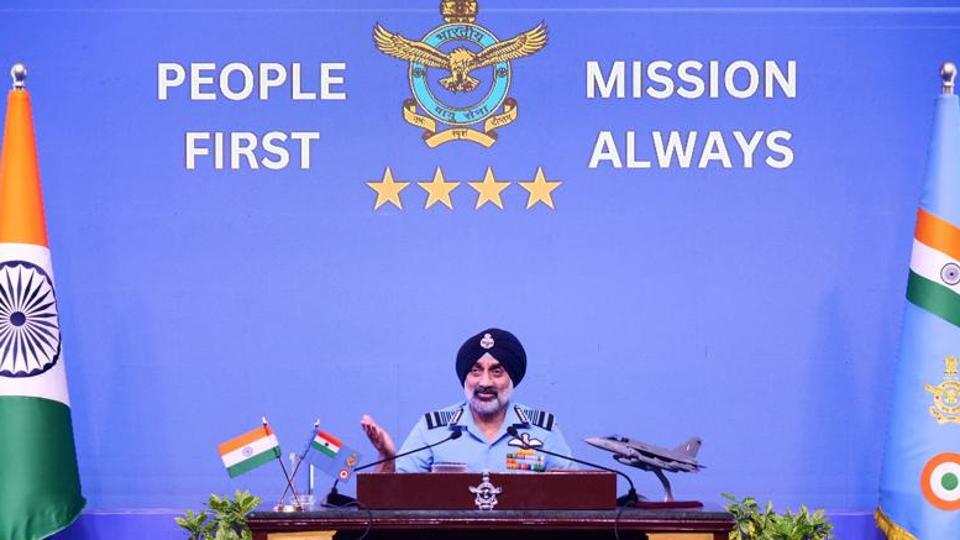
He also awarded citations to a few Indian Air Force units, including a Rafale squadron, for their role during the operation.
“India’s bold and precise attacks (during Operation Sindoor) restored the rightful place of offensive air action in the national consciousness. Our robust air defence architecture and long-range surface-to-air missile systems limited the adversary’s freedom to operate and ensured safety of our vital assets,” Singh said at the 93rd IAF Day celebrations at the Hindon airbase.
Operation Sindoor marked New Delhi’s direct military response to the April 22 Pahalgam terror attack in which 26 people were killed. India launched the operation in the early hours of May 7 and struck terror and military installations in Pakistan and Pakistan-occupied Kashmir (PoK). Between the launch of the operation and the ceasefire on May 10 evening, Indian forces bombed nine terror camps in Pakistan and PoK, killing at least 100 terrorists, and the IAF struck targets at 13 Pakistani airbases and military installations.
“Our performance in Operation Sindoor fills us with professional pride,” said Singh, who arrived in Hindon in a 1960s vintage Ford car pulled out of the Air Force museum for the function.
Singh hailed the role of locally produced weapons during the confrontation. “The outstanding performance of the indigenously developed and integrated weapons, which delivered precise and devastating blows deep inside enemy territory, vindicates our faith in home-grown capabilities. Operation Sindoor is a shining example of what can be achieved through meticulous planning, disciplined training and determined execution.”
Last week, Singh said Pakistan lost as many as 12 to 13 aircraft, including fighter jets such as US-made F-16s and Chinese-origin JF-17s, to the IAF’s precision strikes on ground and in the air during Operation Sindoor. At his annual press conference on October 3, he said there were “signs” that India destroyed 6-7 aircraft in its ground strikes on Pakistan airfields and another six jets in the air. He also dismissed Islamabad’s claims of downing Indian jets as “fanciful tales” aimed at delivering a message to its domestic audience.
It was the first time that a senior military leader has disclosed that the number of Pakistani jets that India destroyed during Operation Sindoor breached single digits.
Singh on Wednesday underlined the need to train hard and stay prepared for the future.
“As we celebrate our triumphs and success, we must remain prepared for the future. Our planning must be innovative, practical and adaptive. Our training must be based on the principle of ‘train like we fight’. It should continue to be honest, rigorous and relevant to the emerging challenges. We must recognise that victory comes with effective teamwork. We have to leverage our collective strength, foster synergy and promote interoperability, not only within the IAF but also with other defence services and organisations to achieve national goals.”
The increased pace of integration of new systems, weapons and equipment into the air force’s operational plans has been a significant success, Singh said. “I can see that there is an increased culture of accountability, safety and security amongst the air warriors and this is directly reflecting in our reduced incidents and accidents. At all levels, leaders are leading from the front, demonstrating exceptional vision and empathy. They are ensuring that every individual is empowered with the necessary training and is motivated,” he added.
Speaking on theaterisation last week, Singh said India must devise its own joint structure that is capable of delivering better results than the existing one.
“If we can’t achieve better than what we are doing today, then that structure is not good enough. There is no doubt in my mind that we need joint structures for warfighting, but which structures is what we have to really think about…discussions are on. If you don’t have different opinions about a thing, we will never reach the best…If we just say yes to everything, we will not reach the best (model).”


