E-Paper



Over 8 million shots on Day 1 of new drive
On Monday, almost every state in the country vaccinated the most people ever covered in one day until now, but some warned that they may not be able to keep up the pace unless supplies were replenished.

 Prefer HTon Google


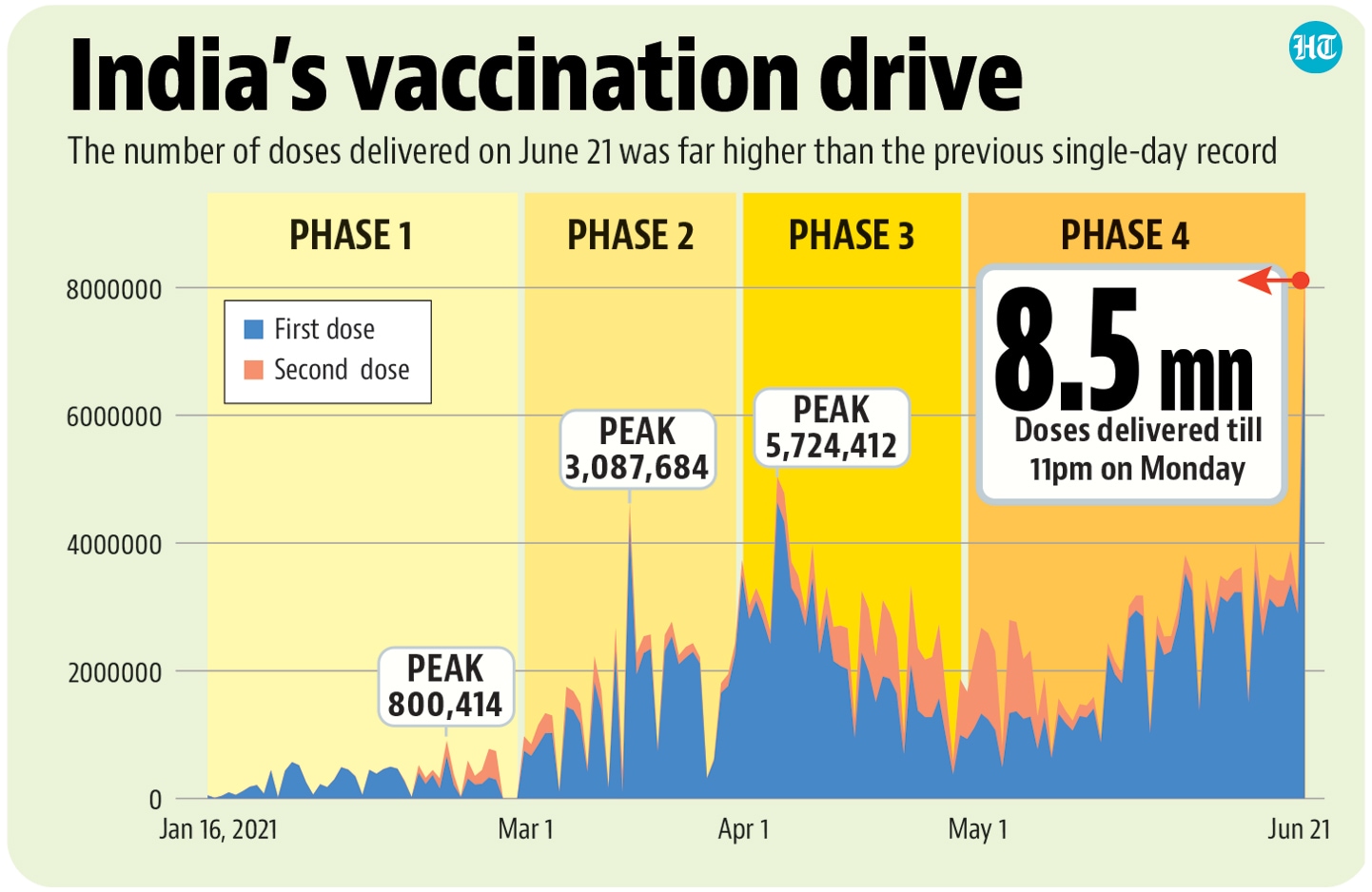
India vaccinated a record 8.5 million people till 10pm on Monday, the start of the new phase of its vaccine drive -- more in a single day than any country other than China -- even as questions remained over whether the country can keep vaccinating at this pace through July. If it were to, the country would need 260 million doses next month, and it isn’t clear whether it will have that many.
Still, Monday’s record numbers mean the new phase of its vaccine drive is off to a good start – by end of day, over 233 million Indians had received at least one shot and more than 50 million were fully vaccinated. “Today’s record-breaking vaccination numbers are gladdening. The vaccine remains our strongest weapon to fight Covid-19. Congratulations to those who got vaccinated and kudos to all the front-line warriors working hard to ensure so many citizens got the vaccine. Well done India!” Prime Minister Narendra Modi said in a tweet in the evening.
The country has set its sights higher. “We will be prepared to jab close to 10 million people in a single day by August,” said Dr NK Arora, chairman, working group on Covid-19 vaccines in India.
That is an ambitious target, and, again, one that will depend on supplies, but Monday’s performance shows that if supplies aren’t a constraint, Indian can vaccinate a lot of people in a day.
According to the latest available information, Serum Institute of India (SII) will produce 100 million doses of Covishield in July, and perhaps more from August. And, according to media reports, Bharat Biotech will continue to produce only 20-25 million doses in July, with the capacity likely to double from August. In a statement on May 28, Union health ministry said Covaxin production was being increased from 10 million doses a month in April to 60-70 million a month by July-August. The capacity is expected to reach nearly 100 million a month by September 2021, it added.
It isn’t clear how many doses of Sputnik V will be available in July, and whether local production will start in August as planned (and if so, how many doses will be produced).
SII and Bharat Biotech did not respond to requests for a comment. Dr Reddy’s, which has the rights to market the first 250 million doses of Sputnik V in India, said the vaccine has only had a soft launch so far, and more arrangements were being made. “All necessary supply arrangements are being executed to ensure availability of both dose components in the right quantity and at the right time at partner hospitals. Once the pilot phase is completed, Dr Reddy’s will announce the commercial launch of Sputnik,” the company said.
Also read | 'Well done India!' PM Modi tweets as India records highest Covid-19 vaccination
On Monday, almost every state in the country vaccinated the most people ever covered in one day until now, but some warned that they may not be able to keep up the pace unless supplies were replenished.
“The Centre is claiming that it will inoculate every citizen for free from today (Monday). Upon enquiring about this free vaccination drive, it was confirmed that not a single dose of free vaccine has been distributed in Delhi. On top of that, only 1.5 million doses have been earmarked for Delhi for the month of July which is not enough. If we receive doses at this pace, then instead of three months, it will take approximately 15-16 more months to vaccinate everyone in Delhi,” said deputy chief minister of Delhi, Manish Sisodia.
A senior official of the West Bengal health department said the state did not start vaccination for all from Monday, and continued to vaccinate only the priority groups. “We don’t have enough vaccines. If we start universal vaccination, there would be a mismatch and the priority groups won’t get the vaccines. Unless we complete vaccinating the target groups, we won’t be able to vaccinate others,” said Ajoy Chakraborty, director of health services.
Officials from some other states, particularly those ruled by the Bharatiya Janata Party (BJP), said they do not expect shortages. “We had a stock of 19 lakh doses on Monday and it would last three days. We don’t expect any shortage of vaccinations,” said Madhya Pradesh education department minister Vishwas Sarang.
Uttar Pradesh chief minister Yogi Adityanath said he was confident the state will meet a million vaccinations a day target for July. “We have been assured of enough supply of vaccines to increase vaccination pace,” a state health department official said.
A Union government official said replenishments will be done periodically. “We have finite vaccine supplies at the moment, hence, will be distributed as per the laid down protocol. Having said that there is no shortage of vaccines, and supplies will be replenished to states from time to time,” said a senior central government official aware of the matter, on condition of anonymity.
India’s vaccine drive began on January 16, for health care workers, expanded to include all front-line workers on February 1, and then, everyone over the age of 60 years and people over the age of 45 with co-morbidities, on March 1.
On April 1, it was further expanded to include everyone over the age of 45. Then, in response to demand from states and people, the drive was opened up further, to everyone over the age of 18 years, although states were told they would have to pay for the vaccines of those between the ages of 18 and 45. Private hospitals were also allowed to offer vaccinations. However, with supplies constrained, the drive faltered. The country’s Supreme Court too termed the approach “arbitrary”, forcing a rethink.
On June 7, Prime Minister Modi announced that the Centre would again be in charge of sourcing and supplying vaccines. It would, he added, buy 75% of locally available vaccines, with the remainder being reserved for private hospitals. And it would bear the cost of the entire 75%, he added.
The new phase of the vaccine drive comes even as cases of Covid-19 are declining in the country, with the ebbing of the second wave. However, with most states opening up and allowing movement and activities to resume, experts fear that there could be a spike in cases – unless India vaccinates more people. Till Monday evening, 24.6% of the eligible population of 940 million people had received at least one dose of the vaccine.
“I am happy to see the increased pace of vaccination. Making universal adult vaccination free has helped, along with walk in registration facility for all ages. We should utilise available stocks fully without letting hospitals hold them unused. With more vaccines likely in July-August, the pace should pick up further. We now need to step up efforts to increase coverage in rural areas,” said Dr K Srinath Reddy, senior public health expert, and founder, Public Health Foundation of India.
To cover more people, India needs more days like Monday. Which means it needs more vaccines.