E-Paper



Overflowing Naini Lake floods Nainital’s Mall Road
Noted environmentalist Ajay Singh Rawat, who lives in Nainital, said it is for the first time that the Naini Lake has overflown to such an extent


Dehradun: With parts of Nainital district receiving the highest-ever rainfall in the last 124 years, water from Naini Lake overflowed its bank and flooded the iconic Mall Road and Naina Devi temple complex on Tuesday.
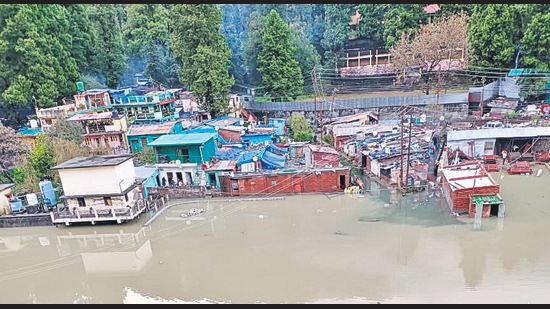
Several visuals on social media showed people wading through ankle-deep floods as water from the mango-shaped lake, which is situated at a height of 1,938 metres, overflowed and entered residential and business areas. Even fish from the lake spilled over to the streets, prompting a few local residents to put them inside a bucket and release them later into the lake.
Some people were also spotted kayaking down the flooded Mall Road.
“You could swim and move in a boat on the flooded road here. I also saw fish in large numbers moving in the waters on the road. I have never seen such a sight here before,” Pawan Singh Bisht, who runs a shop near the lakeshore, said.
Noted environmentalist Ajay Singh Rawat, who lives in Nainital, said it is for the first time that the lake has overflown to such an extent. “In 1995, the water had overflown to some extent. But this time, it has happened in a big way. I don’t think such a case has happened here before,” he said.
Generally, Rawat said, local authorities tend to release the waters into Baliyanala when the water level rises in the lake. “But this time, the rains were so severe that it left the entire area inundated,” he said.
In 1880, 151 people were killed after a major landslide hit Nainital’s Sher Ka Danda area. Following this, a 79 km drain network was built by the British along the slopes and Nainital was divided into safe and prohibited zones for construction.
“But constructions have come up in the same zones as well. And some constructions are over three storeys. Many drains have narrowed down due to encroachment and dumping of solid waste inside them. This has affected the free flow of rainwater into the lake,” Rawat said.
Maruti Sah, president of Talital market association in Nainital, alleged that the authorities opened the gate of the lake late despite a rain alert in the district.
“They opened the lake gate manually at 1.30 pm on Tuesday but it was already late. They should have opened the gate well in advance,” he said, adding that several people and traders around the lakeshore were affected.
Varun Adhikrai, a resident of Nainital who works as a consultant geologist with the railway ministry in North East, said the overflowing of the lake may impact the stability of its slopes and sidewalls.
“One overlooked factor which can contribute to slope instability around the lake is the sudden fluctuation in the water level. A full lake itself creates pressure on the slope walls on its sides. And when the water level suddenly drops by even a few metres, it can lead to slope instability on the sides of the lake and even cause a landslide,” he said.