E-Paper



Pakistani defence systems ineffective against BrahMos: Amit Shah in Gujarat
Shah praised the IAF for damaging several Pakistani airbases, including Sialkot, Nur Jahan, Sukkur, Karachi’s Malir Cantt, and Bholari, using indigenous BrahMos cruise missiles.

 Prefer HTon Google


The indigenously built BrahMos missiles destroyed Pakistan’s Chinese-supplied air defence systems during Operation Sindoor, Union home minister Amit Shah said on Sunday as he highlighted the success of India’s military action in the wake of the Pahalgam terror attack that claimed 26 lives.
“Pakistan’s air defence systems, borrowed from China, were destroyed by our BrahMos missiles that are made in India. Our Brahmos have given a strong reply to Pakistan,” Shah said while addressing an event in Ahmedabad as part of his two-day visit to Gujarat.
In his speech, Shah paid tribute to victims of the April 22 terror attack, praised the subsequent military operation –– highlighting its three key achievements: dismantling terrorist infrastructure, exposing Pakistan’s complicity in terrorism, and demonstrating India’s military capabilities.
“After the attack, Prime Minister Narendra Modi vowed in Bihar to reduce the terrorists to ashes. Within days, through PM Modi’s unwavering political will, our military’s valour and precise intelligence, we destroyed nine terrorist base camps,” he said in reference to the May 7 strikes against terror infrastructure in Pakistan and Pakistan-occupied Kashmir (Pok) as part of Operation Sindoor.
The pre-dawn strikes –– in which at least 100 terrorists were killed –– sparked a series of attacks and counterattacks across the western border, involving fighter jets, missiles, armed drones, and fierce artillery and rocket duels.
Shah emphasised the military action’s historic scope, noting that unlike the cross-border surgical strikes in 2016 and the Balakot air striks in 2019 which were confined to PoK, Operation Sindoor saw Indian forces strike 100km inside Pakistan.
He also highlighted the operation’s role in exposing Pakistan’s complicity in terrorism. “Pakistan claimed there were no terrorists on their soil, refuting India’s concerns as false. But, when the missiles of Operation Sindoor struck and terrorists were eliminated, Pakistan’s lies were laid bare before the world.”
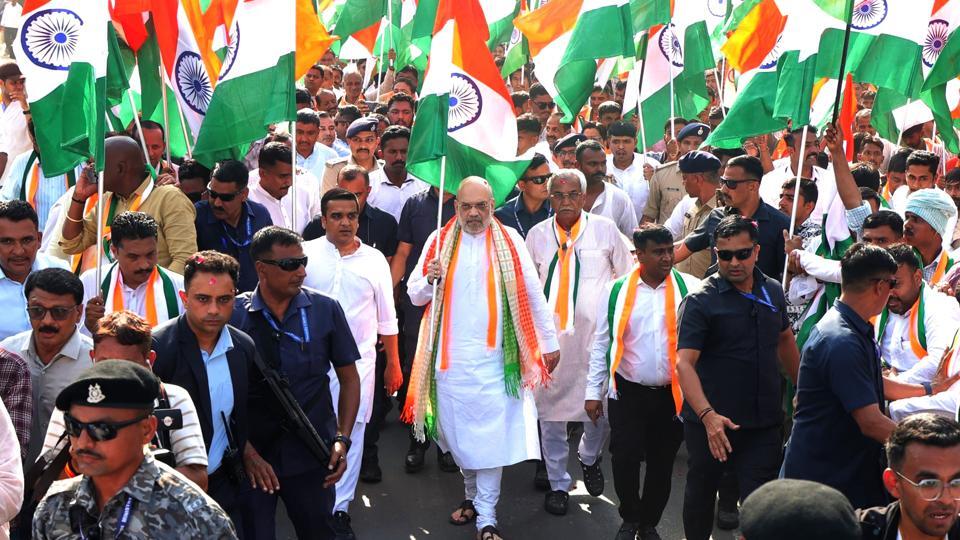
Earlier in the day, Shah took part in the Bharatiya Janata Party’s Tiranga Yatra rally in Sanand area of Ahmedabad, celebrating the success of Operation Sindoor.
Holding the Tricolour, the home minister walked from Nal Sarovar Chowkdi till Maharana Pratap Chowk on Eklingji Road, where he paid floral tributes at the statue of the 16th century ruler. Along with him, Gujarat home minister Harsh Sanghavi and other party leaders were part of the event.
He said that the presence of senior Pakistani military officials at funeral prayers for the slain terrorists as evidence of the “alliance between Pakistan, Pakistan military and terror groups,” a revelation that has drawn global attention.
The home minister praised the Indian Air Force for damaging several Pakistani airbases, including Sialkot, Nur Jahan, Sukkur, Karachi’s Malir Cantt, and Bholari, using indigenous BrahMos cruise missiles.
Shah also echoed Modi’s firm stance on India’s stand on terrorism after the Pahalgam attack, quoting the Prime Minister’s assertion that “the waters of the Sindhu river and the blood of terrorists cannot flow together.” Shah said that PM Modi has also warned that Pakistan must dismantle its terror infrastructure to maintain access to Indus River waters under the 1960 Indus Waters Treaty, which India suspended in response to the Pahalgam attack. Additionally, Shah reiterated PM Modi’s position that trade and terrorism are incompatible and that any future talks with Pakistan will focus on the return of PoK.
Shah said that Modi personally named it Operation Sindoor to honour the widows of the Pahalgam victims, referencing the vermillion mark symbolising marital honour in Indian tradition. “Those who dared to wipe the sindoor (vermilion) from our women have been wiped out,” Shah said.
He expressed pride in Gujarat’s connection to the operation, calling Prime Minister Modi, a son of Gujarat and the architect of India’s resolute response to terrorism.
“Under Modi’s leadership, India has progressed toward becoming a global leader in all sectors by 2047… Operation Sindoor will be remembered as a golden chapter in India’s history of safeguarding its borders,” he said.
(With inputs from PTI)