
 E-Paper



Panel on OBCs seeks new survey for equitable distribution of quota benefits
The proposal comes in the wake of an initial finding by the commission, based on data on quota-based admissions and recruitments in recent years.


A commission set up to suggest sub-categorisation of Other Backward Classes (OBCs) for a “more equitable distribution” of quota benefits has now proposed a fresh survey for determining the “relative population” of different castes included in the central list of OBCs, people aware of the development said on Friday.
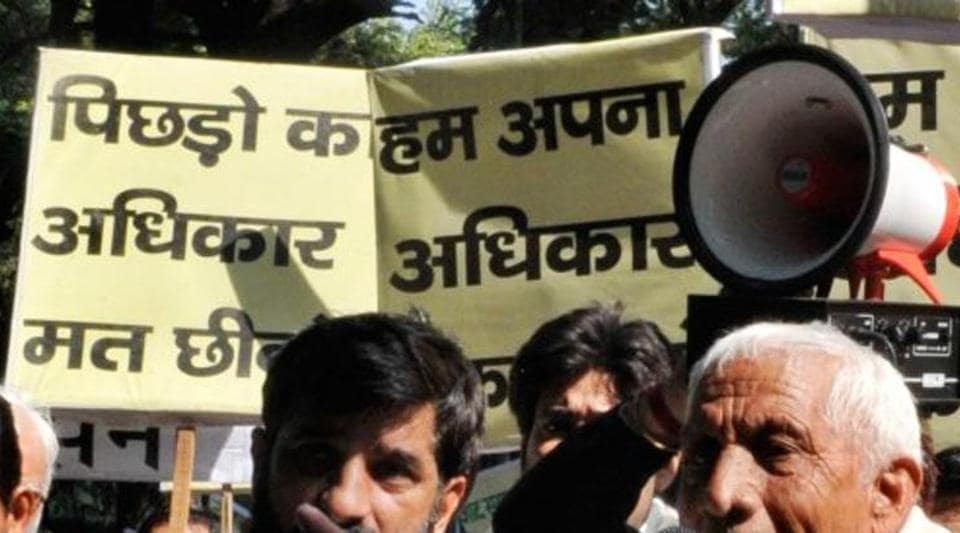
Proposing a new pan-India survey, the commission informed the union government that since no official caste-wise population data has been compiled post-Independence there is need for a fresh poll, which will include information from OBC households about their education and employment status.
The proposal comes in the wake of an initial finding by the commission, based on data on quota-based admissions and recruitments in recent years which it studied, that “indicates that there is a high level of inequity in the distribution of benefits across different communities included in the central list.”
In its consultation paper, the commission pointed out that as many as 150 castes are the top beneficiaries of quotas earmarked for OBCs while nearly 983 castes are not able to avail of the benefits at all.
Under existing rules, 27% of government jobs and seats in educational institutions are set apart for OBCs, excluding the so-called creamy layer, or economically well-off.
“The commission has proposed to divide the available central quota of reservation among different sub-categories on the basis of the relative all-India population of the castes placed in these sub-categories,” a government official aware of the details said on condition of anonymity.
A preliminary analysis by the commission indicates that such sub-division of the central quota in proportion to the relative population of various sub-categories is unlikely to lead to any significant loss to any community, but would open up new possibilities for a large number of communities that are not able to avail of any benefit now.
The commission headed by former Delhi high court chief justice G Rohini was appointed by President Ramnath Kovind in October 2017, to examine the extent of inequitable distribution of reservation benefits among castes and communities; and work out the mechanism, criteria, norms and parameters of a scientific approach to the sub-categorisation within OBCs.
“The central list has over 2,600 castes, many of which are small in number and are geographically scattered, so the commission has proposed data collection from every sub-district of the 31 states and UTs (union territories) for which OBC lists are available. The sample size would roughly be 1 million households,” the functionary quoted above said. According to the commission, the fact that only a few castes are the recipients of the quota benefits is based on factors such as their population and the access that they have to education and other facilities.
“The next step for the Commission is to prepare a scheme of categorisation of socially and educationally backward classes (SEdBCs),” former bureaucrat PS Krishnan said.
Krishnan said the commission can follow and adapt the south Indian methodology, especially that of Andhra Pradesh, Telangana, Kerala and Karnataka, and draw up its recommendations for categorisation with sub-quotas speedily. “This can be further adjusted after SEdBCs data are available from the 2021 census.”.


